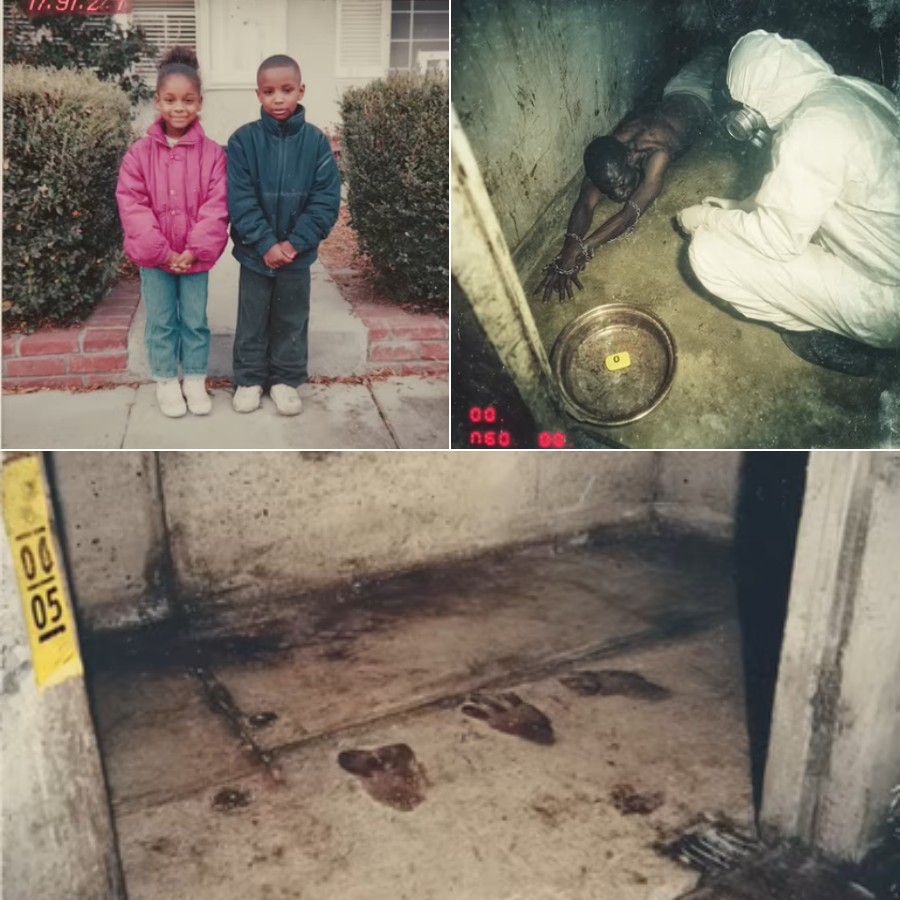
The autumn of 1993 in Lake Forest, Illinois looked like it had been designed for a magazine spread.
The air was crisp but gentle, the kind that made lawns almost glow in the late afternoon light. Sycamore Lane curved through the neighborhood like a polished ribbon, lined with colonial houses that all seemed to have agreed on the same dress code: white trim, dark shutters, neat porches with hanging ferns. Kids rode bikes in slow, lazy arcs. Sprinklers ticked across chemically perfect grass. The biggest problems, or so people liked to tell themselves, were dandelions and whether the Cubs would ever make it to the World Series.

The Johnsons’ house was the one that always made people look twice.
Not because it was messy or loud or out of place. If anything, David and Mariah Johnson had gone out of their way to fit in. Their shutters matched the neighborhood’s unspoken color palette. Their lawn was as carefully edged as anyone else’s. Seasonal wreath on the door, tasteful mums on the porch in fall, tiny white lights in the bushes at Christmas. The house, from the outside, did not make a statement.
The family living inside it did.
David Johnson was one of the few Black men people saw in that part of Lake Forest who wasn’t there to fix something. He wore tailored suits and carried a sleek leather briefcase, leaving every morning at the same time with a travel mug of coffee and a quick kiss to his wife before the train downtown. Mariah, with her natural creativity squeezed into a tidy graphic designer’s desk job, had learned to keep her hair in styles that wouldn’t get her “too many questions” at work, as she put it. Neat, controlled, professional.
They knew what people saw when they drove past: a successful Black family in a sea of white affluence. They had learned to live with the feeling of being observed, as if a spotlight followed them from the grocery store to the parent-teacher conferences to the neighborhood block parties.
“Smile,” Mariah used to whisper to David when they stepped out of the car at community events. “We are ambassadors, remember?”
“Ambassadors don’t have to bring potato salad to every barbecue,” he would mutter back, but his arm would slide easily around her waist, and he would smile anyway.
The center of their universe was upstairs, in the bedrooms at the end of the hall, where six-year-old Ethan and Olivia slept with their doors cracked open, night-lights sending small hazy moons across the carpet.
The twins shared everything.
They shared toys, and snacks, and secret jokes that left adults frowning in confusion. They shared a stubborn cowlick in the front of their hair. They shared the habit of unconsciously curling their toes whenever they were concentrating. They shared, above all, a language that belonged only to them.
It had started when they were toddlers sharing a crib. They would lie on their backs, tiny fingers brushing each other’s arms, and murmur nonsense syllables that made perfect sense to them. As they got older, the language shifted from babble into a code of glances, half-smiles, and a soft, rhythmic signal they could send through walls.
Tap tap.
Two taps on the shared wall between their bedrooms. Light as breath.
I’m here. You’re not alone.
Sometimes, on stormy nights, Mariah would stand in the dark hallway, heart aching, listening to it. Olivia’s small bed squeaking as she rolled over, Ethan’s soft sigh, and then—tap tap—from one side, a pause, and tap tap from the other. A call and an answer. Proof that they found each other even when they couldn’t see.
It made her feel like maybe the world was safer than the news always suggested. Inside this house, in this little pocket of suburbia, her children were tethered to each other by something that nothing could break.
On the morning of the day everything ended, life felt almost embarrassingly normal.
Mariah overslept her alarm by twelve minutes, which meant everything after that was a slightly more frantic version of the usual routine. Toast burned. Ethan couldn’t find his other sneaker. Olivia, already bafflingly fully dressed and ready, begged to wear her bright pink jacket even though Mariah insisted it wasn’t that cold out.
“I’ll just take it off if I’m hot,” Olivia argued, slipping her arms into it before her mother could object again. “But what if I’m freezing and I don’t have it? Then I’ll die, Mommy. Do you want me to die?”
“Drama queen,” David said, coming in to kiss the top of her head and snag a piece of toast at the same time. “You get that from your mother, you know.”
Mariah threw a dish towel at him, laughing. It missed and hit Ethan, who grinned and wrapped it around his head like a superhero mask.
It was a morning full of small, meaningless choices. The kind people never remember until they are forced to replay the day in excruciating detail and wonder which tiny decision might have rerouted reality.
Mariah decided to stop at the supermarket after picking up the twins from school, instead of going in the morning like she usually did. She decided to go to the bigger store instead of the smaller one closer to home because there was a sale on cereal she liked. She decided not to call David at lunch, because she knew he had a big meeting. None of that felt like anything at the time.
Ethan and Olivia spilled out of the school doors that afternoon in a tangle of backpacks and stories, Olivia already talking about a game she’d played at recess, Ethan quietly clutching a drawing of a spaceship he’d made in art.
“It’s got room for two,” he explained seriously, showing her the tiny figures he’d drawn in the cockpit. They had the same round heads and wild hair. “You and me. We go everywhere together.”
“Obviously,” Olivia said, as if the alternative were ridiculous. She grabbed his hand, and they set off toward the car, nearly dragging Mariah in their wake.
The parking lot of the grocery store was busy but not chaotic. Grocery carts clanged. Car doors opened and closed. Somewhere, a baby was crying in a carrier. Mariah found a spot halfway down a row, nudged the station wagon in, and twisted around to look at the twins.
“Okay,” she said. “Quick trip. You two stay close.”
Olivia rolled her eyes but nodded, already unbuckling herself. Ethan followed, slower, carefully placing his spaceship drawing on the seat.
Inside, it was routine. Fruit, milk, cereal (the sale had been worth the drive), pasta, chicken. Olivia begged for cookies. Ethan asked for a book from the spinning rack near the checkout. Mariah compromised and said they could each pick out one thing from the discount bin near the front doors on their way out.
That promise bought her twenty hassle-free minutes inside the store.
By the time she pushed the loaded cart out into the bright October air, the twins were vibrating with post-school energy.
“Stay near the car,” Mariah called as she popped the trunk. “Where I can see you, please.”
“We will!” Olivia answered, already darting toward the cart corral, her pink jacket a quick flash of color. Ethan chased her, his laughter chasing hers.
Mariah’s hands were full. Milk first, then the heavy bag of dog food, then the overloaded sack of canned goods that made the cart’s front wheel seize up with a familiar, maddening twist. She yanked at it, metal screeching against concrete, feeling the pinch between her shoulder blades that meant she’d pay for this later.
She wrestled the stubborn cart forward, shoved it into the corral with a sharp metallic clang, and turned back toward the car, ready to tell the twins it was time to buckle up.
And looked at empty air.
The space where they had been a heartbeat earlier was vacant. No pink jacket. No mop of Ethan’s curls. No cluster of small bodies playing hide-and-seek around the bumpers of nearby cars.
For half a second, her brain scrambled for an explanation that would keep the world the same.
They were behind the car, maybe. Or crouched behind the cart corral. Or they had run a few feet further down the row.
“Ethan?” she called, her voice too bright. “Livvy? Come on, guys, not funny.”
Silence.
Her feet moved faster than her mind. She stepped around the cart corral, peered behind the surrounding cars, called their names again, louder this time.
“Ethan! Olivia!”
Her heart, a steady background percussion moments ago, slammed hard against her ribs. There was no laughter. No small feet pounding on asphalt. Just the faint rumble of distant traffic and the rustle of a plastic bag caught on a shopping cart.
She started to run.
She checked between cars, eyes skimming under bumpers for small sneakers. She turned in place, scanning the whole expanse of the parking lot, stomach plunging as she noticed, really noticed, the ring of strangers around her. A man loading bottled water into a truck paused to look in her direction, frowning. Two older women with neatly set hair stopped talking and watched as Mariah’s voice rose.
“Ethan! Olivia!” Now there was a crack in it, a raw edge that made people frown harder.
“Ma’am?” A teenage bagger standing near the entrance called. “You okay?”
“My kids,” she said, sucking in air that wouldn’t settle in her lungs. “My kids were just right here. They were—” she gestured wildly to the empty air “—right here.”
“Maybe they went back inside?” the boy suggested, because that was what you said when reality began to slant.
She thought of Ethan’s spaceship drawing on the backseat. Olivia’s pink jacket flashing in the sunlight.
“No,” Mariah said. The word came out thin, like a wire pulled too tight. “No, they wouldn’t… they wouldn’t leave me. They were just—”
And then the screaming started. She wasn’t sure when she lost control of her voice, when her calls shifted from questions to raw, ripping sounds that had no shape.
“I can’t find my children!” she heard herself yell as she ran toward the store. “Call 911! Somebody call 911!”
In those first wild minutes, everything happened at once and also not fast enough.
A store manager appeared, his name tag shining, his voice clipped and official as he barked into a phone. An announcement went out over the intercom, disjointed and far away in Mariah’s ears. “We have a… a situation in the parking lot… two missing children… Ethan and Olivia Johnson, six years old…”
Customers turned, curious. Some drifted toward the doors to see. A few stayed where they were, staring into their carts as if the right brand of pasta could anchor them in the comfortable version of reality where things like this did not happen.
By the time the first police car rolled into the lot, lights spinning red and blue against the pale blue sky, Mariah’s legs were shaking so badly she could barely stand. A stranger’s hand rested on her arm, trying to steady her. Someone offered her water. A woman she vaguely recognized from the PTA put her arm around Mariah’s shoulders and murmured, “They probably just wandered off, you know how kids are,” in a voice too thin to carry any real comfort.
Mariah’s hands were empty.
She kept looking at them, as if she should be holding something—small fingers, a backpack strap, a pink jacket—and couldn’t understand why they were bare.
The first officer to approach her was young, not much older than some of the teenagers bagging groceries inside, but his posture was already practiced. Notepad ready. Pen in hand. Eyes scanning for facts.
“Ma’am,” he began, “I’m Officer Reynolds. Can you tell me what happened?”
“My children are gone,” she said, because that was still the only sentence her mind could assemble. “They were right here. Right here.” She pointed to the patch of asphalt beside the cart corral. It looked like any other patch of asphalt, textured gray, a faint oil stain spreading in one corner. There was nothing to mark it as the place where a world had ended.
“How long were they out of your sight?” Reynolds asked.
“Thirty seconds,” she said automatically. “Maybe less.”
His pen hesitated. He glanced up, his expression pinched, skeptical.
“Think carefully,” he said. “Sometimes when we’re stressed, our perception of time—”
“Thirty seconds,” she snapped, heat flaring through the numbness. “I know how long I turned around. I’m their mother. I was right there.”
More officers arrived. One took over from Reynolds, older, with more gray hair, more lines around his eyes, and something hardened behind them. His name was Detective Miller. He introduced himself quickly, his handshake firm but cool, as if he were meeting a new client instead of a woman watching her life disintegrate in a supermarket parking lot.
He walked the scene, asked other officers questions, peered at a security camera mounted too high and at too wrong an angle to have caught anything helpful. He nodded as someone told him the store’s tapes would need to be reviewed. He frowned at the rows of cars, all so ordinary, their drivers long gone.
Then he came back to Mariah.
“I know this is hard,” he said, with a rehearsed edge of sympathy. “But we need to get as much information from you as we can as soon as possible. Is there somewhere we can sit down and talk?”
“The store manager’s office?” someone suggested.
Mariah wanted to scream that there was no time to sit, no time to talk, because every second they weren’t ripping open car trunks and stopping traffic and turning the city upside down was a second her children were… somewhere. With someone. But her legs would not hold her upright any longer. So when Miller gently steered her toward the sliding doors, she let him.
The office smelled like paper and warm electronics. There was a poster on the wall about shoplifting. None of it seemed real.
Miller’s questions, on the surface, made sense at first. Names. Ages. What they were wearing. Any identifying marks. Medical conditions.
Then his pen started to take on a different rhythm.
“And your husband?” he asked, not looking up from the page. “He was with you?”
“No. He’s at work. I called him. He’s on his way.” Her voice wobbled on the last words. She imagined David driving like a man possessed, running red lights, fists clenched on the wheel. He would walk through that office door at any minute and she would throw herself at him and they would fix this, somehow, together.
“Are you and your husband… under any stress lately?” Miller asked. “Financial difficulties? Marital problems?”
Mariah blinked. “What?”
“Sometimes,” Miller continued, his voice smooth, casual, “when there’s a lot of pressure at home… custody disputes, debt… things can get complicated. People do desperate things.”
“My children were taken,” Mariah said slowly, as if talking to someone whose first language was not English. “By someone in the parking lot. I turned around and they were gone.”
“We’re just trying to get the full picture,” Miller said. “Have either you or your husband ever been involved with child protective services?”
Her mouth fell open. “No. Never. My God, no.”
“Any history of substance abuse?”
“What does that have to do with—”
He didn’t answer. He only wrote something else down, his pen scratching quietly on the pad. The sound made her want to tear the paper from his hands, to fling it across the room.
“Detective, my children are out there,” she said, leaning forward. “They’re six. They’re babies. You should be—” She gestured helplessly, as if she could shape with her hands the kind of chaos she expected to see: roadblocks, helicopters, sirens.
“We’re doing everything we can,” he said. It was a phrase that sounded like comfort but landed in her stomach like a stone.
By the time David burst into the office, tie askew, chest heaving, the investigation had already taken its first wrong turn.
He did not appear in Miller’s mind as a grieving father. He appeared as a variable.
He was Black. He was successful. He lived in a neighborhood where people still used the word “diversity” like it was a kind of furniture polish. He fit neatly into a set of statistics and stories Miller had absorbed over twenty years in law enforcement. In Miller’s “experience”—a word he loved to use, as if it were a shield—things were rarely as random as they looked.
“Is this about me?” David said later, in a small, windowless interview room that smelled of stale coffee and tired air. “Do you think I did something to my own children?”
Miller’s gaze slid over the spreadsheets in David’s file: salary, mortgage, car payments. “We just have to rule out all possibilities,” he said. “A man in your position… sometimes there are debts, enemies…”
“My children are missing,” David said, his voice dropping into something dark and dangerous. “And you’re asking about my car?”
Miller did not flinch. “Are you and your wife getting along?”
David’s chair scraped loudly against the floor as he stood up. “Find. My. Kids.”
But the investigation, once nudged, continued on that tilted track.
Background checks were run on the Johnsons, their relatives, their close friends. Old neighbors were asked if they’d ever heard shouting in the Johnson house. A coworker of David’s was asked if he seemed “stressed” at the office. Someone took a half-remembered argument between Mariah and a cashier about a mis-scanned price and turned it into a note in a file about “emotional volatility.”
Meanwhile, out on Sycamore Lane, the real answer watered her azaleas and watched the news.
Her name was Judith Sinclair.
To most of the neighborhood, she was a quiet, unobtrusive older woman who lived alone in a house that smelled faintly of lemon polish and old books. She had spent most of her life as a librarian, the keeper of silent spaces and straight shelves. She wore cardigans no matter the season and spoke in a voice that never rose above “polite murmur.”
People knew her, in the way you know someone from a hundred nods on the sidewalk, a “how are you” at the mailbox, a brief chat about the weather after church. They did not know that inside her head, a different narrative had been playing for years.
Judith believed in order.
Order meant clean lines, matching towels, books arranged not just by subject but by height. It meant routines, and quiet streets, and neighborhoods where people “fit.” It meant a dark, private horror at anything she could not control.
Once, a very long time ago, Judith had wanted a child. The wanting had curdled when it refused to be satisfied. Doctors’ visits. Tests. A miscarriage at twelve weeks that left her in a hospital bed with white sheets and a nurse with pity in her eyes. A pregnancy that almost made it to term and ended in silence in an operating room, the baby’s skin too blue, the umbilical cord wrapped in a cruel loop.
People brought casseroles. They told her everything happened for a reason. They told her God had a plan. Judith heard, underneath all the words, a different message.
You are not meant to be a mother.
She took that verdict and twisted it, deep inside herself, until it became something else.
If she could not have a child, then perhaps she could save one. From chaos. From parents who did not deserve them. From the world itself.
When the Johnsons moved onto Sycamore Lane, Judith was in her late forties. She watched them unload the moving truck from behind her lace curtains. At first, her reaction was a vague, sour disapproval at the way they didn’t match the rest of the block, like a painting hung in the wrong frame.
But then she saw the twins.
Two small brown children with bright eyes and easy laughter. A boy and a girl. The girl’s hair in puffballs, a pink barrette flashing in the sunlight as she ran down the front walk. The boy trailing behind her, more cautious, clutching a stuffed dinosaur.
They were beautiful. And to Judith’s mind, in a way she never tried to examine too closely, they were also wrong.
Wrong house. Wrong parents. Wrong life.
She watched them grow for years. First day of kindergarten, small backpacks bouncing. Halloween costumes, a matching pair of astronauts. Summer evenings with chalk drawings spreading across the driveway like bright spiderwebs.
She saw Mariah talking to other mothers on the sidewalk, noticed the small stiffness in their smiles. She heard the way they described the Johnsons at book club. “So accomplished.” “So polished.” “So impressive.” Compliments that left a faint residue of surprise behind them.
Judith began to see herself as the only one truly paying attention.
The girl, Olivia, was vibrant and bold and unafraid to look adults in the eye. She spoke clearly. She asked questions. She was, in Judith’s mind, a bright, perfect gem. Judith imagined her in a different house, wearing smocked dresses, learning to play the piano in a formal living room that smelled of polish and history. Not the daughter of… them.
The boy, Ethan, with his quiet gaze and watchful stillness, unsettled her. He reminded her too much of herself. A little too intense. A little too much like someone who watched instead of belonging.
The seed of an idea, once planted, grew in the dark corners of Judith’s mind.
Saving Olivia would be a kindness. A correction. A restoration of order. And as for the boy… her thoughts would always stop there, skipping away from any fully formed sentence, because even in her warped universe, some truths felt dangerous to name.
By the time October 1993 rolled around, Judith had been watching the Johnsons for months with a new kind of focus.
She knew Mariah’s routines. Monday and Wednesdays, the small supermarket near the school. Fridays, the larger one a little further out, if there were sales. She knew how long it took Mariah to get from her car to the cart corral, how often she glanced back over her shoulder. She knew that the children had been taught to be polite, to respond when spoken to by adults.
On the afternoon of the abduction, Judith parked her gray van in the spot directly beside the Johnsons’ usual area. She arrived early. She waited.
She looked like any number of other middle-aged women sitting in cars in parking lots across America—hands folded on the steering wheel, cardigan buttoned, purse on the seat beside her. No one saw the tremor in her fingers. No one heard her whisper, “This is for your own good,” to herself as she watched Mariah wrestle with a shopping cart.
When the twins emerged from the store, Judith’s heart beat so hard she could feel it behind her eyes.
She waited until Mariah’s back was turned, muscles straining, curses forming silently on her lips as she wrenched at the stuck wheel. Then Judith got out of the van and walked around to the side where the sliding door immediately faced the cart corral.
“Oh, hello there,” she said, her voice soft, kind, the same tone she used to explain the Dewey Decimal System to small children in the library. “My goodness, aren’t you two helpful, keeping your mommy company.”
Olivia’s head snapped up, drawn by the attention. Ethan hovered slightly behind her, fingers curled in the fabric of her jacket.
“I seem to have lost my little puppy,” Judith continued, letting a note of gentle distress enter her voice. “He’s very shy. I think he might be hiding in my van. Would you be sweet and help me look for him?”
A van. A puppy. A nice old lady who smelled like soap and vanilla. Every instinct their parents had tried to instill about Stranger Danger collided with something stronger: the urge to be good, to be helpful, to be kind. To not be rude.
Olivia glanced over Judith’s shoulder toward her mother. Mariah’s back was still turned, body straining as she shoved the cart into the corral.
“Just for a second,” Olivia said under her breath to Ethan, as if she needed to justify it. “We’ll just look. Then we’ll tell Mommy we helped.”
Ethan hesitated. Somewhere inside his chest, a small alarm bell rang. His fingers tightened on his sister’s jacket, but she had already taken a step toward the van.
Judith slid the door open with a quick, practiced tug.
The inside of the van was not messy. No scattered fast food bags, no toys, no lingering smells. Everything was perfectly plain and clean, the way Judith kept everything. There was a thick blanket folded on the floor, but no puppy.
“Maybe he’s hiding behind the seats,” Judith said.
Olivia climbed in. Ethan followed, because that was what he always did.
The moment both small bodies crossed the threshold, Judith moved with a speed that would have surprised anyone who knew her only from the library. She grabbed the edge of the blanket and flipped it, sending it over their heads, pushing them down with more force than they’d ever felt from an adult.
“Hey—” Olivia began, but the word was cut off as the blanket muffled her voice.
The door thudded shut. A lock clicked. The outside world went on breathing.
By the time Mariah turned around, hands finally empty, it was already done. The van, its windows heavily tinted in the back, looked like any other anonymous vehicle in a sea of metal and glass. No one saw it pull away.
In the days that followed, Mariah and David’s lives became a blur of search parties, press conferences, phone calls, and the steady erosion of their belief that the people in charge knew what they were doing.
At first, the neighborhood rallied. Flyers went up on telephone poles, Ethan and Olivia’s school pictures staring out from grainy photocopies. Parents organized informal search teams, combing the woods behind the park, the drainage ditches near the main road. Volunteers came to the Johnsons’ house with trays of sandwiches, with hugs, with practical help.
Then, quietly, the tone shifted.
There was an article in the local paper that quoted an unnamed source in the police department saying they were “looking at all possible angles, including domestic.” The evening news ran a segment that spent more time on David’s income and the size of their house than on the last known images of the twins. A neighbor overheard a police officer mutter, “Something about this doesn’t add up,” and that sentence spread through the community like mold.
The casseroles slowed. People’s eyes slid away in the grocery store. More than once, Mariah heard her own name lowered to a whisper as she walked past.
A week after the abduction, desperate to fill an hour with something other than staring at the empty bedrooms, she forced herself to go back to the supermarket. They needed milk. Her body, betrayed by habit, walked the same path from parking lot to doors. She saw the cart corral out of the corner of her eye and felt her stomach lurch.
Inside, she kept her head down. She went straight for the dairy aisle, grabbed the first gallon she saw, and walked toward the registers. As she passed the cereal aisle, she heard two women talking, their voices low but not low enough.
“…you never really know what goes on in people’s homes…”
“Well, they always seemed so perfect…”
“That’s what I’m saying. Too perfect.”
She kept moving, hands clenched around the milk jug. At the register, the cashier—who used to chat with her about their kids’ teachers—wouldn’t look her in the eye.
“Have a nice day,” the cashier muttered, eyes on the conveyor belt.
Mariah stepped back out into the parking lot and had to grip the metal side of the cart to keep from collapsing.
The police, still funneling energy into trying to fit the Johnsons into a theory that made sense to them, largely stopped looking outward.
There was no composite sketch of a librarian with a polite smile and a gray van. No knock on Judith Sinclair’s door beyond the initial, perfunctory sweep that had every neighbor asked the same simple questions.
Did you see anything unusual that day?
No? Thank you for your time.
Judith had smiled, her cardigan buttoned all the way to her throat. “Those poor people,” she had said, because it was what she knew she was supposed to say. “Such a tragedy.”
Then she had gone back inside, closed the door, and double-checked the bolts on the basement.
Down there, in the dark, the twins’ lives forked.
The first hours were chaos for them as well.
The van had smelled strange, sharp, something bitter and chemical beneath the faint sweetness of dryer sheets. Ethan remembered trying to kick his way out from under the blanket, his foot hitting smooth plastic and metal. There had been a sting in his arm, sudden and hot, and his limbs had turned heavy, the world blurring around the edges.
He woke in darkness.
It wasn’t the darkness of a bedroom at night with a night-light down the hall. It was thick, absolute. His eyes were open; he knew they were open, but there was nothing. He couldn’t even see the outline of his own hand when he lifted it in front of his face.
He tried to sit up and felt the cold bite of metal around his ankle. The chain rattled, loud in the silence.
“Olivia?” he whispered. His voice sounded wrong in the small space, swallowed almost immediately.
Nothing.
He curled in on himself, heart pounding, waiting for his sister’s answering whisper, for the tap tap on whatever surface separated them. The familiar, soothing signal.
Tap tap.
It didn’t come.
Upstairs, Olivia woke in a bed that smelled like lavender and starch. Someone stroked her hair. When she opened her eyes, Judith’s face hovered above her, rearranged into an expression of deep, sorrowful love.
“There you are, my lamb,” Judith whispered. “You had the most terrible scare.”
“Where’s my mom?” Olivia croaked. Her throat felt scraped raw. “Where’s Ethan?”
Judith’s hand on her hair did not falter. “Shh. The people you were with… they weren’t keeping you safe. They left you alone in that parking lot. Anything could have happened. I brought you home.”
“Home?” Olivia repeated, confusion fogging her brain.
“This is your home now,” Judith said. “You’re safe with me.”
“My mom—”
“There, there.” Judith’s tone hardened for a fraction of a second, then smoothed again. “Sometimes the people who are supposed to love us… don’t know how. You’ll understand when you’re older. For now, all you need to know is that you are special, and I will never let anything happen to you.”
Olivia, six years old, disoriented, head thick with whatever Judith had used to keep her quiet, began to cry. Judith pulled her against her soft cardigan and murmured nonsense words into her hair, the same way Mariah used to, but the wrongness of the touch settled into Olivia’s bones.
That was the beginning of two lives lived in parallel isolation.
For Olivia—renamed Chloe within weeks, because Judith insisted that “Olivia” was a frivolous, unserious name for a serious, special girl—reality became a carefully curated story.
The world outside the curtains was dangerous, Judith explained. It was filthy, loud, full of sickness and random violence. People were unkind, especially to “children like you,” she would say, and though she never explained exactly what she meant by that, there was always a faint curl to her lip when she said it.
Your real mother, Judith told her, had been a beautiful, exotic woman from a faraway land. A princess in everything but title. She had entrusted her only daughter to Judith’s care to keep her safe from harm. Then, tragically, the princess had succumbed to illness. There had been no one else. So Judith, brave and steadfast, had taken the child as her own.
The story struck something deep inside Chloe, even as it left a shadowy hollow where facts should have been. Children will cling to whatever narrative makes their world feel less chaotic. She accepted it. She cherished it.
Whenever she asked about the outside, Judith would tell stories that made Chloe’s skin crawl: news clips of kidnappings, disease outbreaks, riots. She edited them, of course. Chloe never heard about missing Black children whose cases received ten seconds of airtime; she heard about “random attacks in the city,” about “filthy people spreading things,” about “those neighborhoods,” always said with the same curled lip.
“Out there, they would not see you as the princess you are,” Judith would say as she carefully combed chemicals through Chloe’s hair in the kitchen every few months, steam rising from the straightening treatment. “They would mistreat you. They would ruin you. In here, you are safe. In here, you are loved.”
Chloe would nod, tears prickling her eyes as the chemicals burned her scalp. She would look at her reflection in the oven door—brown skin, straightened hair, nightgown two sizes too big—and try to reconcile the word princess with what she saw.
Sometimes, late at night, she would lie in bed and feel a strange emptiness she could not name. A gap. As if something was missing from the story. As if she should remember a different house, a different voice, a different pair of arms around her. When that feeling got too strong, she would press her fingers lightly against the wall, as if she could send a signal out into the darkness.
Her hand would twitch, inexplicably, in a tiny, rhythmic pattern.
Tap tap.
She never understood why.
For Ethan, time became an ocean with no shore.
In the beginning, he cried until his throat gave out. He screamed until he learned that screaming brought only pain—a sharp pressure between his ribs, a blow to the side of his head, a voice hissing, “Be quiet, be quiet, be quiet,” from a mouth he never fully saw.
He learned the boundaries of his world by touch: three steps from the back wall to the front, two and a half to each side. The floor was rough concrete. The chain on his ankle allowed him a small circle of movement. There was a bucket in one corner, a thin mattress in the other, and a small metal slot in the bottom of the heavy door.
Food arrived without a voice. The slot would scrape open. A plastic bowl would slide through. The smell of something warm would fill the cell. Sometimes it was soup, watery but hot. Sometimes oatmeal. Sometimes, on what he came to think of as “special days,” there was a dab of jam or a slice of banana.
He learned not to rush the bowl. Once, in the early days, he had lunged forward before it was fully through and slammed his fingers in the slot. The pain had been blinding. The door had creaked open a crack, enough for a hand to reach in and grab his wrist hard enough to leave bruises.
“You did that to yourself,” a voice had said flatly. “If you want to be fed, you wait. You behave. This is for your own good.”
The slot slammed shut. He ate the cold soup with his uninjured hand, tears mixing with the broth.
Light came only as a thin strip at the bottom of the door when someone moved in the room beyond. Ethan learned to tell the time by that glow, by the pattern of footsteps overhead, by the distant flushing of toilets, the creak of floorboards.
To keep from sliding entirely into madness, his mind held on to one thing: his sister.
At first, he called for her out loud. “Olivia!” he would shout, voice cracking. “Livvy! Where are you?”
Silence answered.
Then he remembered their secret language.
Tap tap.
He found a small, smooth stone in his pocket, a treasure he had picked up from the supermarket parking lot without thinking. He pressed it to the floor and tapped. Softly at first, then harder, until the pads of his fingers ached.
Tap tap.
I’m here. You’re not alone.
He imagined that, somewhere, through some shared wall in this place, Olivia would hear it. That her hand would twitch, that she would tap back. That the code that had always bridged the gap between their bedrooms would find her now, across whatever awful distance had opened between them.
He never heard an answer.
But he kept tapping.
Years folded over themselves.
On Sycamore Lane, life went on—awkwardly, guiltily, imperfectly. New families moved in. Old ones moved away. The story of the Johnson twins became a kind of local ghost tale, something whispered at sleepovers, mentioned in passing when kids begged to stay out after dark. “Don’t you remember what happened to those twins?” parents would say. “We live in a safe town, but you never know.”
The suspicion that had shadowed David and Mariah never entirely dissipated, but it thinned over time, diluted by the steady drip of other people’s crises and the numbing passage of years. Officially, the case went cold. Unofficially, it had never truly been hot.
For Mariah, there was no cooling.
The first decade after the abduction felt like being trapped underwater. She went through the motions of living—working, eating, occasionally sleeping—but everything was muffled, slowed, tinted a dull blue.
She and David nearly broke under the strain more than once. There were nights when he would sit on the edge of the bathtub staring at his reflection, fingers digging into his thighs, convinced that if he had just left work early that day, if he had just taken them to the store himself, if he had just done anything differently, they would still be here.
There were afternoons when Mariah would stand in the twins’ empty rooms, unable to move a single toy, a single book, hearing Miller’s voice in her head asking if she’d “gotten confused about time.” She would imagine walking into the station and throwing every piece of evidence of their life on the table. “Look at them,” she would want to scream. “Look at their drawings. Their report cards. Their favorite pajamas. How could you look at these things and think we hurt them?”
She channeled her rage into movement.
She read everything she could about missing children. She went to support groups in dingy community centers and church basements and sat in circles of plastic chairs with other parents whose eyes all had the same hollow look. She met mothers whose children had been missing for three months, three years, three decades.
She began to notice a pattern.
Whose cases made the evening news for more than a night? Whose faces were plastered over national headlines? Whose disappearances were treated as epic tragedies instead of regrettable misfortunes? Whose parents were interviewed with sympathy, and whose were grilled with suspicion?
She clipped articles. She highlighted statistics. She connected dots with colored string on a corkboard in her home office, the same way she wished someone had done with her own children’s case.
Some nights, David would lean against the doorframe and watch her move pins around the board.
“You’re going to make yourself crazy,” he said quietly once, after she had spent an entire evening rearranging the clippings to show that Black children were far more likely to be classified as runaways, even when their families insisted otherwise.
“I’m already crazy,” she replied without looking at him. “I can either be crazy and do nothing, or crazy and do something.”
Out of that restless fury, slowly, painfully, The Unheard was born.
It started as a website. A simple page listing names and faces the media had ignored, with brief, sharply written summaries of their cases. Mariah sent links to anyone who would listen—journalists, bloggers, pastors, politicians. A few responded. More didn’t.
Over time, she learned how to navigate the media ecosystem with a ruthless efficiency that would have surprised the polite, eager-to-please younger version of herself. She learned which phrases made news producers’ ears perk up (“pattern of neglect,” “systemic bias”), and which made them glaze over. She learned how to stand behind a podium and look straight into cameras without letting her voice shake.
She became, in the eyes of many, “that woman who’s obsessed with missing kids.” As if obsession were not the logical response to what had been done to her.
Thirty years after her children vanished, in the winter of 2023, her office looked like the control center of a one-woman war.
A large map of the Midwest covered one wall, peppered with pins and Post-It notes. Photos of missing children—some in school portraits, some in grainy home snapshots—were taped in overlapping layers, like a collage of vanished futures. Age-progressed images of Ethan and Olivia hung in the center, updated every five years. Their faces had matured under the forensic artists’ hands, as if they had continued to live somewhere beyond reach.
On that particular day, Mariah sat at her desk, the phone pressed to her ear, listening to a mother in Gary, Indiana sob.
“They said he’s probably just run away,” the woman choked out. “He’s seven. Seven. He can’t even cross the street without holding my hand. How he gonna run away?”
“What’s your name?” Mariah asked gently, pen poised over a legal pad.
“Kesha,” the woman whispered.
“And your son?”
“Kevin.”
“Okay, Kesha. Listen to me.” Mariah’s voice took on a steel she had earned. “You cannot let them turn this into a runaway case. You hear me? That label will kill his chances.”
“I tried,” Kesha said. “They said I was hysterical. That word. Hysterical.”
Mariah closed her eyes for a moment, feeling thirty years collapse into a single hot point in her chest.
“Of course they did,” she said softly. “That’s their word for a mother who is doing her job. You are not hysterical. You are accurate. Now here’s what you’re going to do. You’re going to call the local news station. Tell them your son is missing and use the words ‘endangered’ and ‘in danger.’ Then you call the ones in Chicago. Do not wait for the police to do it. You send them the cutest picture you have of him. You make noise. You make so much noise they can’t ignore you.”
On the other end of the line, Kesha sniffled. “How you know all this?”
Because no one did it for me, Mariah thought. Because I didn’t know how. Because while they were searching my bank records, my children were—
Alone. Somewhere. Somehow.
“I’ve been where you are,” she said instead. “Now write this down…”
While Mariah fought that battle from her home office, less than a mile away, in the house with the lace curtains, another kind of silence was settling.
Judith was old now. Her hair, once a steely gray, had gone thin and white. Her cardigans hung more loosely on her shoulders. She had begun to move more slowly, carefully, as if the house that had always obeyed her might suddenly reach out and trip her.
Chloe, thirty-six and pale from a lifetime indoors, noticed the small changes—extra pills lined up in a plastic organizer, more frequent naps in the afternoon, a slight slurring of words in the evening—but she had no baseline other than this woman’s version of normal.
Her days were still tightly structured. Wake at the same time. Eat the same breakfast. Study. Practice piano. Clean. Eat. Read. Sleep.
Sometimes, when Judith had a good day, she would take Chloe outside, onto the small back porch, where a high wooden fence blocked most of the view of the neighborhood. The air tasted different out there, bigger somehow. Chloe would stand with her hand resting lightly on the railing, feeling the chill of winter on her skin, and try to imagine what lay beyond the fence.
“Ugly things,” Judith would say if she caught her staring at the top of the fence, where the sky opened up. “Noise. Filth. People who would hurt you without even knowing they were doing it.”
Chloe knew better than to ask for more.
The night before the stroke, Judith had been particularly tired. Chloe had helped her to bed, fluffing her pillows, adjusting the lamp.
“Thank you, my lamb,” Judith murmured. Her fingers, veined and thin, closed around Chloe’s wrist with surprising strength. “You know what to do if… anything happens, don’t you?”
Chloe frowned. “What do you mean?”
“The binder in my desk,” Judith said. “Insurance. Bank accounts. If I’m taken ill, you have to sign some things. Talk to some people. Don’t trust them, but you must speak to them. Do you understand?”
Chloe nodded, though she didn’t. The world of papers and banks felt as distant to her as the surface of the moon.
The stroke came like a thief in the early morning.
Chloe found Judith on the living room floor, one side of her face slack, her body twisted at an unnatural angle.
For a moment, she froze. Every instinct Judith had planted screamed at her to keep the world out, to never open the door, to never invite strangers into their sanctuary. The outside was dangerous. The outside would hurt them.
But Judith was barely breathing. Her eyes, one wide and panicked, one drooping, met Chloe’s.
“Phone,” Judith whispered, or tried to. The sound that came out was garbled, thick. She looked furious at her own body’s betrayal.
Chloe looked at the phone on the side table as if it were a weapon. She had used it only a few times in her life, mostly to talk to doctors who spoke quickly and reluctantly to the woman who called herself Judith’s daughter. The paramedics, years ago, had insisted she learn how to dial emergency services. “Just in case,” they had said brightly, never imagining the case that would require it.
Her hands shook as she picked it up. The numbers blurred for a second, then snapped into focus. 9. 1. 1.
The voice that answered on the other end was calm and professional.
“911, what is your emergency?”
“My mother,” Chloe stammered. “She’s… she’s on the floor. I think she’s… she can’t… talk right.”
The dispatcher asked for an address. Chloe gave it, her voice wobbly. She had never imagined giving those numbers to anyone outside. They were something private, sacred, part of the bubble.
“The paramedics are on their way,” the dispatcher said. “Stay on the line with me.”
The sirens shattered the quiet minutes later.
The door opened to let in noise, color, strangers in uniforms. Chloe pressed herself against the wall as they swept past her, carrying bags that smelled of plastic and antiseptic. They knelt by Judith, spoke to her in a language of numbers and abbreviations, lifted her onto a gurney.
“Are you her daughter?” one of them asked.
“Yes,” Chloe whispered.
“Come with us,” he said. “We’ll need information.”
The ride to the hospital was a blur of fluorescent lights and beeping machines. Chloe sat on a hard plastic seat, arms wrapped around herself, trying to shrink into the smallest version of herself she could.
At the hospital, everything was too bright, too loud. People in scrubs moved quickly, voices overlapping. Someone handed her forms to fill out. Insurance information. Emergency contacts. Medical history.
Chloe stared at the lines, pen hovering uselessly.
“I… I don’t know,” she said. “My mother always…” She gestured helplessly, as if the movements of Judith’s hands could fill in the boxes.
The nurse frowned. “You don’t know her insurance provider?”
Chloe shook her head.
“We’ll see if we can find it in her records,” the nurse said, already moving on.
After an hour of sitting alone in the waiting room, heart hammering, mind spinning, Chloe realized something terrifying: Judith had always been the one who handled everything. The house. The money. The interactions with the few outsiders they allowed into their world. Without her, Chloe had no idea how to make the machine of their life continue.
Which meant she had to go back to the house. She had to find the binder.
The idea of leaving the hospital without Judith felt like walking away from her own lungs. But the doctor who spoke to her—a kind-eyed woman with tired lines around her mouth—made it clear that Judith would not be coming home soon. If ever.
“She’s had a major stroke,” the doctor said gently. “She’s in critical condition. We’ll keep you updated.”
“Can I… see her?” Chloe asked.
“Briefly,” the doctor allowed.
Judith looked impossibly small in the hospital bed, swallowed by white sheets and wires. Machines made rhythmic sounds around her, little electronic heartbeats. Her eyes were closed. Half her face looked slack, strange.
Chloe stood beside the bed and put her hand lightly on the sheet.
“Mother,” she whispered. “You have to wake up. I don’t know how to…”
How to pay the bills. How to work the washing machine without being told exactly how much detergent to use. How to live.
Judith didn’t move.
On the way back to the house, Chloe’s hands clenched on the steering wheel of Judith’s small car. She drove slowly, terrified of doing something wrong. Other cars honked at her, zipped around her. The world outside looked nothing like Judith’s descriptions, but it didn’t feel safe either. Everything was too much. Too bright, too fast, too unfamiliar.
When she opened the front door, the house smelled like it always had: lemon polish, old paper, a faint undercurrent of bleach.
Without Judith in it, it felt… hollow.
She went straight to the study, to the desk where Judith had always sat to pay bills. The top drawer held pens, rubber bands, paper clips. The second, neatly labeled file folders: Utilities. Taxes. Bank. Insurance.
She searched them all. There were statements, but no clear, simple instructions, no magical binder that would explain everything.
Her anxiety ratcheted up with each empty folder.
She moved to the bedroom. She opened the closet, the nightstands, the boxes under the bed. She found old letters, jewelry boxes, a stack of photographs of people she did not recognize—older versions of Judith’s face next to a man with kind eyes, a younger Judith in a cap and gown, a toddler with fine blonde hair in a stroller. The toddler made her chest ache in a way she couldn’t explain.
Still no binder.
The house, always so orderly, suddenly felt like a maze. Every room she had lived in for thirty years seemed to hold some hidden compartment she had never been allowed to see.
By the time she reached the basement door, she was shaking.
The basement had always been Judith’s domain. Chloe was allowed in the laundry room, but the other half of the basement was strictly off-limits. “Chemicals,” Judith had said in that clipped, disapproving tone. “Dangerous solutions from my bookbinding days. I keep them in a locked room. Never go near that door, Chloe. It could kill you.”
Chloe believed her. Once, as a child, she had seen Judith spill a small bottle of something on the concrete floor outside that door. The acrid fumes had made her throat burn and her eyes water. She had coughed so hard she’d thrown up. Judith had held her, murmuring, “See? Dangerous. You must trust me.”
But now Judith was not here. And the house, which had always obeyed Judith’s rules, seemed to hum with secrets.
Chloe thought of the doctor asking for insurance information. The nurse’s frown. The sense of being a child in a world of adults. She thought of Judith in that hospital bed, hooked to machines that would not keep running forever without someone to pay.
She thought of the small, heavy iron key she had noticed over the years on Judith’s keyring. The one Judith never used in front of her.
The ceramic bowl by the front door still held that keyring. Her fingers closed around it.
The iron key felt colder than the others. Heavier. More serious.
The basement stairs creaked under her weight. The air grew cooler with each step. The hum of the furnace was a low, steady vibration under her feet.
At the bottom, the basement was divided into two spaces. To the left: the familiar laundry area. Washer, dryer, shelves with detergent. To the right: the plain wooden door she had always avoided.
It looked ordinary. No signs. No padlocks. Just a doorknob and, just above it, a keyhole.
The skin on the back of her neck prickled.
She stood there for a long moment, key in hand, every warning Judith had ever given ringing in her ears.
Never go near that door, Chloe. It will hurt you.
But the house was different now. The silence felt less like safety and more like a held breath.
She pressed the iron key into the lock.
It resisted for a moment, then turned with a loud, rusty click that echoed off the concrete walls.
The door opened onto a small, windowless room. An antechamber. Airlock.
A single wooden chair sat facing another door, this one made of solid steel. There were heavy deadbolts along the side, their metal dulled by time but clearly functional. At the bottom of the steel door, a small sliding slot, just big enough for a bowl, sat closed.
On the small table beside the chair rested an old baby monitor, its plastic casing yellowed with age, its cord coiled neatly. A stack of plastic bowls, washed but faintly stained, sat next to it.
This was not a storage room.
This was a guard post.
For a second, Chloe’s brain refused to make the picture resolve. The wooden chair. The steel door. The feeding bowls. The baby monitor.
A story tried to assemble itself in her mind. It came out jagged, terrifying.
Her hand lifted, almost of its own accord, and touched the nearest deadbolt.
It felt stiff under her fingers. Unused, perhaps, but not rusted shut. She hesitated, heart pounding so hard she could hear it in her ears.
If she opened this door, she knew without knowing why, nothing in her life would ever be the same again.
She slid the bolt back.
The metallic thud made her flinch. She almost turned and ran upstairs, slammed the basement door, pretended she had never come down here.
Instead, she moved to the next bolt. And the next. Each one slid back with a heavy sound, the sequence becoming a grim rhythm.
When the last bolt was unlocked, she wrapped her fingers around the single thick handle and pulled.
The steel door opened with a low, agonized groan. A wave of smell hit her—the stench of human waste, sweat, rot. It was so strong it felt like a physical blow. Her eyes watered. Her stomach lurched.
She gagged, one hand flying to her mouth. Her first instinct was to slam the door shut, to force the smell back into whatever nightmare space it had escaped from.
Then she heard it.
A sound from inside the darkness. Faint. Rhythmic.
Tap tap tap.
Not like a machine. Not like pipes. Like fingers on concrete.
Her skin went cold.
Her trembling hand fumbled for the phone the paramedics had insisted she take. It was still in her pocket, a small rectangle of unknowable power. She found the flashlight icon almost by accident. A beam of white light sliced through the dark.
The room beyond was small, entirely concrete. No windows. No furniture except a thin mattress on the floor, darkened in places she did not want to think about. In the corner, a figure curled on the ground flinched from the light with a hiss, like a wild animal dragged from its den.
He was naked to the waist. His skin was pale to the point of translucence, stretched over a skeleton of sharp bones. His hair hung in matted ropes around his face. A chain bit into the skin of his ankle, connecting him to a ring in the wall. His hands, thin and shaking, had been pressed to the floor, where faded patterns of marks scored the concrete—thousands of short, vertical scratches.
The tapping stopped when the light struck his eyes. He scrambled backward, pressing himself into the corner, one arm thrown over his face.
Chloe’s scream tore up from somewhere deep in her gut. It was a sound that had never been let out before, thirty-six years’ worth of fear and confusion and repressed questions ripping free in a single keening note.
She dropped the phone. The light went out, plunging the room back into total darkness. For a second, she stood there, frozen, lungs burning, heart galloping.
Then instinct—the one that had always told her to flee the unknown—took over.
She yanked the steel door shut, slamming the bolts back in place with shaking hands. Thud. Thud. Thud. Each one felt like it reverberated up through her bones.
She ran up the stairs, stumbling, hands scraping the wall. The house, once her sanctuary, now felt like a trap filled with hidden pits. She burst through the front door and onto the lawn, where she collapsed to her knees on the frozen grass.
When the police arrived, summoned by her frantic, half-coherent 911 call, they found her rocking back and forth, arms wrapped around her middle, hair disheveled, eyes staring at something only she could see.
Detective Daniel Harding had been with the Lake Forest Police Department for almost twenty years. He had come up under men like Miller, had absorbed their habits and their “experience,” and had spent the last decade quietly, stubbornly unlearning them.
He had joined the force because, as a kid, he had watched his parents be treated like suspects for calling in a burglary at their own house in a neighboring town. He had watched the way officers looked at his father’s dark skin, his mother’s accent, and decided, implicitly, that they were less credible, less important. He had decided he wanted to be one of the people who did it differently.
He was the one on call that day when the dispatcher’s voice crackled over the radio.
“Unit 3, respond to a possible hostage situation or unknown person in basement at 147 Sycamore Lane. Caller is the homeowner’s daughter, sounds highly distressed.”
Sycamore Lane. The address pricked at something in the back of Harding’s mind. Old files. Cold cases. Yellowed photos.
He pulled up in front of the Sinclair house behind the ambulance. Officers were already moving in, paramedics standing by with gurneys. The woman on the lawn—Chloe—looked like a ghost.
“What’s in the basement?” he asked her gently, crouching down to her level.
She looked at him, eyes wild. “A man,” she whispered. “A man in a… in a box. He’s… chained…” Her voice dissolved into sobs.
Harding felt a cold, steadying weight settle in his gut. Whatever this was, it wasn’t a misunderstanding. It wasn’t someone sleeping in a guest room. It felt wrong down to the wiring of the house.
He led two uniformed officers down the basement stairs.
The smell hit them halfway down. The officers swore under their breath. Harding swallowed bile.
The antechamber with the chair and the steel door looked, to Harding’s trained eye, like a scene from a prison he had never visited but had read about too many times. The baby monitor, the bowls, the deadbolts.
“This wasn’t spur-of-the-moment,” he muttered.
They opened the bolts. They pulled the steel door wide.
The beam from his flashlight cut through the dark. The figure in the corner flinched again, curling tighter.
“Oh, Jesus,” one of the officers whispered.
Harding stepped into the cell, knees bending slightly to bring himself closer to the ground, closer to the man’s level.
“Sir?” he said softly, though the man looked barely more than a boy under the filth. “We’re the police. We’re here to help you.”
The man made a sound that might once have been words but had rusted into a hoarse croak. His fingers, where they rested on the floor, twitched.
Tap tap tap.
Harding’s flashlight swept across the walls, catching the thousands of marks scratched into the concrete. It was a calendar, he realized with a sick twist. Days. Weeks. Years.
He imagined this person, whoever he had once been, marking time in this box while the world above him changed and grew and forgot him.
“We need medics down here now,” Harding called over his shoulder, his voice tight.
The paramedics came, masks on, moving with careful urgency. They wrapped the man in blankets, started IV lines, spoke to him in gentle voices that bounced harmlessly off a mind that had been starved of human contact for three decades.
As Harding moved to let them work, his flashlight beam skimmed over something small on the floor: a smooth stone. It had been worn down, over years of being pinched between fingers and tapped against concrete.
Tap tap.
Harding stepped back into the antechamber, swallowed hard, and forced himself to keep going. There was another floor to search, another possible victim, given Chloe’s description. He sent officers upstairs to look for locked rooms, hidden spaces.
They found none. Just the meticulously clean, tidy house of a librarian.
When they brought Chloe inside, carefully, to sit at the kitchen table and answer questions, Harding noticed something in her posture: a deep, bone-deep fear of him.
“Did you know he was down there?” he asked gently, once she had stopped shaking enough to hold a cup of water without spilling.
She shook her head violently. “No. I swear. She told me… chemicals… poison. I never… I never went near that door.”
“Okay,” he said. “Okay. You did the right thing by calling us.”
Later, when the house had been swarmed by forensic techs, when the street outside was clogged with news vans, Harding sat in his car and pulled up an old case file on his laptop.
The disappearance of Ethan and Olivia Johnson. October 1993. Lake Forest.
The file was thick but not in the way it should have been. Interviews with the parents, the parents’ coworkers, the parents’ friends. Notes about financial records. Speculation about marital stress. Very little about suspicious vehicles. Very little about people who lived within walking distance of the supermarket or the Johnsons’ house.
A single, thin page noted that “neighbors on Sycamore Lane were canvassed.” One of the names on the list: “J. Sinclair.”
Interview summary: “Did not see anything. Very distressed about situation. Cooperative.”
Harding stared at the line until the words blurred.
He thought of the man in the basement, the way his fingers had tapped on the floor, the way his body had flinched from the light. He thought of the age-progressed photos he had just seen in the file.
DNA would be needed to be sure. But his gut told him what the results would say.
He picked up his phone and dialed the number listed for David and Mariah Johnson.
It rang four times before a woman’s voice answered. Her tone was professional, wary.
“Mariah Johnson.”
“Mrs. Johnson,” Harding said, and cleared his throat when his voice came out hoarser than he expected. “My name is Detective Daniel Harding with the Lake Forest Police Department. I’m calling about a case from 1993.”
A pause.
“Yes,” she said finally. Her voice had gone flat, almost brittle. “I assumed you’d lost that file by now.”
He deserved that. The department deserved it.
“We’re at the residence of a Ms. Judith Sinclair,” he said. “On Sycamore Lane.”
Another pause. He heard her sharp intake of breath.
“She lived four doors down from us,” Mariah said slowly. “The police… they talked to her. They said…”
I know, he thought. They said she was fine. They said you were the problem.
“There’s been a medical emergency,” he said instead. “Ms. Sinclair is in the hospital. We conducted a search of the residence. We found someone in the basement. A man.” He swallowed. “And another individual. A woman. We have strong reason to believe they are your children.”
Silence. Long enough that he pulled the phone away from his ear to see if the call had dropped.
When her voice came back on the line, it sounded like it had been scraped raw.
“Are they alive?” she whispered.
“Yes, ma’am,” he said. “They’re alive. They’re receiving medical care as we speak. We need you and your husband to come down to the station. There’s a lot we have to… talk about.”
The sound that came through the phone then was not a word. It was a sob that seemed to reach back thirty years and break every dam it found along the way.
For David and Mariah, the drive to the police station felt like traveling through a warped mirror of that drive in 1993.
Back then, they had been pulled along by panic and disbelief, barely able to see the road through their tears. Now, they drove in silence, their hands locked together on the center console.
“They said alive,” David murmured once, as if testing the word in his mouth. “They said alive.”
“They also said they were looking into all possibilities,” Mariah replied, staring straight ahead. “They said they were doing everything they could. Words don’t mean what they’re supposed to.”
He flinched, but he couldn’t argue.
At the station, Harding met them in the lobby. He looked younger than they expected, though he was probably in his forties. His eyes were tired but clear. He shook their hands with a grip that felt more like solidarity than formality.
“I want to say first,” he began, “that I’ve read the original file. I’ve seen how this was handled. It was wrong. On every level. I’m… I’m sorry.” The word felt inadequate, but he let it hang there anyway.
Mariah stared at him, as if trying to decide whether she trusted his face. “You found them in that woman’s house?” she asked.
“Yes,” he said. “A man in the basement, in what can only be described as a cell. And a woman upstairs who believed herself to be Ms. Sinclair’s daughter. We’ve already done preliminary DNA swabs. The lab moved them to the top of the queue given the circumstances. The first results came back an hour ago. The matches are… definitive.”
He slid two printed pages across the table. The lines of numbers and markers meant nothing to them, but the highlighted sections, the words “consistent with biological parentage,” hit like a physical blow.
Mariah made a sound somewhere between a laugh and a sob. David put his hand over hers, his knuckles white.
“They’re at a medical facility now,” Harding continued. “Separate units. There are… significant medical and psychological issues. You’ll get full briefings from the doctors. But before that happens, I wanted to give you a chance to see their faces. To… prepare yourselves.”
He turned a folder around and opened it. Two photographs lay side by side.
On the left: a hospital bed, wires, a pale emaciated man whose eyes were closed. His cheeks were hollow. His hair had been cut short by hospital staff, but the shadow of it clung to his skull. The chain had been removed from his ankle, but the raw, dark ring it had left on his skin was still visible.
On the right: a woman sitting in a plastic chair, blanket wrapped around her shoulders. Her hair was straight, hanging limp. Her skin was the same rich brown as Mariah’s, but almost ashen with shock. Her eyes, wide and frightened, looked directly into the camera as if it were a threat.
Between their faces, like a ghost, the age-progressed versions of Ethan and Olivia flashed in Mariah’s mind.
“Oh,” she whispered. “Oh my God. That’s…”
“That’s my son,” David finished, voice breaking. “And my daughter.”
The first meeting with Olivia—Chloe—was arranged with the care of a delicate surgical procedure.
The hospital had a wing for trauma cases, both physical and psychological. It smelled of antiseptic and something softer, like lavender, an attempt to soften the edges of pain.
A therapist named Dr. Ana Sharma met them in a small conference room. She had a notebook in her hand and something very close to compassion in her eyes.
“I need to set some expectations,” she said, sitting opposite them. “The woman you’re about to meet has lived her entire life believing that Judith Sinclair was her mother. That the world outside this house was dangerous and that she was different, special, in a way that required her to be hidden. She has just discovered that Judith was lying about something huge. She is in shock. She is not going to run into your arms. She may, in fact, reject you. That is not a reflection of your love or your worth. It’s a reflection of thirty years of indoctrination.”
“Indoctrination,” David repeated quietly. “That’s a nice word for brainwashing.”
Dr. Sharma didn’t disagree.
“If at any point she becomes overwhelmed, I’m going to pause the meeting,” she continued. “Your job is to be present. To let her see your faces. To tell her, simply and truthfully, that you love her and that you are here. Think of this not as a reunion but as an introduction.”
The phrase stung. Mariah nodded anyway.
They were led into a small room with soft lighting and neutral walls. A box of tissues sat on the table as if someone had placed it there as a matter of routine, like a pen, not understanding that it felt like an insult to the scale of their grief.
Dr. Sharma stepped out and returned a moment later with Olivia.
Mariah’s first thought was that she walked like someone who had never learned how to walk in the world—not physically, but socially. Her steps were small, careful, as if each one had to be considered before it was taken. She hovered in the doorway, eyes darting around the room, landing on the corners, the clock, finally on the two strangers at the table.
Her gaze snagged on Mariah’s face.
For a heartbeat, some small muscle around her eyes twitched. A flicker. Recognition? Or just the shock of seeing another Black woman in a life where she had been the only one?
“Olivia,” Mariah whispered. The name felt fragile in her mouth. “Baby…”
The woman flinched.
“My name is Chloe,” she said quickly, voice thin but firm. “That’s what my mother calls me.”
Dr. Sharma put a gentle hand on her shoulder. “The woman who raised you called you Chloe,” she said softly. “These are your biological parents, Olivia. Their names are Mariah and David. They’ve been looking for you for a very long time.”
Olivia—Chloe—shrank back slightly at the word biological, as if it were a clinical term she’d read in a textbook but never expected to apply to herself.
“You’re lying,” she said, but the conviction in her voice wavered. “My mother would never… she saved me. She kept me safe.”
Mariah’s heart twisted. Safe. In that house. With a boy chained in the basement.
She forced herself to breathe.
“The woman who took you told you a lot of things,” she said, trying to keep her voice from shaking. “She told you the outside world was dangerous. That people would hurt you. That she was the only one who could keep you safe. That your real mother was some… exotic princess who had to give you away.”
Olivia’s eyes widened. “How do you know that?” she whispered.
“Because I’ve imagined a thousand lies she could have told you,” Mariah said. “And that one… that sounds like her. Doesn’t it? You were six, baby. Six. We were in a parking lot. I turned around for thirty seconds. She took you.”
Olivia shook her head, tears spilling down her cheeks. “No,” she said. “No, no, you’re… you’re trying to… the world is dangerous. She told me…”
“She lied,” David said quietly. He hadn’t spoken until now. His hands trembled where they rested on the table. “She stole thirty years of our lives. Yours too. We’re not asking you to believe us because we say so. The science—” he tapped the folder in front of him “—says so. DNA doesn’t… care how anybody feels.”
The room went quiet.
Olivia stood there, shoulders shaking, caught between two realities. The one she had always known, with its careful routines and constant warnings. And this new one, where everything she’d been taught was recast as an instrument of control.
“She’s in the hospital,” Olivia whispered finally. “My… Judith. Is she… okay?”
There was a childlike pleading in the question that made Mariah’s throat close.
“She had a major stroke,” Dr. Sharma said gently. “She’s unconscious. The doctors don’t know if she’ll wake up, or what condition she’ll be in if she does.”
Olivia made a small, wounded sound. Whatever Judith had done, she was still, in Olivia’s mind, the only person who had ever tucked her in at night, who had tended her fevers, who had straightened her hair and told her she was special.
“You’re asking me to choose between you and her,” she said, looking at Mariah and David with wet, desperate eyes.
“No,” Mariah said immediately. “No, baby. We’re not asking you to choose anything. We’re asking you to listen. To take your time. To let us be here.”
“You hate her,” Olivia said. “You have to. If what you’re saying is true…”
“We hate what she did,” David said. “We don’t hate the fact that she gave you food. Or taught you things. Or kept you alive. We hate that she did it by taking you away from us. Both those things can be true at the same time. It’s… complicated.”
Complicated was an inadequate word for a situation in which a woman had both saved and destroyed their children’s lives.
Olivia sank slowly into the chair across from them. She looked at her own hands as if they belonged to someone else.
“What about…” She hesitated. “The man in the basement.” The word man came out strangled, as if she couldn’t reconcile the adult she had seen with whatever image she held of him.
Mariah’s breath hitched. She had refused to look at the photos of Ethan in the cell. She’d seen enough in the hospital picture.
“The doctors will tell you more,” Dr. Sharma said. “But yes. We believe he’s your twin brother.”
Olivia’s shoulders hunched, as if someone had put a weight on them. “I always felt like… something was missing,” she whispered. “Like there was supposed to be someone else. Like if I stretched my hand out far enough in the dark, someone would… touch it. I thought I was… imagining things.”
Mariah’s tears fell freely now. “You weren’t,” she said. “You weren’t imagining. You were remembering. The two of you… you used to talk through the wall at night. Little taps. Drives and teachers and everything else I’ve forgotten in my life, I remember that sound.”
Olivia’s fingers twitched involuntarily on the table. Tap tap.
She jerked her hand back, startled, as if her own body had betrayed her.
In a different part of the facility, in a room that was kept dim on purpose, Ethan was trying to learn how to exist in a world that was too big.
Dr. Matthew Thorne, the neurologist assigned to his case, was not a man easily rattled. He had treated stroke patients, victims of car accidents, soldiers with traumatic brain injuries. He had seen the brain’s capacity for both resilience and ruin.
Ethan’s scans, however, had made him swear softly under his breath in the radiology suite.
“The optic nerves show significant atrophy,” he explained to David and Mariah in yet another conference room. “Thirty years with almost no light… the brain reallocates resources. He may perceive some light and shadow near his remaining eye, but functionally, he is blind.”
Mariah sat rigid, her hands clenched in her lap. Blind. The word slammed into her. In all the nightmares she had had about her children over the years, she had imagined blood, broken bones, shallow graves. She had imagined them dead more times than she could count. She had not let herself imagine something as cruelly permanent and yet utterly non-violent as this.
“Can he… learn braille? Can he…” David stopped, pressing his lips together as if he could hold back the wave of questions.
“In time, perhaps,” Dr. Thorne said. “But blindness is only one layer. His muscles have atrophied severely. Thirty years of minimal movement… it’s a wonder his heart is as strong as it is. We have him on a very careful physical therapy regimen. But we have to go slowly. His body will respond to change as trauma.”
“His mind?” Mariah asked. “What did… all those years… do to his mind?”
Dr. Thorne sighed. “We don’t fully know,” he said. “There are prisoners who have been in solitary confinement for years. We have some data on what that does to a human nervous system. But thirty years, starting at age six… we’re in uncharted territory.”
He leaned forward.
“Imagine,” he said, “that every bit of information your brain received about the world for thirty years came from four sources: the feeling of cold concrete, the taste and texture of very simple food, the sound of your own breathing and heartbeat… and one other ambient sound. In his case, the hum of the furnace. Occasionally, a human voice, but only associated with hunger, pain, or fear. That’s it. That’s his entire sensory diet.”
He glanced toward the observation window. Through it, they could see Ethan sitting on the bed, head tilted slightly, fingers moving against the blanket in small, repetitive motions.
“Now we’ve brought him into a world where there are dozens of voices. The beep of machines. The rustle of fabric. The feel of sheets, pillows, clothes. The smell of… everything. Even this room is a riot of information compared to what he’s used to. His brain is overloaded. He’s responding by shutting down as much as he can. Rocking. Tapping. Retreating into the rhythms he knows.”
“Is he… in there?” David asked hoarsely. “Our boy? Does he know… anything?”
“He knows something,” Dr. Thorne said quietly. “He knows hunger, and fear, and pain. He knows the sound of his own tapping. He knows that the world he lived in before we found him was small, predictable, and horrific. This one is big, unpredictable, and…” He hesitated. “Possibly more horrific at first.”
He looked back at them, his gaze steady.
“I won’t lie to you,” he said. “There is a chance he may never develop what you and I would call a normal life. He may never speak in full sentences again. He may never understand what happened to him. Or… he might surprise us. The brain is remarkable. It has been damaged, but it has also been practicing survival in the hardest conditions imaginable. We’ll move in inches. Not miles.”
Later, when they stood at Ethan’s door, watching through the glass as nurses adjusted his blankets, Mariah pressed her palm to the cool surface.
He looked nothing like the little boy who had drawn spaceships at the kitchen table. But when he shifted, she caught a fleeting expression on his face—a slight frown, a tiny pinch between the brows—that was pure Ethan.
“Hey, baby,” she whispered, knowing he couldn’t hear her. “We’re here. We were always here. I’m so sorry we couldn’t find you.”
His fingers, resting on the sheet, moved.
Tap tap.
The first time the twins were in the same room again, thirty years after playing tag in a supermarket parking lot, it was at Dr. Sharma’s insistence.
“Trauma doesn’t erase all connections,” she said to Mariah and David. “Sometimes, even when conscious memory fails, the body remembers. The nervous system remembers. I want to see what happens when they’re physically near each other. Carefully. Safely.”
The therapy room she chose was larger than the others, with soft chairs placed around the perimeter and a mat on the floor in the center. Ethan was brought in first, in a wheelchair. His bare feet twitched against the air, searching for a floor he could feel. His head moved slowly, as if tracking sounds in a fog. His fingers tapped lightly against the arm of the chair.
Tap tap.
Across the room, Olivia stood near the door, arms wrapped around herself. She had agreed to come only after an hour of talking with Dr. Sharma about choice, autonomy, and the difference between confronting the past and being swallowed by it.
“Just for a few minutes,” she had said. “I don’t know if I can… look at him.”
Now, seeing him in person, she almost bolted. The chain scars on his ankles. The thinness of his wrists. The way his hair had been shaved down, exposing his skull’s angles. This was not the brother she had imagined in her late-night fantasies, the mirror version of herself who had grown up happy in some unknowable elsewhere.
“Remember your breathing,” Dr. Sharma murmured at her side. “In, two, three. Out, two, three.”
Olivia nodded, eyes pinned to the floor.
Dr. Sharma moved to stand between them.
“Ethan,” she said softly. “There’s someone here I’d like you to… meet. Or see. Feel.”
Ethan’s head tilted toward her voice. His fingers paused for a moment, then resumed their light tapping.
Tap tap.
Olivia’s hand, where it hung at her side, twitched.
She didn’t notice at first. The movement was small, automatic. Fingers flexing, then tapping, against the seam of her jeans.
Tap tap.
The sound was barely audible. Dr. Sharma’s eyes flicked down, then back up.
“Do you hear that, Ethan?” she asked.
He cocked his head, brows tightening.
Tap tap, his fingers answered.
Olivia’s chin lifted slowly. Her eyes moved to his hands.
She didn’t remember the code as words. The memory was deeper than that. Body-deep. It sat in the same place where, as a child, she had known exactly how to match her brother’s knock on the wall.
Her own fingers began to move more deliberately.
Tap tap.
Across the room, separated by twenty feet and thirty years, two sets of fingers fell into a rhythm that belonged only to them.
Tap tap. Tap tap. Tap tap.
David let out a sound that was almost a sob. Mariah covered her mouth with both hands.
“They’re talking,” she choked out. “They’re talking to each other.”
Dr. Sharma’s eyes shone. She did not interrupt. For long minutes, she simply watched as the siblings’ hands moved, tapping out patterns whose meaning no one else in the room understood.
It was not a full conversation. It was not a magic key that unlocked thirty years of lost time. But it was something.
A bridge. A thread. A ghost of a language that had survived in the dark.
Later, when Mariah sat at her desk again, the map of missing children around her, she printed out two new photos and pinned them in the center of the board.
Not the school pictures from before they vanished. Not the age-progressed composites. But two images from the present.
One of Olivia, sitting in a chair, eyes wary but not empty, hands folded in her lap, the faintest hint of defiance in the angle of her chin.
One of Ethan, head turned slightly to the side, listening, fingers resting on his blanket, ready to tap.
She looked at their faces and felt a complicated, almost unbearable swirl of emotions.
Grief, for the six-year-olds she had lost. Rage, for what had been done to them. Joy, sharp and fragile, for their continued existence. Fear, for the long road ahead and all the ways it could still go wrong.
She thought of the mothers who called her hotline, whose children were still missing, whose corkboards had no new pictures to pin.
Her heart ached with survivor’s guilt.
She picked up her pen.
When she wrote about her own case now, in speeches and op-eds, she told the whole story. The racism. The failure. The thirty years in a basement. The thirty years in an airtight, curated lie.
She ended every piece the same way.
“This is not a story about a miracle,” she wrote. “This is a story about what happens when a system decides some families are suspicious instead of worth saving. It’s a story about what happens when neighbors look away. It’s a story about the kind of damage one person can inflict in the quiet, unexamined spaces of a community.
“My children did not come home to the lives they were supposed to have. They came home broken and bewildered, and we are learning, slowly, how to love each other in this new reality. Our reunion is not an ending. It is a beginning. A painful, messy, beautiful beginning.
“I will spend the rest of my life learning the language of their scars. I will spend the rest of my life making sure that when a Black mother says, ‘My children are missing,’ the first response is not suspicion but action.
“Because somewhere, right now, there is another child in another small, dark room. Tapping. Waiting for someone to hear.”
In a quiet therapy room, months after that first meeting, Ethan sat in his wheelchair, hands folded in his lap. Olivia sat beside him, closer now than she had been before. Their parents sat across from them, leaning forward, listening.
There was no neat resolution in sight. Some days, Olivia didn’t come to therapy at all, retreating into the familiar narratives Judith had planted in her head. Some days, Ethan screamed when anyone touched him, the world still too much. Some nights, Mariah lay awake, staring at the ceiling, wondering if she was strong enough for the long, slow work of rebuilding.
But in that moment, in that room, something simple and astonishing happened.
Ethan lifted his hand and tapped—slowly, deliberately—on the arm of his chair.
Tap tap.
Olivia looked at him. Then at their parents.
“That means,” she said, voice unsteady but clear, “I’m here. You’re not alone.”
Her fingers moved in response.
Tap tap.
For the first time, she looked at Mariah not as a threat, not as a stranger, but as someone who had once sat outside her bedroom door listening to that exact sound.
“We used to do that,” she whispered. “Through the wall. Didn’t we?”
“Yes,” Mariah said, tears making her voice thick. “Yes, baby. You did.”
Olivia swallowed hard. She looked back at Ethan, then at her parents.
“Maybe,” she said slowly, “you can… teach me the rest. Of who I was. Of who we were. Before.”
It was not forgiveness. Not yet. It was not trust. That, too, would take time.
But it was a beginning.
Outside, the world went on—cars moving down Sycamore Lane, sprinklers ticking, kids riding bikes. The Sinclair house sat empty, its basement door now unbolted, its secrets dragged into the light.
Inside the therapy room, four people sat together, held in place not by chains or lies, but by something far more fragile and far more powerful: the shared decision to keep trying.
Tap tap.
I’m here.
You’re not alone.