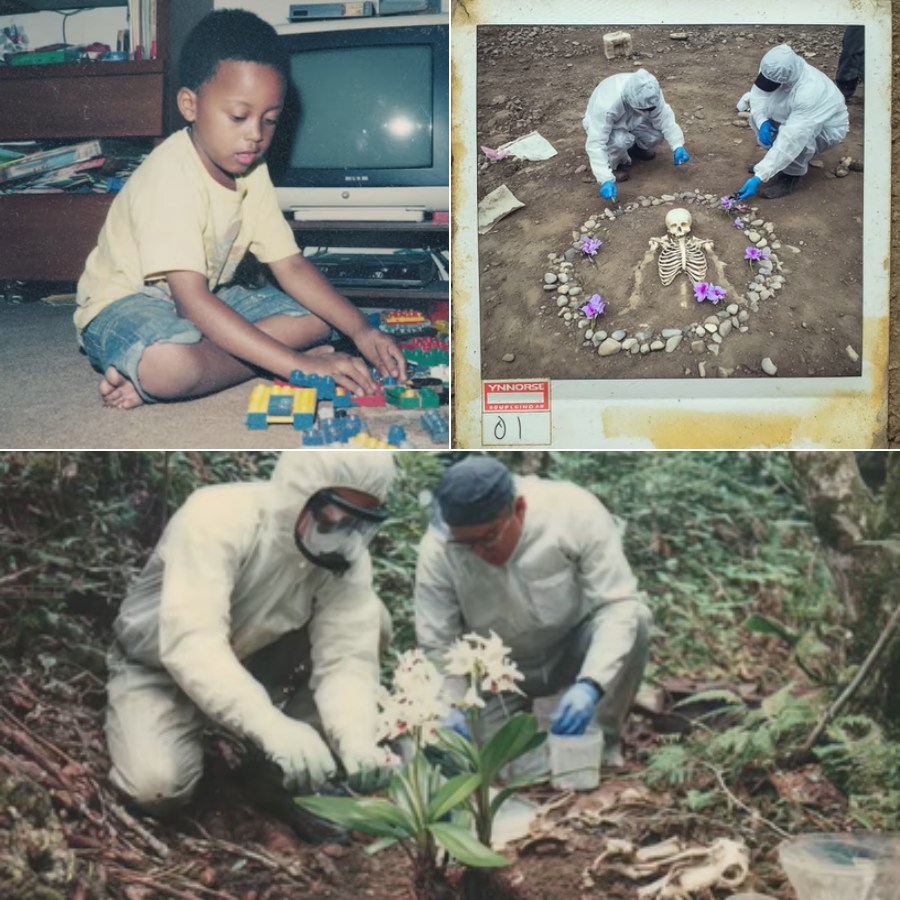
The boy in the yellow shirt disappeared between one heartbeat and the next.
One second, Kian Sterling was at the edge of the family campsite, map in his small hand, stick tucked under his arm like a seasoned explorer. In the next, he was simply… not. The space where he had been—between the crooked pine and the glinting ribbon of creek—was just air and shadows and the distant murmur of water over stone.

No scream.
No splash.
No struggle.
Just an absence that would carve its way through five lives, through a whole community, and—five years later—drag the truth out of the ground along with a ring of impossible flowers.
The day had begun as one of those almost painfully beautiful summer mornings in the mountains.
The road into Pisgah National Forest wound and curled like a lazy snake, dipping through pockets of cool shade where the trees met overhead, then bursting out into bright, hot sunlight. Kian pressed his forehead against the window glass of the SUV and left a smear of nose-print there, watching the trees whip past.
“Elevation eight hundred and forty-two meters,” he announced gravely, reading the little number on his dad’s dashboard GPS as if he were giving a report to mission control. “Approximate humidity… really sticky.”
Naomi laughed softly in the passenger seat. “Is that a scientific measurement, Dr. Sterling?”
“Very,” Kian said. “I can feel it behind my knees.”
From the driver’s seat, Gabriel grinned. “Then it must be serious. Behind-the-knee humidity is no joke.”
He was in his mid-thirties, handsome in a lanky, distracted way, his dark hair already starting to show a little salt at the temples. He designed houses for a living—beautiful, airy homes full of light and clean lines. Today he wore a faded T-shirt and cargo shorts and the relaxed expression of a man who had been planning this trip for months.
In the back seat, behind Naomi, an extra duffel bag jostled against Kian’s backpack. That bag belonged to Donovan Hail.
Donovan had been Gabriel’s best friend since college—roommates, then business partners, the kind of friendship people liked to joke was closer than a marriage. Where Gabriel was big-hearted, impulsive, and openly expressive, Donovan was cooler, more contained, his humor drier, his mind sharper in the numbers and contracts Gabriel always waved off.
He rode in the back now, one long arm stretched along the seat, watching Kian with an indulgent half-smile.
“You’ve got your maps ready?” he asked.
Kian straightened, all seriousness. “Three maps,” he said. “One of the campground, one of the waterfall trail, and one of the whole forest. I laminated them so they don’t get wrecked.”
Donovan held a hand to his chest. “My hero. If we get lost, I’m following you.”
Naomi turned slightly toward the back seat. “Sweetheart, you remember the rules, right?”
Kian rolled his eyes just a little. “Mom. We went over the rules like five times.”
“Humor me,” she said gently.
He sighed, but he was still smiling. “Stay where you can see me. Stay on the trails. No going in the water without an adult. No talking to strangers unless you’re there, too. And if we somehow get separated, I stay put and blow the whistle three times.”
He tapped the bright orange whistle that hung from his neck on a nylon cord.
“Good,” Naomi said. “And you remember the most important one?”
Kian thought a second. “Don’t feed your father after midnight?”
Gabriel barked a laugh. “Rude, sir. Very rude.”
“No,” Naomi said, but she was smiling. “The most important rule is: we will always come for you. No matter what. If you’re scared, if you’re lost, if something feels wrong, you stay where you are and we will come. We will always come.”
Kian shrugged, clearly not seeing how that could ever be necessary. “Okay. But I’m not planning to get lost.”
The campground was busy when they pulled in. Tents sprouted everywhere like small, bright mushrooms—domes of blue and green and orange. Children were already running between them, bikes rattling over gravel, dogs barking. Somewhere a radio played an old rock song, the sound thin and tinny in the warm air.
Kian practically vibrated with excitement as they checked in at the ranger station and then drove the looping access road to their assigned site.
“This is it,” Gabriel said, pulling into the gravel pad. Two flat tent spots, a metal fire ring, a picnic table scarred with years of carved initials. Beyond that, a narrow strip of trees, and then—through the branches—the glitter of a creek.
“Base camp,” Kian whispered reverently.
They tumbled out of the car. The air smelled of pine and damp earth and smoke from someone else’s breakfast fire. Cicadas buzzed in the trees, a shrill electric saw of sound.
Naomi stretched and rolled her shoulders, breathing deep. “I can’t believe we finally did this,” she murmured to Gabriel.
“Hey, we said eight was the magic age.” Gabriel nudged her gently with his shoulder. “Old enough to hike more than ten feet, young enough to think hanging out with us is still cool.”
From the back of the car, Donovan appeared, carrying two armfuls of gear. He wore a soft gray T-shirt and jeans, and despite the load he moved with an easy, athletic grace. He took in the campsite at a glance—those careful surveyor’s eyes always working.
“Creek’s closer than I expected,” he said. “Nice.”
Kian had already seized his hiking stick and map case. He marched to the center of the campsite, planted the stick in the ground, and squinted at the map like a tiny general.
“Okay, expedition team,” he called. “Listen up.”
Gabriel snapped to attention and saluted. Donovan followed suit, face solemn.
Naomi—though she was still half-digging through the cooler—raised her hand. “Present, sir.”
“The primary waterfall objective,” Kian declared, tracing a line with his finger, “is approximately one point five miles from this location. Elevation gain not too intense, but there might be switchbacks.”
“Copy that,” Donovan said. “Any dangerous wildlife on the route, leader?”
Kian considered. “Snakes,” he said. “Probably black bears. Maybe squirrels, but they’re mostly chaotic neutral.”
“Chaotic neutral squirrels,” Gabriel murmured. “Terrifying.”
“Also, there’s a creek right there,” Kian went on, pointing. “Recon opportunity. Potential butterflies.”
He tried so hard to sound adult that it pulled at something in Naomi’s chest. He still had the rounded cheeks of a child, the faint scatter of freckles across his nose, the wayward cowlick in his hair that never wanted to lie flat.
“Just make sure your calculations include a mandatory stop for s’mores, Mr. Leader,” she said.
“Obviously,” Kian said. “That’s like… rule number one of camping.”
They set about pitching tents. The air filled with the slap of nylon, the metallic clink of tent poles, the rhythmic thud of Gabriel’s mallet driving stakes into the soil. Bees fussed lazily around the clover along the edge of the campsite. Somewhere close, someone laughed, the sound quick and bright.
For a while, everything was ordinary. Beautiful, peaceful, ordinary.
Then Donovan said, almost off-handedly, “Hey, Keeks. Heard a rumor at the ranger station.”
Kian, wrestling with the zipper on his sleeping bag stuff sack, looked up. “What rumor?”
“Rare species sighting near the creek.” Donovan’s voice dropped to a theatrical whisper. “Eastern tiger swallowtail. Very elusive.”
Kian froze. Butterflies and maps: those were his two great loves. He scrambled to his feet so fast he knocked over the stuff sack.
“Seriously?” he demanded.
Gabriel straightened up from the tent fly, wiping sweat off his forehead with the back of one wrist. “Uh oh,” he said. “You’ve awoken the bug nerd within.”
“What kind?” Kian repeated, eyes wide.
“Big yellow and black wings,” Donovan said, sketching a shape in the air with his hands. “Striped. Likes sunlit clearings near water. Maybe, I don’t know…” He tilted his head as if thinking. “Right about where that bend in the creek is.”
He pointed through the trees.
Kian’s heart pounded, the way it always did at the possibility of discovering something rare and alive and fluttering. He grabbed his map and the small mesh net he’d insisted on bringing, though Naomi had made him promise he’d catch and release, not keep anything.
“Dad, can I go look?” he asked breathlessly. “I won’t go far. Just to the creek. I can see it from here.”
Gabriel hesitated, glancing toward the water. The creek glittered through the trees, the sound of it soothing and light. It wasn’t far. The campground was full of people. The picnic table behind them was still crowded with un-unpacked food; the tent half-finished. Everything felt solid and safe and normal.
“Okay, buddy,” he said finally. “But you do not go out of sight. Got it? Where we can see you at all times.”
“Yes, sir,” Kian said, already nodding. He snapped a mock salute so crisp it would have impressed a drill sergeant.
“Take your whistle,” Naomi added automatically.
“It’s on,” he said, fingers brushing the cord around his neck. “I’ll just be, like, right there.” He jabbed a finger toward the creek again.
Donovan ruffled his hair. “If you find it, I want a full report, yeah?”
“Obviously,” Kian repeated. “Expedition leader always reports to his crew.”
He turned and trotted away, bright yellow shirt bright against the green. The mesh net bounced lightly against his leg. His small figure zigzagged between trees, following the sound of water.
For a few seconds, they all watched him, that small moving point of color.
Then Gabriel turned back to the tent. “Okay, stakes in at the corners, then—”
He never remembered what he was about to say.
The next minutes of his life existed only as a blur broken into fragments he would replay over and over: a joke half-made. The shadow of a bird overhead. The soft clunk of the cooler lid as Naomi opened it. Donovan tossing kindling into a rough pile.
And then something quietly wrong.
Later, when he tried to explain it, he’d say the air felt… empty. As if some thin, taut thread in the back of his mind had snapped.
He straightened, squinting toward the trees.
The creek still murmured. The same sunlight still filtered through the branches, dappling the ground. But the yellow of Kian’s T-shirt was no longer there.
“Kian?” he called. Just a little louder than conversational. “You still see that butterfly?”
Silence, save for the rush of water and the very faint shriek of another child laughing somewhere two campsites over.
Naomi’s hands stilled in the cooler. Donovan’s head turned.
“Kian?” Gabriel called again, louder this time. “Answer me, bud!”
Nothing.
The cold that rushed through him was sudden and absolute, like icy water dumped over his head. He dropped the tent peg, barely aware of it.
“He’s probably just behind a tree,” Donovan started, but Gabriel was already moving.
He ran toward the creek, feet slipping in pine needles, heart thudding so hard it felt like it might crack his ribs. Naomi was right behind him, her sandals snapping branches, Donovan a close third.
The creek was shallow, a clear stream laced with ribbons of white foam where it slid over moss-slick rock. Dragonflies hovered in place like tiny helicopters. The bank was muddy in places, lined with roots that curved out like knotted fingers.
And Kian was not there.
The place where he should have been—on the little gravel bar near the bend Donovan had pointed out—was empty.
“KIAN!” Naomi screamed, the sound ripping out of her so raw and loud that a woman at the next campsite turned in alarm.
Her mind, even through the rising panic, ran down the clinical list: water, fall, head injury, drowning. Her eyes scanned the surface of the creek, searching for any bright flash of yellow under the water, any small limb.
Nothing.
“Kian!” Gabriel bellowed. His voice bounded off the trees and came back to him warped.
They crashed along the creek bank, up and down, calling and calling, voices growing more hoarse, more fractured. Gabriel stumbled through ferns and brambles, his leg catching on something; he didn’t feel it. Naomi’s breath came in ragged gasps; she kept seeing flashes of yellow that turned out to be leaves, wildflowers, trash.
Donovan tried to organize the chaos, calling out suggestions in a steady voice—“Gabe, you take upstream; Naomi, stay here in case he comes back; I’ll check down”—but even his voice had a strained edge.
Other campers were starting to notice. A man in a baseball cap came over, face serious. “You missing somebody?” he asked.
“My son,” Naomi choked. “Eight years old. Yellow shirt. He was just… he was just here.”
Phones came out. People started walking the trails, peering under trees, calling his name.
“KIAN! ANSWER! BLOW YOUR WHISTLE!”
No whistle blew.
The minutes lengthened and twisted. Naomi checked the campsite three, four times, as if Kian might somehow have looped around behind them and be sitting in his camp chair, annoyed that no one believed him about the butterfly. His comic books were still in a neat stack where he’d left them. His backpack sat on the picnic table, unzipped.
His map of the campground lay open, a small X carefully drawn on their campsite in red pen.
Gabriel called the ranger station. His fingers trembled so badly he could barely tap the buttons. He kept messing up the unlock code and had to start over. The ranger on the other end was calm and efficient.
“Stay where you are, sir. We’re coming to you. What’s his name again? Spell it for me? What was he wearing? Any medical conditions?”
“No,” Gabriel said, voice cracking. “He was just—he was just here.”
By nightfall, the campground had transformed.
Floodlights on tall poles bathed the gravel and the surrounding trees in harsh, artificial daylight. Trucks and SUVs were crammed into every available space. Radios crackled. The air hummed with the overlapping noise of dozens of people working, moving, planning.
In the middle of it all, Gabriel and Naomi sat in a pair of folding chairs provided by a paramedic. Someone had draped a blanket over their shoulders, though the night was still warm. Neither of them felt it.
Gabriel stared at the treeline. Every few seconds, his fingers clenched on his knees.
Naomi’s hands twisted themselves together in her lap, rubbing the skin on her left thumb raw. The pediatrician in her tried to surface, tried to rationalize probabilities and time frames and survival rates, but every clinical thought crashed into the image of her son’s face: stubborn, bright, alive.
Donovan paced, his energy channeled into motion. He talked to whoever needed talking to—the sheriff’s deputies, the park rangers, the volunteer search-and-rescue teams arriving in dusty trucks with dogs jostling eagerly in the back.
When Detective Ben Carter arrived—tired, square-jawed, carrying a Styrofoam cup of rapidly cooling coffee—he found Donovan already with a crude map spread on the hood of a vehicle, outlining the terrain with a pen.
“Here’s the creek,” Donovan was saying. “It curves this way, then there’s a ravine. If he followed it, he’d hit a steeper slope. Pitch is around—what, Gabe, twenty degrees? Thirty?”
Carter listened, eyes on the paper, mind already moving through the standard procedure. Air search, ground teams, dogs. Time since last seen. Weather conditions. Temperature. He’d done this before. He knew, with a sick intuition born of experience, how little margin a child had out here.
He interviewed them one by one in the back of an ambulance, taking notes in a small spiral notebook, his questions careful but precise.
“What time was he last seen?”
“What direction did he go?”
“Any history of wandering?”
“Fights? Arguments today?”
He didn’t say the words that sat heavy behind those questions: abduction, domestic dispute, custody battle. He didn’t need to. They hung in the air anyway, unspoken ghosts.
Gabriel’s answers came out in bursts. “He walked to the creek, that way, we could still see him, I swear we could still see him.”
Naomi shook her head at almost every question that implied they might somehow be responsible. “No fights. He wasn’t upset. He was excited about the hike. We’ve never—he doesn’t just run off.”
Donovan’s account was different. Cooler. More organized.
“He went to the creek to look for butterflies,” he said, voice steady. “I could still see him through the trees for a minute. Then… I don’t know. I looked up and he wasn’t there. Maybe he followed the water. Maybe he saw something interesting.”
His words fit neatly with the simplest explanation: an adventurous child following his curiosity just a little too far.
It was a story everyone knew how to understand. It required no monsters. Only bad luck and bad timing.
The search began in earnest at first light.
From above, the forest was a solid green carpet, unbroken. From the ground, it was a labyrinth of ridges and hollows, dense underbrush and steep drops. Searchers moved in long lines, calling Kian’s name, eyes scanning for any splash of yellow.
Naomi watched the dogs being brought in—lean, eager German shepherds and long-legged hounds—and thought of all the times she’d reassured anxious parents about their children’s fevers, their strange rashes, their broken bones.
We’ll find what’s wrong. We know what to do. We have a plan.
Now there was no plan. Only hope and a growing, grinding dread.
Days blurred. The sun rose and fell. The volunteers’ faces changed as shifts ended and new ones began, but the same expressions cycled through all of them: focus, fatigue, frustration.
They found candy wrappers, bottle caps, a lost fleece jacket, the half-rotted skeleton of a deer. They marked every bit of possible evidence with flagging tape and logged it on maps.
They did not find a single proof that Kian had ever left the campground.
No shoe. No scrap of shirt. No whistle. No small, frantic footprints leading away from the creek.
The dogs trailed him as far as the water and a short distance along it. Then the scent simply dissolved into the damp, leafy air.
Carter watched the search shrink in circles around that fact. He thought about statistics. About all the files on his desk, each one a story that began with a phone call very much like the one that had brought him here.
On the seventh day, with the volunteers bone-tired and resources stretched thin, the official operation was scaled back. The big floodlights were taken down. The command center tents were folded. The campsite where it had all begun stood quiet again, save for a few scuffed patches of earth and the faint, lingering smell of gasoline.
In a borrowed office at the ranger station, Carter sat across from Gabriel and Naomi and delivered the report like a blow.
“We covered over twenty square miles,” he said, voice hoarse. “If he was out there, we would have found some trace. We have no evidence of an abduction. Nobody reported anything suspicious. There are no tire tracks, no witnesses. The most probable scenario is that he followed the creek farther than he meant to, got disoriented, and became lost. Hypothermia and dehydration happen fast in children, even in summer nights. I’m so sorry.”
Naomi stared at him. The clinical side of her brain screamed objections.
“The dogs lost his scent at the creek,” she said. “You said the ground doesn’t hold tracks. You said—how can you be sure he didn’t—”
Her voice cracked. All the precise medical language she had spent her career learning suddenly fled, leaving behind only raw, animal sounds.
Donovan sat beside them, jaw tight, eyes bright with tears he didn’t quite let fall. He rested a hand on Naomi’s shoulder in a gesture that looked steady and reassuring.
“Honey,” he said quietly, “sometimes there isn’t anyone to blame. Sometimes terrible things just… happen. You can’t torture yourself with what-ifs.”
Later, Naomi would replay that sentence over and over, every word like a thorn.
At the time, she almost clung to it. Because the alternative—that some person had taken her child, hurt him—was too monstrous to face.
The case went inactive. Not closed, not solved. Just… shelved. Waiting for something new to disturb the dust.
The forest closed its green mouth over whatever truth it held.
Grief did not hit like a wave for Gabriel and Naomi. Waves recede and return. This felt more like being dropped into deep, black water and left there.
The first year was sharp and jagged. Every object in their home seemed to hold some shard of Kian—his Lego rocket on the shelf, the smudged fingerprint on his bedroom window, the slightly crooked poster of a world map he’d insisted on tacking up himself.
Naomi kept working. How could she not? Her patients were children. Children didn’t stop getting sick because her world had ended.
At first, it was excruciating. Every little boy with a cowlick, every girl clutching a stuffed animal, was an arrow driven straight through her. She learned to breathe carefully, to build walls in her mind.
She never told the parents who apologized for “bothering” her with something minor that she would have gladly woken at three in the morning every night for the rest of her life to take Kian’s temperature just one more time.
Gabriel buried himself in the firm. He and Donovan had built it from nothing—two hungry young architects with a couple of laptops and a rented office above a coffee shop. Sterling & Hail had grown into something real. A team. A brand. Beautiful photos of their houses in glossy magazines.
Now Gabriel came in before anyone else and left after they were all gone. He drew obsessively: lines and angles, plans and elevations. His designs shifted subtly over time: colder, more severe, all sharp edges and glass. He stopped putting kids’ bedrooms in his renderings.
In the evenings, their house was quiet.
Sometimes, Naomi would turn on the TV without watching it, just to drown out the silence.
Sometimes, Gabriel would pull up satellite images of Pisgah on his laptop and stare at them until the pixels blurred, mapping and remapping every ravine, every ridge, trying to imagine a route an eight-year-old boy could have taken.
On Fridays, Donovan came over without fail.
He let himself in with a key they’d given him years ago when life was simple. He brought takeout—Thai, usually, or pizza—and a bottle of wine.
“Hey, you two,” he’d call softly. “I come bearing carbs.”
They would sit at the table where Kian had done his homework and colored his insect diagrams, and Donovan would talk. He was good at talking. At maintaining a flow of conversation that didn’t demand too much of them.
Sometimes he told stories from college, making Gabriel snort with reluctant laughter. Sometimes he told stories about Kian.
“Remember the time he ‘redesigned’ my living room?” he’d say, eyes going distant. “Moved all the chairs because he said my ‘circulation path’ was inefficient.”
Naomi would smile, even as the memory stabbed at her. “He was right,” she’d murmur.
They needed those stories. They clung to them. It kept Kian alive in some small way. It kept the three of them bound together, co-owners of a loss too heavy to carry alone.
If, occasionally, something in Donovan’s grief felt rehearsed—if the inflection he used when describing certain memories never changed, as though he were reading from a script—they ignored it. What else could they do?
He was all they had left of that last day besides each other.
Naomi noticed other small things, here and there.
The way Donovan sometimes watched her and Gabriel with an intensity that made her skin prickle. The way he seemed always to know when Gabriel was about to spiral into one of his dark, silent funks and managed to text or drop by at just the right moment.
She wrote it off as hyper-vigilance born of his own trauma. He had been there too, after all. He had searched until his legs gave out, his hands bled. He had bolstered them through funeral-without-a-body, through anniversaries, through birthdays that were marked only by flowers left at an empty creek and tears spilled in silence.
At five years, the grief changed. It did not get smaller. It hollowed them out in different ways.
Naomi’s sharp, occasional bursts of hope—those irrational flashes where she’d think, what if he was taken and somehow survived, what if he’s out there somewhere—dimmed and finally went out. She stopped imagining a grown version of Kian walking through their door, some scarred miracle.
She accepted what she’d never wanted to say aloud: her son was dead. The only question left was how, and where, and why.
Gabriel stopped talking about Pisgah. He stopped talking about the search. He stopped talking, mostly, about Kian at all. When Naomi tried to bring him up, Gabriel would squeeze his eyes shut, as if the very name hurt.
Silence grew between them, not loud, not angry. Just… wide. Like two people standing on opposite sides of a deep ravine, shouting across.
Donovan remained the bridge between those sides. Friday dinners, check-in texts. He helped with the legal nightmare when Gabriel finally agreed to wind down his ownership in the firm. He took over almost all the business-side responsibilities, insisting Gabriel focus on design “when he feels like it” and healing the rest of the time.
“You just worry about breathing,” he said once, squeezing Gabriel’s shoulder. “I’ll handle the rest.”
Naomi thanked him through tears. Gabriel clapped him on the back. What else do you say to someone who appears to be sacrificing huge chunks of his life to hold yours together?
You do not ask what he might be getting out of it. You do not examine his motivations too closely. You are too tired for that.
So when the call finally came—five years to the month after that bright, ordinary morning at the campsite—Naomi did not once think of Donovan.
She thought, distantly, of death certificates and exhumations and everything she’d learned in medical school about decomposition and animal activity on remains.
She did not think of orchids.
Maya Torres and Ben Liu had not gone into the forest that day intending to find a grave.
They were working on their master’s degrees, which meant they were tired most of the time and perpetually poor, and they loved their field of study more than was probably good for them. Plants were not just green things in the background. Plants were stories—about climate, about history, about boundaries between worlds.
They parked their beat-up Subaru at a small gravel pull-off and shouldered their packs. Their permit allowed them to bushwhack off-trail in a remote section of the forest to survey a particular fern species that preferred damp, shaded ravines.
“Remind me,” Ben said as they started up the slope, “why we couldn’t have studied something reasonable. Like… I don’t know. Slime molds.”
“Excuse you,” Maya said. “Ferns are noble and ancient and extremely reasonable.”
The forest swallowed them, one step at a time. The sound of distant traffic faded, replaced by the hush of leaves, the whisper of wind, the glug-glug of a small seasonal creek.
They followed that creek, hopping from stone to stone. It twisted them deeper into the forest, into a world of moss-coated logs and deep green shadows.
After an hour or so, Maya was breathing hard. She paused, one hand on the trunk of a hemlock, to catch her breath—and that was when she saw it.
At first, her brain refused to accept it as anything but a trick of light.
The forest floor here was a chaos of debris: fallen branches, rotting leaves, saplings fighting for space. But about thirty yards ahead, on a small shelf of relatively flat ground, was a circle of… nothing.
No underbrush. No leaf litter. Just bare, dark soil enclosed by an almost perfect ring of stones.
“Ben,” she said slowly. “You see that?”
He stepped up beside her, squinting. “That’s weird,” he murmured.
They approached, not speaking, their boots making almost no sound on the soft ground.
Up close, the weirdness increased. The stones weren’t native to this ridge—they were smooth, rounded, river stones, carried from somewhere else. Each had been placed with deliberate care, forming a boundary.
Inside that boundary, the soil was darker, richer. It looked cultivated. Turned. Someone had worked this ground.
Maya felt the hair on the back of her neck prickle.
“This isn’t natural,” she said under her breath.
“Yeah,” Ben agreed quietly. “No kidding.”
Then they saw the bones.
Not all at once. Their eyes picked up a pale curve here, a white twig-like line there, and then the pattern clicked into meaning.
A rib cage, small and fragile. The curve of a skull, round and smooth. Long bones radiating outward in a careful pattern.
Maya’s stomach lurched. The world narrowed around her, sound muffled.
“Jesus,” Ben whispered. “Oh my God. Is that…?”
“A child,” Maya said. Her voice didn’t sound like her own.
The skeleton had been arranged.
The skull lay in the center of the circle, tilted slightly upward. The long bones of arms and legs had been laid out like spokes in a wheel. The tiny bones of hands and feet sat in neat piles.
It was grotesque and tidy and somehow worse than any messy grave could have been.
Then Maya’s botanist brain did something strange: it noticed the flowers before the horror could entirely swallow her.
Just inside the ring of stones, planted in a second circle, were a dozen plants in full bloom, their flowers a shock of rich, impossible purple against the dark soil.
The blossoms were large, with striped petals and a curious pouch-like structure in the center. The leaves were glossy, veined, healthy. These weren’t wildflowers.
“What the…” Ben breathed. “Those are orchids. Aren’t they?”
But they didn’t belong here. Every instinct Maya had about habitat and range screamed that this was wrong.
“They shouldn’t be growing outside at all,” she said numbly. “Not like this.”
The clearing pressed in on them, heavy with its own odd gravity. The forest around it suddenly felt very far away.
“Okay,” Ben said finally, voice thin. “We are backing away. Slowly. Right now.”
They did.
Only when the circle was no longer visible through the trees did he fumble for the satellite phone in his pack. His fingers shook as he dialed.
“This is Ben Liu,” he said when the dispatcher answered. “We’re in Pisgah. We found… we found human remains. A child, I think. It’s… you need to send someone. Please.”
Detective Zoe Shaw stepped off the helicopter into a blast of rotor wash and the taste of gasoline on her tongue.
She pulled her hair back into a tighter knot at the nape of her neck and adjusted her pack. The makeshift landing zone—a flattened patch of meadow a short hike from the crime scene—buzzed with activity: uniforms, crime scene techs, a couple of county officials with tight mouths and furrowed brows.
Zoe flashed her credentials and got the brief on the walk toward the trees. Child-sized skeletal remains discovered by two hikers. Unusual arrangement. Possible ritual elements. Remote location. Coordinates matched a place not far, geographically, from a campground she remembered reading about in an old missing persons file.
As they hiked, she listened to Maya and Ben’s halting description, the way their voices still wobbled around certain details. She’d seen that look before. People who had stumbled over a horror the world wasn’t quite designed to hold.
When they reached the strip of orange tape marking the edge of the crime scene, everything slowed down.
The air felt thicker, cooler. Birdsong seemed quieter.
The circle of stones was exactly as described. The soil inside was dark and almost velvety, the kind of rich, compost-heavy growing medium people paid ridiculous amounts of money for.
The bones lay at the center, clean and white, the arrangement symmetrical.
And around them, the orchids glowed.
Zoe had seen a lot of scenes in her career. Bodies left where they’d fallen. Bodies buried in shallow pits. Bodies concealed under floorboards, in trunks, in freezers. She had seen bones scattered by animals and by time.
She had never seen anything like this.
She crouched just outside the stone circle, careful not to disturb even a fallen leaf, and studied the flowers.
She wasn’t a botanist. She couldn’t name species by sight. But she could recognize what did and did not fit.
Everything about these plants screamed artificial.
They were too healthy for a wild patch—no insect damage, no fungal spots. Their arrangement was too regular. The soil around them hadn’t been sitting here for decades; it had been brought in, turned, amended.
“Those orchids,” she said over her shoulder, “are they native?”
Maya, beyond the tape, shook her head sharply. “No. No way. They might be a Paphiopedilum species but they’re definitely not from North America. They look… Asian.”
Orchids from Asia. In a remote North Carolina forest. Thriving.
Zoe filed that away. Her mind did what it always did, unfurling possibilities like branches: smuggling, collectors, greenhouses. People with money and obsession.
She stood, joints crackling a little, and looked down at the entire scene as if from above.
Someone had killed a child, or at least moved the child’s body here. Then they had arranged the remains with obsessive care, planted their prized flowers around them, and left the forest to keep the secret.
Not just a killer. A curator.
The state medical examiner would later confirm via dental records and DNA what everyone had already begun to suspect: the skeleton was that of eight-year-old Kian Sterling, missing for five summers.
The news hit the Sterlings like a blow, landing in the middle of one of their silent evenings.
Naomi sat at the kitchen table, sorting through a stack of insurance forms she’d been avoiding. Gabriel stood at the window, mug in his hand, watching the dusk creep into the yard.
The phone rang. Naomi almost didn’t answer it; she was so tired of automated voices and surveys and calls for a child who no longer lived there.
“Hello?”
“Dr. Sterling?” The voice on the other end was female, professional. “This is Detective Zoe Shaw. I’m with the State Bureau of Investigation. I’m afraid I have some news about your son.”
Naomi put the phone on speaker without quite remembering doing it. Her hands had gone cold.
Gabriel turned, color draining from his face.
“We believe we’ve found his remains,” Zoe said gently. “We’re very, very certain. I’m so sorry.”
Silence descended over the kitchen like a blanket. Even the refrigerator hum seemed to fade.
Naomi swallowed. “You’re sure?” she asked, because hope was a stubborn thing, even when it had no business being there. “It’s him? Not… not some mistake?”
“There will be formal confirmation,” Zoe said. “But the belongings matched. The size matches. The location…” She paused. “It’s him.”
Gabriel made a small, strangled sound and sat down heavily. The mug slipped from his fingers and rolled, coffee spreading across the floor.
Naomi pressed her hand to her mouth. Her eyes flooded with tears, but they didn’t fall right away. They just sat there, blurring everything.
“There’s more,” Zoe said quietly. “I’m afraid it’s not as simple as… as the lost child theory you were given before. I need to speak with you in person about what we found. About the way he was buried.”
Buried. The word lodged in Naomi’s chest like a stone.
The crime lab’s report on the flowers arrived on Zoe’s desk in a fat folder smelling faintly of printer ink and dust.
She read it twice.
Paphiopedilum rothschildianum. The Gold of Kinabalu. Critically endangered, strictly protected, native to a single mountain in Borneo. Among orchid enthusiasts, it had near-mythical status—a holy grail plant. Mature blooming specimens fetched thousands of dollars in the legitimate trade and much more on the black market.
Not something you picked up at the local garden center.
The report went into excruciating detail about its cultivation requirements: carefully filtered light, high humidity, specific temperature ranges, meticulously controlled watering and fertilization. Getting one to bloom at all outside its native habitat was a feat.
“The specimens recovered at the crime scene were in exceptional health and flowering profusely,” the botanist had written in a neat, precise hand. “This strongly indicates they were grown in a carefully controlled environment by someone with significant horticultural expertise and resources. These were not wild plants.”
Zoe sat back in her chair and stared at the photo paper-clipped to the report.
The orchids were undeniably beautiful. Alien, yes, but beautiful. The idea of someone using them as a frame for a child’s bones made her teeth clench.
Whoever had done this loved these flowers, she thought. Cared for them, fussed over them, spent years coaxing them to this point.
And then, at some moment, they’d decided the right place for their rare, precious blooms was around the body of an eight-year-old boy.
That wasn’t random. That wasn’t some chaotic act of wilderness violence. That was specific and personal and planned.
The initial buzz among some of the officers, when the bones were first found, had centered on cults. On rituals. On whispered stories of backwoods groups doing strange things out in the trees.
Zoe assigned a couple of detectives to that angle, because you had to. Because if you didn’t rule it out thoroughly, some defense attorney later would make hay of it.
They dug through old case files and rumor. They interviewed locals who claimed to know about gatherings in the woods. They tracked down a long-defunct doomsday group whose former members now worked at car dealerships and grocery stores.
Nothing fit. Nobody had ever heard of a ritual involving exotic orchids. Nobody remembered anything about children being harmed.
And the orchids themselves didn’t fit that world. They were too high-end, too specialized.
No, Zoe thought, turning back to the report. This isn’t some random coven. This is someone who lives a very different life.
Someone with money. With a greenhouse. With a secret.
While the occult rabbit hole slowly collapsed under its own lack of evidence, Zoe kept following the plants.
She requested a full materials analysis of the soil that had been collected from around the orchids. Not the surface stuff—a deep dig, chemically and physically. She was looking for hitchhikers: particles or fibers that had traveled with the soil from wherever it had originally sat.
The forensic geologist assigned to the task was a quiet man named Henderson who could talk for an hour about the difference between one kind of gravel and another. He worked methodically, sifting and burning and analyzing.
Most of what he found was what you’d expect in a high-quality orchid mix: bark, perlite, charcoal, fertilizer. All of it available at specialty suppliers around the state.
But then he called Zoe and said, in a voice that was just barely more animated than usual, “You’re going to want to see this.”
Under the electron microscope, the soil looked like an alien landscape: shards and spheres, crystals and fibers.
Henderson pointed at a few of the latter. They were shockingly bright even in grayscale—thin strands, unnaturally smooth.
“See these?” he said. “Those aren’t organic. They’re synthetic. Some kind of plastic, most likely. I pulled them out and ran them through FTIR. Spectroscopy says they’re extruded polystyrene.”
Zoe frowned. “Insulation?”
“Exactly,” he said, a little pleased. “Not just any insulation. The chemical signature and dye composition match a specific brand of high-end rigid foam used in construction. Blue stuff. Comes in big sheets.”
“Could that have been in the soil mix when it was bought?”
He shook his head. “Unlikely. This isn’t manufacturing contamination. These fibers look like they’ve been sheared off something during cutting or installation. They probably stuck to someone’s clothes, shoes, tools, and then transferred into the potting mix in a second location.”
“Like a potting bench near an insulated wall,” Zoe said slowly. “In a greenhouse.”
Henderson nodded.
There it was: the thread.
Tiny blue slivers of plastic, invisible to the naked eye, had hitched a ride from a construction site to potting soil to a grave in the mountains. They anchored the crime to something tangible: a structure, somewhere, built or renovated with that specific insulation.
Finding that structure turned into an exercise in data cross-referencing that would have made Donovan, with his architect’s love of precision, proud.
Zoe’s team pulled building permit records from half a dozen counties, filtering for anything labeled greenhouse, conservatory, or similar, over a five-year period. The initial list was long.
They called insulation distributors and asked, with plausible cover stories, who they had sold that particular brand of blue foam to in the region. Fewer names.
They cross-checked those names against membership lists from orchid societies, high-end gardening clubs, and the subscriber rolls of niche horticultural magazines. Even fewer.
In the end, there was only one name that appeared on all three lists: a man who had commissioned a custom greenhouse six months before Kian disappeared, who’d paid extra for premium insulation, and who was an active, if discreet, participant in the rare orchid scene.
When the analyst told Zoe the name, the room seemed to tilt for a second.
She had to ask him to repeat it to make sure she’d heard correctly.
“Donovan Hail,” he said. “Co-founder of Sterling & Hail Architects.”
Zoe had met Donovan once already, briefly, in his glass-walled office.
At the time, he’d been the grieving family friend, all careful composure and flashes of pain. He’d shaken her hand with a firm, steady grip and said, “Detective, I will cooperate in any way you need. We’ve been waiting five years for answers. I’d like to see the monster who did this rot.”
He’d looked at the photo of the orchids and shaken his head, brow furrowed. “Never seen anything like that. Some kind of… sick artwork.”
He’d told her about Kian with obvious affection. About Gabriel and Naomi with obvious concern.
He’d been very good at it. If she hadn’t been watching closely, she might have missed the minuscule tightening around his eyes when she mentioned the odd soil at the crime scene. The way his gaze flickered for half a second when she said “potting mix.”
It hadn’t been enough for anything. People reacted strangely to details all the time. But it had been enough to plant a question.
Now that question had an answer.
Zoe obtained search warrants for Donovan’s house, his office, his greenhouse, his financial records. She kept them sealed and moved fast. People like him, smart and meticulous, were dangerous if given time to prepare.
At dawn one morning, while Donovan was still sipping his first coffee in his office, state agents walked in and placed him under arrest on suspicion of murder.
He blinked, startled, the mug pausing halfway to his lips.
“Excuse me?” he said sharply. “There must be some mistake.”
At the same time, Zoe stood in Donovan’s backyard, staring at the greenhouse.
It was beautiful. Sleek metal frame, glass panels, a design that whispered money and taste. If she hadn’t known what she was looking for, she might have admired it in a dispassionate way.
Inside, the air was thick and warm, fogging her glasses slightly. The smell of damp earth and leaves and blossoms was almost overwhelming after the cool morning outside.
Rows of orchids stretched away, each in its own pot, leaves glossy, flowers vibrant. Some species she recognized from gardening magazines; others were stranger, with spidery petals, mottled patterns, shapes that looked like birds in flight or insects.
At the back, behind a sliding glass partition, was the crown jewel collection.
Under soft purple-white LED grow lights, in temperature-controlled conditions, a dozen Gold of Kinabalu orchids stood in careful ranks.
Their flowers matched, down to the tiniest detail, the ones that had ringed Kian’s bones.
Zoe felt a cold fury settle into her bones. The patience it took to grow these things. The years. The fussing. And this was what he’d done with them.
In the attached potting shed, bags of special orchid mix leaned against the wall. The floor around the potting bench glittered under the flashlight with nearly invisible blue flecks.
Techs knelt and began collecting them.
Zoe’s phone buzzed. It was one of the financial crimes analysts.
“We’ve gone through the firm’s books,” he said. “You’ll want the summary.”
Greed stories are rarely as complicated as their consequences.
On paper, Sterling & Hail was comfortably successful. On glossy cardstock, in the form of brochures and magazine spreads, it looked positively thriving. Clean, modern homes. Happy clients. Awards.
In the ledgers and bank statements, when you looked very closely, breaking through layers of creative accounting, a different picture emerged.
Donovan had been siphoning money from the firm for years: small amounts at first, hidden in complex lines of expenses and reimbursements. Then larger sums funneled into speculative real estate and risky investments that had not paid off.
By the time Kian disappeared, Sterling & Hail was teetering, though Gabriel—who hated paperwork and had happily delegated all financial oversight to his more meticulous partner—had no idea.
Bankruptcy loomed. Embarrassment. Loss of status. Maybe even criminal charges if anyone traced the missing funds.
Unless, of course, something happened that changed the equation. Something that triggered a large influx of cash and gave Donovan a sympathetic role to play in the narrative.
Two years before the camping trip, Donovan had convinced Gabriel to agree to a key man insurance policy.
“It’s standard,” he’d said in the conference room, sliding the documents across the table. “We’re a real company now, Gabe. If something happened to either of us, the whole firm would be screwed. This way, we’re protected. The company gets a payout, we keep people employed. It’s responsible.”
Gabriel, who had been sketching a foyer on his notepad instead of reading the fine print, had frowned.
“I don’t know, man. It feels…”
“Paranoid?” Donovan had smiled. “It’s not. It’s just planning. Look, Naomi’s a doctor. Ask her. She deals with worst-case scenarios every day. This is just us acknowledging that we’re not immortal.”
Gabriel had signed.
The policy was for several million dollars. The beneficiary was the firm. In other words, Donovan.
Zoe stared at the photocopy of the signature page and felt a familiar, tired anger. It was always this simple, underneath the elaborate trappings. Money and fear. Fear of losing what you felt you deserved.
The theory of the crime fell into place piece by piece.
Donovan needed Gabriel dead. Needed it to look like an accident, not a murder, so the insurance would pay and suspicion wouldn’t land on him. A camping trip in rugged terrain, far from hospitals and witnesses, offered opportunities.
He’d gone along as the loyal friend, the fun Uncle Don, armed with charm and inside jokes and an intimate knowledge of the land thanks to his firm’s previous projects in the area.
Somewhere that afternoon, perhaps after Kian had been allowed to wander to the creek, Donovan had suggested to Gabriel that they scout a trail or a lookout point nearby. Maybe he’d framed it as a favor: “I want to show you something. You’ll love the view. We could hike it tomorrow with Naomi and Kian if it looks good.”
Gabriel, trusting, had followed.
What happened next was harder to reconstruct. Donovan’s confession would fill in some of it later, but some details would always remain in shadow.
Maybe Donovan had planned to push Gabriel from a particular rock outcropping, where a fall could be written off as a tragic misstep. Maybe he’d tampered with climbing gear or a footing. Maybe he’d just intended to shove him into the ravine when they were alone.
What he hadn’t planned for was Kian.
The boy had maps and curiosity. He loved to track where people went, to follow paths. It would have been natural for him, once he’d realized his father and uncle had gone off somewhere, to trace their route—especially if he thought they were heading somewhere interesting.
In Donovan’s version, he turned and found Kian standing there behind him in the trees, yellow shirt very bright, map tucked under his arm, face puzzled.
“Uncle Don?” he’d said. “What are you doing?”
In that moment, the entire careful, cold plan Donovan had constructed collapsed.
He saw the future: Kian, talking. Not even intentionally betraying him, just telling Naomi later, “Dad almost fell off this rock because Uncle Don was standing too close,” or “They were arguing about money,” or any number of small observations.
He saw investigations. He saw insurance companies looking more closely at the firm’s finances. He saw prison.
He saw everything he’d spent his life building—not just the company, but the persona of Donovan Hail: successful architect, cultivated man of taste, devoted friend—crumbling.
He said, in the interview room later, voice flat, “I panicked. It was like a tunnel. Like there was only one way forward.”
He blamed a sudden impulse. A moment of madness. But madness didn’t arrange bones in a circle five years later. Madness didn’t lovingly carry orchids up a mountain.
Zoe thought it was simpler, and more damning: he valued his own life, his own comfort and reputation, more than that of an eight-year-old boy who trusted him.
Maybe he lured Kian farther from the trail with a promise: “There’s another butterfly spot down here. Don’t tell your parents yet; it’s a secret.”
Maybe he simply moved quickly and brutally.
Either way, the result was the same.
By the time Naomi and Gabriel noticed their son’s absence, by the time the first calls went out through the forest, by the time the search lines combed the trails, Kian was already gone, his small body hidden somewhere the searchers never thought to look.
Donovan threw himself into the search with convincing fervor because he knew what they were up against. He knew how huge the forest was, how easy it would be not to find a child if you didn’t know exactly where he was.
He answered every question from investigators with apparent candor. He expressed what seemed like genuine horror and sorrow. He agreed with the lost child theory because it absolved him. It turned his act into a tragic accident in everyone else’s minds.
He comforted Gabriel and Naomi because he needed to watch them, to see if any stray suspicion flickered there. He offered them his time and his support because it kept him in their lives, close to the place where his crime might one day be exposed.
The orchids came later.
He couldn’t explain, not even to himself, why he did it. “It felt… right,” he said in the interview, groping for words. “I’d done this… this ugly, ugly thing. And I had these beautiful things.”
He’d spent years perfecting his greenhouse. Tuning the humidity, the light. Winning quiet applause in online forums under a pseudonym for his cultivar’s health.
The Gold of Kinabalu were his pride. He’d spent a small fortune acquiring them from dubious sources. He’d nursed them through fungus and shipping shock, pored over temperature charts.
The day Kian’s bones were found, those orchids were in full, spectacular bloom.
Zoe imagined Donovan standing in the greenhouse doorway, looking at them. At the messy potting bench to the side, with its spilled soil and blue flecks of insulation. At the line of glossy leaves and perfect flowers.
She imagined something twisting in him—a bizarre, private logic. A need to rewrite the ugliness he’d done with an overlay of beauty.
He carried the orchids and the soil into the forest, along a route that skirted the paths searchers had combed years before. He found a small flat place that felt—what? Right? Appropriate? Remote enough.
He dug. He arranged. He transplanted.
He made himself a shrine.
He told himself, maybe, that this was an apology. A gift. A way of saying sorry to the boy whose life he’d taken in a moment meant for someone else.
What it really was was a monument to himself.
He’d created something singular: a story no one else could tell. A crime absolutely unique. In his warped mind, that might have felt like some small victory.
He never anticipated that the orchids—the source of so much of his pride—would betray him.
The interview room was windowless and gray, lit by fluorescents that hummed softly.
Donovan sat with his hands cuffed in front of him, elbows on the metal table. He had lost some of his polish. His shirt sleeves were rumpled. His usually immaculate hair was mussed at the crown where an officer had placed a guiding hand a little more firmly than necessary.
Still, he held himself with a kind of residual poise. Chin up. Eyes direct.
Zoe slid a thick folder onto the table and opened it calmly.
She started with the science. Photos of the orchids in the forest. Close-ups of the petals, annotated by botanists. The lab report on the soil. Electron microscope images of the blue fibers. The spectroscopy results.
“These fibers were in the soil around the boy,” she said evenly. “And these”—she slid a plastic evidence bag across the table, blue specks winking under the light—“were on the floor of your greenhouse.”
He glanced at them and looked away, jaw tightening.
She laid down photos of the greenhouse interior. The Gold of Kinabalu under their grow lights. The potting bench.
“These plants are rare,” she said. “Beautiful. I can see why you love them. In fact, you love them so much you’re on several orchid forums under the username ‘Kinabalu_Architect.’ You’ve posted pictures of that greenhouse. That collection.”
His fingers twitched. He’d thought he’d kept those worlds separate.
She put down copies of bank statements and insurance documents next. Highlighted sections. Transfers. Losses. The key man policy.
“I know about the embezzlement,” she said. “About the investments that went bad. About the insurance you took out on your partner. About the timing. A jury will understand the motive. It’s very straightforward.”
She watched his face carefully as she spoke of Gabriel. Of sweat equity. Of trust.
For the first time, something like genuine emotion broke through his careful control. His mouth tightened. His throat worked.
“It was never supposed to be about Kian,” Zoe said softly. “You planned to kill Gabriel. You picked a place where a fall would make sense. You would be the devastated survivor. The insurance money would fix everything. You would be the hero who held the firm together.”
His hands curled slowly into fists.
“And then,” Zoe went on, “your plan ran into a variable you didn’t account for. A bright little boy with a map. Who saw something he shouldn’t have. Who trusted you.”
Donovan’s eyes squeezed shut.
Zoe let the silence stretch. The hum of the light grew louder.
“You can keep pretending,” she said finally, her voice very quiet, “that this is still a story you control. Or you can tell the truth. The science already has. Every tiny blue fiber. Every inch of that greenhouse. Every dollar missing from your accounts. The only thing the science can’t tell us is what you said to him. At the end.”
That did it.
His shoulders slumped. His head bowed. A single strangled sob escaped him, raw and ugly.
When he spoke, the words came out in fits and starts. He tried, at first, to make himself sound trapped. Panicked. A victim of a split-second decision. But the details betrayed him.
He described the trip to the overlook with Gabriel. The moment he’d almost done it, the way his hand had flexed as he stood just behind his best friend near the edge. The way he’d lost his nerve and laughed it off, saying he’d changed his mind about the hike.
He described turning to go back and seeing Kian. The boy’s small frown. The way he’d said, “What are you doing? Dad almost fell.”
He described his own heart pounding, the sudden rush of calculations: could he trust an eight-year-old to keep a secret he didn’t know was a secret? What if Kian repeated something in front of Naomi later? What if he told a teacher?
He described leading Kian a little farther down the slope, under the pretext of looking for a rare butterfly spot. “He trusted me,” Donovan said, voice cracking. “He always trusted me.”
He did not describe the exact moment of killing. He said only, “It was fast.”
The medical examiner’s report later suggested strangulation. There were faint marks on the small bones of the neck that pointed that way.
He admitted to hiding the body in a crevice, camouflaging it with rocks. To joining the search with frantic energy, knowing full well it was a performance as much as a real effort.
He admitted to building the greenhouse months later, a project he framed as “therapy” for his grief. To pouring his obsession into orchids because they were controllable in a way life was not.
He admitted to carrying the Gold of Kinabalu up into the forest and arranging the bones when he realized animals had scattered them from their original hiding place.
“It was a mess,” he said, disgust coloring his tone—not at the act of murder, Zoe noted, but at the mess. “I couldn’t stand it. It didn’t… look the way it should. So I… I fixed it.”
He didn’t seem to hear the weight of that word.
His lawyer would later argue, in court, that Donovan had been under extreme emotional distress. That his mind had broken under the combined pressure of financial ruin and grief. That the ritualized arrangement of the bones was evidence not of cold-blooded calculation but of a psyche unraveling.
The jury did not buy it.
The fibers. The finances. The insurance. The deliberate nature of the shrine. The manipulation of the Sterlings afterward. It all painted a picture not of a man who snapped in an instant, but of one who had made a series of choices, each more selfish and cruel than the last.
He was convicted of first-degree murder for Kian’s death and attempted premeditated murder for his plan toward Gabriel. The death penalty was initially on the table but ultimately commuted to life without parole after the appeals began.
The sentence meant nothing to Naomi, not really. No number of years in a concrete box could balance the absence at her kitchen table.
But the truth mattered.
Knowing what had happened, however unbearable, was better than the shapeless void of not knowing.
The clearing in the forest was quieter when they returned, months later.
The tape was gone. The soil had been disturbed so thoroughly during evidence collection that it no longer looked like a circle. The stones had been removed, the orchids carefully extricated and catalogued.
The forest had already begun to reclaim the space. Leaves had blown in and decomposed into a thin, soft layer. Moss had begun to creep along the edges where the rich soil met the native clay.
Naomi and Gabriel stood side by side, hands clasped. They had hiked the last stretch with a ranger, who now waited a respectful distance away.
In Gabriel’s free hand was a small granite marker, simple and weighty.
They had worked together on the design, sitting at the dining table late one night with a pencil and a pad of paper. It had been the first joint project they’d undertaken in years that wasn’t about bills or logistics.
On the marker’s face was a compass rose, finely etched. Around it, a tiny map: not of this forest, but of the world. Simple continents, recognizable but stylized. And below, their son’s name and a line that had made Naomi cry the first time Gabriel suggested it.
KIAN STERLING
OUR EXPEDITION LEADER
FOREVER EXPLORING
They knelt in the center of the clearing.
Gabriel pressed the marker into the soil with his own hands, pushing until it sat firm and level.
Naomi brushed some stray leaves away from the base. Her fingers trembled.
For a long time, they didn’t speak.
The forest did what forests do. A breeze moved through the canopy, making leaves whisper. A bird called from somewhere high on a branch. The creek, farther off than it had been near the campground, murmured to itself, indifferent.
“This is where they found him,” Naomi said softly. “Not where he died. But… where he was. For a while.”
Gabriel nodded. His throat worked. “He should have been on a trail,” he whispered. “Complaining about blisters. Asking how much farther.”
Naomi reached for his hand and squeezed, hard.
“He should be starting high school,” she said. “Instead of… instead of this.”
Grief rose in her chest, old and new all at once. But it felt… different, here.
For five years, she had pictured her son lost. Wandering. Alone and afraid. She’d tormented herself with images of him calling for them, voice hoarse, while they searched in the wrong direction.
Now she knew—horribly, definitively—that he hadn’t wandered for days. That his last moments hadn’t been spent stumbling through the dark.
There was a specific, human cruelty in what had happened. But there was also, in some twisted way, less cosmic indifference.
The forest hadn’t swallowed him. A man had.
That man was identified, confined, named. Not a ghost or a faceless idea. A person, with fingerprints and a prisoner number and a tiny rectangular cell he would pace for the rest of his life.
The wilderness, at least, was innocent.
Naomi closed her eyes. Behind her lids, she saw Kian as he had been that morning: on the edge of the campsite, map in one hand, stick in the other, hair sticking up in the back.
“Mom,” he’d said. “We’re gonna see everything.”
She breathed in, let the damp, earthy smell of the clearing fill her lungs, and breathed out slowly.
“I’m sorry we weren’t there when you were scared,” she whispered, not caring if Gabriel or the ranger heard. “I’m sorry we trusted the wrong person. I’m sorry it took us so long.”
Her voice wavered, but she kept going.
“We found you,” she said. “We know. That part’s over now. You’re not lost anymore.”
Beside her, Gabriel’s shoulders shook once, twice. He leaned forward and rested his forehead lightly against the top edge of the granite.
“You were always the one with the map,” he said, voice muffled. “Show us the way out of this, okay, bud? Because we’re still kind of stuck.”
They stayed until the light shifted and a chill began to creep into the air, talking in low voices. Not about Donovan—he didn’t deserve their words—but about Kian.
About the time he’d made them take a detour on a road trip to stop at a “landmark” that turned out to be the world’s largest ball of yarn.
About the way he’d carefully taped his favorite beetle specimen back together when its wings had broken off, whispering apologies.
About the lists he’d made of places he wanted to hike, museums he wanted to see, things he wanted to learn.
When they finally rose and brushed the dirt from their knees, the granite marker sat solid and sure in the center of the clearing.
It didn’t make anything okay. It didn’t heal the hole.
But it was something tangible. A point on the map.
On the walk back to the car, Naomi found herself looking at the trees differently. Not as an enemy, as she had for years, but as… trees. Living things, rooted and reaching, utterly unconcerned with human schemes.
Some part of her loosened.
Later that night, back home, she lay awake in bed and listened to Gabriel breathing beside her.
“Do you ever think… we could move?” he asked suddenly into the dark.
“Move?”
“Sell the house. Start somewhere else. Not to forget. Just… to not be walking through a museum all the time.”
She thought of Kian’s bedroom, untouched for five years. Of the corkboard with his maps, the Lego rocket, the pile of books on his nightstand. A part of her flinched, hard.
Another part, to her own surprise, felt a small, uncertain flicker of something like… possibility.
“Maybe,” she said, quietly. “Not now. But… maybe.”
They lay there in silence.
Outside, somewhere far beyond their windows, in the vast, indifferent heart of the forest, the small clearing slowly disappeared under leaves and seasons.
But the truth that had been unearthed there stayed, stubborn and solid.
In the end, that was what carried them forward—not closure, not some neat wrapping-up, but a shift from imagined horrors to real, named ones.
The boy in the yellow shirt had vanished in an instant. For five years, his parents had been suspended in an endless, unanswered question.
Now, at least, they had an answer.
They had a stone in the forest, etched with a compass.
They had the knowledge that their expedition leader—bright, serious, butterfly-chasing Kian—would never be lost again.