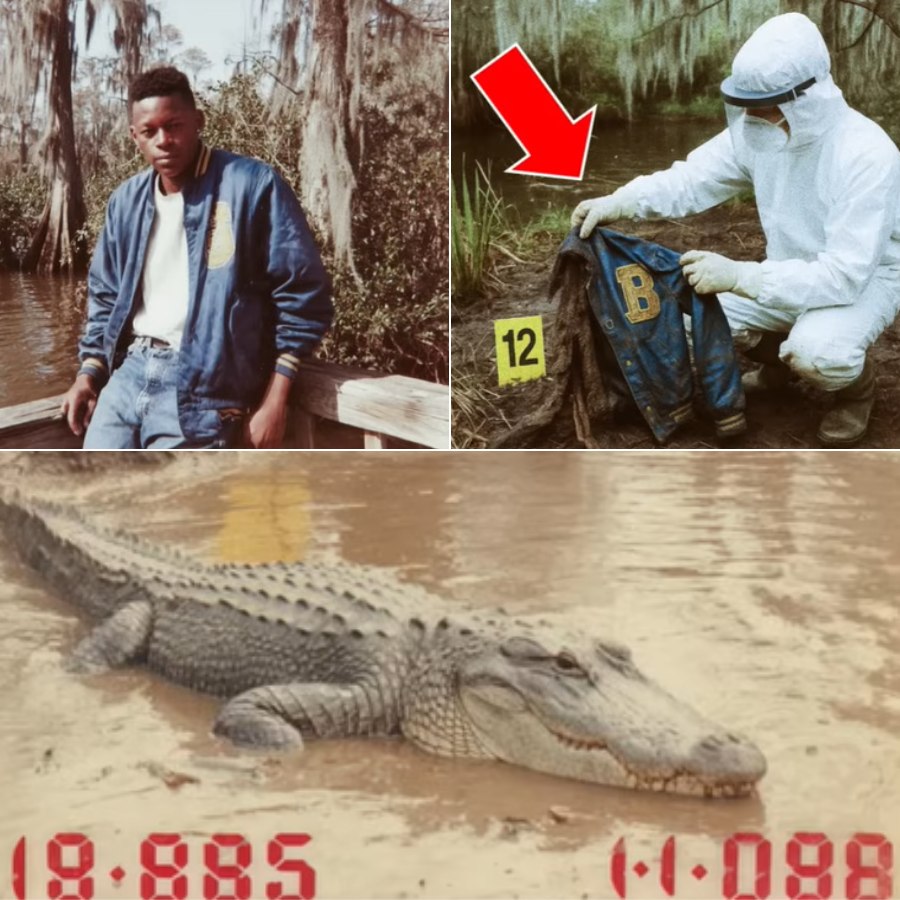
The swamp remembered.
Long after the men in hard hats and the machines of steel had come and gone, long after cigarette butts and beer cans had rusted into the mud, long after a hundred thunderstorms had washed their secrets deeper into the silt, the swamp held its memories in silence.

In the spring of 1986, the Atchafalaya Basin was a living, breathing maze. Cypress trunks rose straight from the tea-colored water like the pillars of some drowned cathedral. Spanish moss drooped from branches in long gray veils, swaying gently in the humid breeze. Dragonflies traced electric-blue lines over the surface. Somewhere, unseen, a bull alligator rumbled—low, resonant, ancient.
Most people in the parish respected that sound like they respected the rattle of a snake: as a warning. Stay out. Stay back. Mind your distance and your business.
But to seventeen-year-old Julian Baptiste, that sound was simply part of the music of home.
He stood barefoot in the shallow water beside his narrow aluminum boat—a beat-up little flatboat with peeling white paint and the fading name WANDERER stenciled on the side. His jeans were rolled up to his knees, and his T-shirt clung to his skinny frame, damp with sweat and humidity. A battered LSU cap, two sizes too big, shaded his eyes.
In his hands, he cradled a glass vial as carefully as other boys held footballs.
He dipped it under the surface of the water, watching the bubbles rise as it filled. When it was nearly full, he eased it upward, corked it with a practiced twist, and examined it. The water inside looked like weak tea, tinged brown from tannins and the dark heart of the swamp. To most people, it would have looked ordinary. To Julian, it was a universe.
He wiped the outside of the vial carefully and slipped it into the foam-lined slot of his carrying case. The kit was his pride and joy: a secondhand tackle box he’d gutted and refitted with dense insulation, custom-cut for vials, litmus paper, reagent bottles, and neatly labeled syringes. A handwritten label on the inside of the lid read:
“WATER QUALITY STUDY – ATCHAFALAYA BASIN – J. BAPTISTE.”
He’d spelled “Atchafalaya” correctly, which in itself felt like a minor miracle.
“Alright, baby,” he murmured to the swamp, voice soft, almost reverent. “Let’s see what you’re trying to tell me.”
He straightened, pushed the boat with his hip, and climbed back in with the easy balance of someone who had been walking on slick planks and rocking hulls since childhood. The small outboard motor coughed, sputtered, then settled into a steady growl. He steered the WANDERER deeper into the cove, well away from the wider, busier channels where grown men rode airboats and shouted to each other over coolers of beer.
This was a place most of the locals didn’t bother with—too still, too eerie, too close to where people said “bad water” collected and the fish came up belly-up. They called this cut of bayou the Dead Man’s Sloo, with the comfortable flippancy people used when they were trying to dress fear in a joke.
Julian didn’t joke about it. He studied it.
The air changed as he entered the cove. The sound of distant boats faded until there was only the buzzing of insects and the occasional plop of something unseen slipping beneath the surface. The smell shifted too. The usual mix of mud, decaying vegetation, and warm water was overlaid with something faint and wrong—sharp and metallic, like a coin left too long in your mouth. He wrinkled his nose.
“Yeah,” he said quietly. “I smell it too.”
He pulled the throttle back, letting the boat drift. The water here barely moved. Sunlight pushed through gaps in the canopy in broken shafts, painting bright rectangles on the dark surface. That surface had an odd trait today: a faint, iridescent sheen. Greasy rainbows slid over each other whenever the boat’s wake disturbed the mirror.
Julian’s curiosity flickered into full alert.
He reached for another vial, then hesitated and leaned over the side, frowning. Just above the waterline, the cypress knees—those knobby, root-like protrusions punching up like blunt fingers—were ringed with a chalky gray film, like someone had painted a perfect bathtub ring around the basin at some invisible height.
He scraped it with a gloved fingertip. It flaked away like ash.
His brain, usually a rush of excited connections, went very quiet and very precise. He didn’t smile. He didn’t narrate to himself. He just worked.
Water samples at three depths. Surface scum in a labeled vial. Scrapings from three different cypress knees, each marked with location, time, and tide level. Photos taken on his cheap camera. GPS didn’t exist here for him; he navigated by cypress clusters, a crooked lightning-struck tree, the smell of the water. Still, he drew a careful sketch in his field notebook: angles, distances, landmarks. This was a puzzle, and he respected puzzles.
By the time the sun had dropped to an orange disk just above the treeline, Julian had filled almost every slot in his case. The air felt heavier. The wrong smell seemed stronger, growing like a bad thought in the back of his mind. He sat in the boat and stared at the water for a long moment.
“This isn’t right,” he whispered. “This isn’t you.”
The swamp, of course, said nothing.
He capped his pen, tucked the notebook away, and headed home.
The Baptiste house sat on the outskirts of town, too close to the swamp for some people’s taste and not close enough for others. It was a worn, single-story wooden house with peeling paint and a wide porch where his parents liked to sit at night, listening to the crickets. Behind it, tucked between two pecan trees, stood the garage—part storage, part workshop, part laboratory.
By the time Julian backed the pickup into the driveway that evening, the sky was losing its last light, and the air was filled with the whine of cicadas. The garage windows glowed faintly.
Inside, his lab looked like a science teacher’s fever dream. A wobbly card table held a small, humming centrifuge he’d convinced a retired teacher to sell him for twenty dollars. A secondhand microscope, its focus knob a little gummy, sat beside stacks of stained notebooks. Hand-drawn charts were taped to the walls over piles of old tools and fishing gear. A jury-rigged drying rack made of coat hangers held litmus strips, each tagged with a thin strip of masking tape.
He moved around the space with the quiet intensity of someone entering a church.
He set down the case, snapped open the lid, and began the careful process of cataloging. Each sample received a number, a note, a place in his mental map. He worked with methodical focus, tongue pressed to the corner of his mouth as he wrote.
The garage door creaked open.
“Still playing mad scientist, little brother?” Simone’s voice floated in, dry and amused.
Julian glanced up, squinting against the bright rectangle of evening sunlight framing her. Simone leaned her shoulder against the doorway, arms crossed. At twenty, she was three years older and infinitely more worldly in his eyes, despite having never left Louisiana yet. Her hair was pulled up in a messy knot, a pencil stuck through it. A camera bag hung from her shoulder, smudged with ink and newsprint.
“I told you not to call it mad scientist,” he said automatically. “It’s environmental science.”
“Uh-huh.” She stepped inside, letting the door fall almost shut behind her. “And that makes it… what, exactly? Slightly irritated scientist?”
He allowed himself a brief smile, then turned serious again. “It’s worse, Simone.”
She heard something in his tone that pulled the teasing right out of her.
“How bad?” she asked, coming closer, the smell of her strawberry lip balm mixing with the sharper scents of reagents and machine oil.
He pointed to a chart he’d been working on. It was hand-drawn, but neat: a baseline comparison of water samples from relatively clean inlets against the ones he’d brought from the cove. Peaks and valleys marched across the paper. Even to an untrained eye, the lines from today looked… wrong. Spiky. Aggressive.
“These from today?” she asked.
He nodded, tapping one cluster of peaks with his pen. “See this pattern?”
“Looks like a seismograph having a panic attack,” she said. “What am I looking at, really?”
“This,” he said, “is dioxin. And this, and this—see how the peaks recur at the same intervals? It’s consistent. Not random. That means it’s not just something that washed in from God knows where. It’s being dumped. Regularly.”
The word hung between them.
“Dumped from where?” Simone asked, though she already had a guess. Everyone did.
Julian reached behind him, snagged a rumpled parish map from the workbench, and spread it out. Someone—probably him—had outlined the basin in blue marker, tracing its inlets and invisible channels like veins on a hand. He pointed to a red X.
“This is where I was today,” he said. “Dead Man’s Sloo.”
“Don’t call it that,” Simone muttered on reflex.
He traced his finger upriver. “And this is the only major industrial site within five miles. Thorn Chemical.”
She stared at the label on the map: a printed black square with a tiny icon of a factory. Everyone in the parish knew that square—even if they’d never been closer than the highway. Thorn Chemical was jobs, paychecks, football sponsorships, scholarship funds. It was the gleaming new wing of the hospital—and the weird smell on certain nights when the wind came in from the east.
“You sure?” she asked.
“As sure as I can be with what I’ve got,” Julian said. “The thing is, this isn’t just some bad septic tank or a leaking drum. The concentrations are… Simone, they’re insane. Mercury levels are off the charts. Lead too. This is legal-limit-times-hundreds. They’re basically pumping poison straight into the water table.”
His hands shook a little as he shuffled his notes. Simone watched him, feeling a cold heaviness settle in her stomach. She’d written stories for the school paper about pollution in the bayou before—nothing huge, just local pieces about trash and oil spills. But this was… bigger. More deliberate. It smelled like a story with teeth.
“What are you going to do?” she asked.
He didn’t hesitate. “I’m going to show them.”
“Them… who? The parish council? The state? EPA?”
“Marcus Thorne,” Julian said, as if it were obvious. “If I go to Sheriff Guidry first, you know what happens. He makes a phone call, Thorne says, ‘Oh no, must be a mistake, we follow all regulations, blah blah,’ and my report disappears into a desk drawer. If I show Thorne the data myself? He can’t ignore it. It’s his name. His plant. He’s not stupid. He’ll see what this means if anyone else finds out.”
Simone’s mind leapt ahead to headlines, press conferences, public apologies. She saw her little brother standing in front of cameras, a brave young scientist holding up charts while a powerful man admitted wrongdoing. She saw awards, scholarships, maybe even a story with her own byline on the front page.
She also saw Thorne’s face in her memory: the tight, controlled smile, the way he walked in the homecoming parade like he owned the asphalt. The rumors about his temper. The way grown men fell quiet when he walked into a bar.
“Jules,” she said slowly, “you’re seventeen. To him, you’re just some kid with some squiggly lines on paper. What if he blows you off?”
“Then I go to the newspapers. To the state. To the EPA. But I want to give him the chance to do the right thing first. It’s his company. He needs to see what it’s doing. The science doesn’t lie, Simone.”
He said it with such simple conviction that for a heartbeat, she envied him. That trust in the idea that facts were bridges instead of weapons. That data would persuade where anger failed.
“Okay,” she said. “Then you’re not going alone.”
He glanced at her. “I can handle it.”
“Didn’t say you couldn’t,” she replied. “But I want to come. If nothing else, I can be the one in the back taking notes while you save the swamp.”
He laughed, and the tension in the room eased slightly. They made their plan there, under the bare bulb, with the scent of ozone and swamp mud in the air: tomorrow, Julian would dress in his best, bring his most polished data, and ask to speak to the man whose factory sat like a metal ulcer on the edge of his beloved basin.
He went to bed that night with his mind still buzzing. He dreamed of charts turning into waves, of cypress knees growing teeth. He woke before dawn, heart pounding, the dream evaporating but the dread still lingering.
By nine o’clock the next morning, he was standing in front of a mirror, frowning at his reflection. The button-down shirt felt stiff and foreign. The knot of his tie—borrowed from his father—kept sliding crooked. His hair had decided to rebel in every possible direction.
From the doorway, his mother watched with a soft, worried smile. “You look handsome, bébé,” she said.
“I look like I’m going to a funeral,” he muttered.
“Then they’ll take you seriously.” She stepped in, adjusted his collar, smoothed his shirt over his shoulders. Her fingers lingered for a second, tracing the line of his jaw. In her eyes, he was still the boy who’d brought home tadpoles in Dixie cups. “Your daddy’s truck is gassed up. Don’t you go driving too fast now, hear?”
“Yes, ma’am,” he said automatically.
On the porch, Simone snapped a photo of him—shirt, tie, nervous smile, folder clutched under one arm, the swamp stretching behind him. “For the front page,” she said.
“Hope not,” he replied, and they both laughed without thinking about why the words sat strange in the air.
Thorn Chemical looked worse up close.
From the highway, it was just a cluster of stacks and pipes on the horizon, something you passed and pretended not to smell. Up close, it was like someone had dropped a piece of another world into the swamp. The chain-link fences, topped with gleaming razor wire, shut out the wildness. Inside, concrete replaced grass, and metal towers hung webs of pipes over squat, windowless buildings. Steam hissed from vents. Trucks rumbled in and out.
Julian parked his father’s pickup in the visitor lot, stepped out, and felt the hair on his arms rise—not from temperature, but from something older, instinctual. A sense of trespass.
Inside the reception area, air conditioning bit into his sweating skin. Generic landscape paintings—fields, mountains, not a cypress tree in sight—hung on the walls. A potted plant with big glossy leaves drooped in a corner. The receptionist behind the desk wore a pleasant, distant smile.
“Can I help you?” she asked, eyes already sliding toward the clock on the wall.
“Yes, ma’am,” Julian said, trying to sound older. “My name is Julian Baptiste. I’m a student at—well, I’m at the high school, but I’ve got a scholarship to LSU. I’ve been working on an environmental science project about water quality in the basin. I think I found something that Mr. Thorne needs to see. It’s important.”
The woman’s brows rose slightly. She took in the shirt, the tie, the folder. Something in his earnestness softened her expression; she’d been in this town long enough to remember when Baptiste kids were just names on attendance sheets, not prodigies.
“Let me check his schedule,” she said, picking up the phone. Minutes stretched. She murmured into the receiver, eyes flickering between Julian and the closed door at the end of the hall—the one with “MARCUS THORNE – CEO” etched in shiny brass.
“He can see you,” she said finally. “But he has another appointment soon, so it’ll have to be brief.”
“I won’t take long,” Julian promised, though his charts and tables felt suddenly enormous and unwieldy in his hands.
He followed an assistant down a hallway that smelled faintly of coffee and printer toner. At the end, the assistant knocked once, then opened the office door.
The room was large enough to fit half his house inside. A massive mahogany desk sat like an altar facing a wall of glass. Behind that glass, the swamp unfolded in curated, framed majesty—its wildness contained by the spotless pane. Pipes and stacks framed the edges of the view like the ribs of a mechanical beast.
Marcus Thorne stood with his back to the door, hands in his pockets, looking out at the water.
“Mr. Baptiste is here, sir,” the assistant said.
Thorne turned. He was in his late forties, his hair thick and streaked attractively with silver at the temples. His jaw was strong, his suit expensive, his smile practiced.
“Ah,” he said, voice smooth as polished wood. “The young scientist. Come in, son. Have a seat.”
Julian sat on the edge of a leather chair that probably cost more than his pickup. His heart thudded. His mind, however, remained clear. He opened his folder, took out the top sheet, and slid it forward.
“I appreciate you taking the time to see me, Mr. Thorne,” he began, his voice only trembling on the first word. “I’ve been conducting a water quality study of the basin, and I found a site—about five miles downriver from your primary discharge point—that shows levels of certain contaminants that are… alarming.”
Thorne’s eyes flicked over the charts. At first, his expression remained bored, vaguely amused. Another kid with a cause, another petition, another plea. He’d seen them all. But as he followed the peaks and numbers, his gaze sharpened.
“This is… detailed,” he said. “You took these samples yourself?”
“Yes, sir. Repeatedly, over several weeks.” Julian pointed to the carefully recorded dates at the top of each column. “This pattern isn’t random. The concentrations of dioxins, mercury, and lead are consistent. It lines up with the output—”
“Dioxins,” Thorne repeated, flipping another page. “Those are… nasty business, aren’t they?”
“Yes, sir. They’re persistent organic pollutants. They don’t just disappear. They build up—in sediment, in fish, in people. These levels…” He tapped another chart, his finger leaving a faint smudge of sweat. “They’re hundreds of times above legal limits. If this gets into the broader water table, it could impact the entire basin.”
“And you’re certain this is tied to my plant?” Thorne asked. The smile had not entirely vanished, but something harder glinted behind it now.
“There are no other industrial sites within the flow radius that produce this particular chemical profile,” Julian said. “At least not that I could find from public records. The signature…” He swallowed, suddenly aware that he was lecturing a powerful man like a teacher correcting a student. “It matches known byproducts of the processes used here.”
Silence settled over the room. The hum of the air conditioner sounded very loud.
Thorne leaned back in his chair, steepling his fingers. He studied the boy across from him. Gangly, earnest, too big for his shirt. But the work in front of him? That was not childish. That was meticulous, methodical, dangerous.
“You’re the Baptist boy,” Thorne said, as if he’d just remembered. “Full scholarship to LSU. The parish is very proud of you. First in your family to go to a four-year university, isn’t that right?”
Julian flushed with a complex mess of pride and discomfort. “Yes, sir.”
“Very impressive,” Thorne continued. “Smart. Driven. The kind of young man any employer would be happy to have.”
Julian’s shoulders straightened slightly at the praise. “Thank you, sir. I just… I couldn’t ignore this. I know your company means a lot to the parish. My dad’s only just scraping by after the mill closed. People need the jobs you provide. But if this gets out…” He hesitated, then forced himself to look Thorne in the eye. “If this gets out, there’ll be lawsuits. Investigations. People could get sick. I figured you’d want to address it before that happens.”
The words hung there like an offering: I came to you first. I trusted you with the truth.
Thorne’s gaze slid to the window. At first glance, it might have seemed thoughtful. In reality, it gave him a moment to let his mask slip.
In his mind’s eye, he saw more than the shimmering water. He saw the hidden bypass pipes—illegal outlets snaking under the surface, carrying concentrated waste far from the monitored discharge point. The system had been working for years, quiet and lucrative. No one had asked questions. No one had had the language to ask them, at least not with this precision.
Until now.
He turned back. The pleasant half-smile had drained away. What remained was like rock: blank and unyielding.
“You’re a very smart young man, Julian,” he said softly. “Smart enough to know that information like this, handled carelessly, could cause… panic. Hurt a lot of people’s livelihoods. Do you understand that?”
“I understand that covering it up would hurt a lot more,” Julian replied, the words surprising him with their own boldness. His hands trembled slightly, but he didn’t look away.
For an instant, something like respect flashed in Thorne’s eyes. Then it vanished.
“I appreciate you bringing this to my attention,” Thorne said. “Leave your data here. I’ll have my people look into it.”
“I’d prefer to keep my originals,” Julian said, reaching for the folder.
Thorne’s hand landed on it first, heavy and immovable. “I insist,” he said, voice low. “You’re a student, not a regulator. Let the adults handle this.”
The boy’s pulse quickened. Instinct told him this was wrong. Every story Simone had ever told him about powerful men hiding behind polite words suddenly felt less like exaggerations and more like roadmaps.
“I made copies,” he lied, the first lie he’d told in this building. “At home. But you can keep those, sure, sir. I just want it fixed.”
Thorne held his gaze for a beat longer than was comfortable, as if weighing something invisible. Then he nodded. “Of course. We’ll get this… fixed. Thank you for your initiative.”
“Thank you for your time,” Julian said, standing.
His legs felt slightly rubbery as he walked to the door. He could feel Thorne’s gaze on the back of his neck like a hand.
Just before he stepped into the hall, he passed another man coming in—a thin, nervous figure with sunburned skin and a receding hairline. The man’s overalls smelled faintly of grease and swamp water. His eyes flicked briefly to Julian’s face, then away, as if trained not to linger.
Neither of them knew that this fleeting moment was the only time they would ever see each other alive.
The door closed behind Julian with a soft click, cutting off the world inside.
In the office, Thorne let the pleasant expression drop entirely. He exhaled slowly, then picked up the intercom.
“Clay,” he said. “Get in here.”
Clay Dubois shuffled in, cap twisted between his hands. He avoided looking directly at Thorne, focusing instead on a scuff on the floor.
“You wanted to see me, Mr. Thorne?”
Thorne slid the folder across the desk. “The Baptist boy came to see me,” he said. “Seems our little engineering solution in the basin wasn’t quite as invisible as we hoped.”
Clay’s heart thudded. He opened the folder with clumsy fingers, scanning the charts. He barely understood them, but he knew enough to see the consistency. This wasn’t some lineworker’s rumor. This was proof.
“He… he found the bypass?” Clay asked.
“Found the cove,” Thorne replied. “And he’s smart enough to piece the rest together. Smart enough to make copies, too, if he has any sense. Which he does.”
Silence stretched. The sound of machinery in the distance filtered faintly through the glass.
“We can talk to him,” Clay suggested weakly. “Explain it’s complicated. He’s just a kid.”
“And when he decides complicated isn’t good enough? When he shows these charts to the newspapers? To some environmental group who’ll be all too happy to drag us through the mud for their fundraising pamphlets?” Thorne’s voice hardened. “No, Clay. This isn’t a story we can spin away. This is a fuse. And I will not let some high school genius burn my life down.”
Clay swallowed. He’d worked for Thorne Chemical since he was nineteen. The job had paid for his trailer, his truck, his wife’s asthma medication. It had also made him the kind of man who shrugged at dead fish and strange smells. You saw things, you smelled things, you didn’t ask too many questions. That’s how you kept your job.
But this felt different. It felt like standing on the edge of something you couldn’t climb back from once you jumped.
“What… what do you want me to do?” he asked, though he was afraid he already knew.
“I want you to take care of it,” Thorne said calmly, unlocking a desk drawer. He took out a revolver wrapped in an oily cloth. When he placed it on the mahogany, it looked obscene—too blunt, too ugly against the polished wood. “You’ll meet him out on the bayou. Tell him you’re a whistleblower. That you know where the pipe is. You get his trust. You get his notebook, any samples he’s still got. And then, Clay… you make sure this problem doesn’t come back.”
Clay stared at the gun. His fingers curled, nails biting into his palms.
“We’re just laying anchors for the new discharge line, right?” Thorne continued, as if discussing concrete mix ratios. “One of the blocks is still curing. You remember how heavy they are? You put him in that. You sink it deep, at the far edge of the cove. I’ll handle the paperwork. All you have to do is follow through.”
“But…” Clay’s voice broke. “He’s just a kid, Mr. Thorne.”
Thorne’s gaze turned icy. “He’s a threat,” he said. “To you. To me. To every man who draws a paycheck from this plant. You think the state will stop with fines? They’ll shut us down. Do you want to be the one who explains to their wives that they’re out of work because you couldn’t do what needed to be done?”
Clay thought of his trailer. The cracked vinyl on his couch. The photo of his wife on the wall, taken before the wheezing cough set in. The boys from the plant, lined up at the bar on Friday nights, grumbling about layoffs at the mill and the factory that never reopened.
His stomach lurched.
“You told me once you’d do whatever it took to protect this operation,” Thorne said softly. “You meant it, didn’t you?”
Clay closed his eyes. When he opened them again, something in his face had sagged, as if a hidden support beam had collapsed inside him.
“Yes, sir,” he said.
That afternoon, the swamp watched a small flatboat approach the quiet cove. Julian, in his worn blue-and-gold letterman jacket now that the heat had loosened his tie, steered the WANDERER through familiar channels. He’d received the call just before lunch—a man from the plant, Clay somebody, saying he’d heard about his findings. Said he wanted to talk off the record. Said he knew where the waste was coming from.
It had felt like confirmation. Like progress.
He spotted the second boat first—a scuffed work skiff tied to a low-hanging branch. Clay stood in it, shifting his weight nervously from foot to foot. The revolver tucked into his waistband felt like a lump of ice.
“You Julian?” Clay called, though he knew the answer.
“Yes, sir,” Julian replied, cutting the motor and letting his boat glide alongside. “You’re Mr. Dubois?”
“Clay,” the man corrected. His eyes darted to the swamp’s edges, as if expecting someone to be watching. No one was. There was only the dense green wall of vegetation and the endless, patient water. “Heard you been poking your nose into the wrong parts of the bayou.”
“I’ve been taking samples,” Julian said. The word ‘wrong’ made him bristle. “Mr. Thorne said—”
“Thorne?” Clay let out a bitter, humorless laugh. “He say he’s gonna fix it all nice and legal-like?”
Julian hesitated. “He said his people would look into it.”
“Yeah. Sure they will.” Clay gestured toward the deeper part of the cove. “You want to see where it’s really coming from? Come on. I’ll show you something you won’t find on any of your maps.”
Julian’s suspicion flickered briefly, then dimmed under the rush of validation. This was what he’d hoped for: someone on the inside, confirming the problem, ready to help.
He tied his boat to Clay’s and climbed over with his field notebook and a smaller case of vials. Clay closed his fingers around the revolver in his pocket, feeling the roughness of the grip under his calloused palm. Sweat trickled down his back, sticking his shirt to his skin.
They moved deeper into the cove, poles pushing the boat through patches of floating vegetation. The air was stifling, heavy with the smell of rot and that sharp metallic tang. Julian scribbled notes even as he scanned the water, eyes bright with terrible fascination.
“Right about here,” Clay said finally, voice hoarse. “Look there.”
He pointed to a barely visible shimmer where the water seemed to swirl differently, darker, as if something below were exhaling slowly. Julian leaned forward, frowning, his scientific brain already ticking.
“You see it?” Clay asked.
“Yes,” Julian said, excitement trumping caution. “It’s like a plume. Coming from… there must be a pipe under—”
The shot cracked across the still air, startling a flock of birds from a nearby tree. The sound echoed off the cypress trunks, bounced back, and was swallowed by the vastness of the swamp.
Julian’s notebook flew from his hand. His body jerked once, then slumped, the momentum carrying him forward. He hit the deck of the boat with a dull thud, eyes wide in shock for the briefest second before glazing over.
Clay stood over him, revolver extended, arm shaking violently. The smell of gunpowder mingled with the swamp’s odors. His ears rang. His stomach churned.
For a frozen heartbeat, he considered throwing the gun into the water and rowing away, pretending none of this had happened. But the weight at his feet, the stillness of that lanky frame, dragged him back.
He dropped to his knees, fingers fumbling at Julian’s pockets. He found the smaller vial case, the field notebook—with its cramped, precise handwriting—and a folded map marked with X’s and arrows. He stuffed them into a duffel bag he’d brought, hands slick with sweat.
“Sorry,” he whispered, though the word sounded useless even in his own ears. “God, kid… I’m sorry.”
On the far side of the basin, on a floating work platform anchored to the muddy bottom, a concrete block waited. It was massive—a rectangular pillar with metal loops embedded in its surface. Its top was still faintly damp, the cement not fully cured. Workers had gone home for the day, skeleton crews left only to make sure the barge stayed secured.
No one saw the small boat approach. No one saw Clay wrestling the inert body onto the platform, every muscle in his back screaming. No one saw the way his hands shook as he pushed the boy’s limbs into the wet concrete, positioning him like some twisted sculpture framed by rebar.
He poured a thinner layer of cement over the semi-submerged form, smoothing it with a trowel until no trace of skin or fabric remained. He worked quickly, frantically, as if speed could somehow soften the horror.
“He becomes part of the foundation,” Thorne had said.
When it was done, Clay stood back, chest heaving. The block looked no different from its brothers lined up along the platform. Just gray, blank, utilitarian. He couldn’t see the boy anymore. That almost made it worse.
With chains hooked to the embedded loops, the crane operator—calloused and oblivious—lowered the block into the dark water later that evening, cursing at the humidity. It vanished beneath the surface with a great gulp of bubbles and a thick, sucking sound, sinking into the muck at the deepest part of the cove.
The swamp closed over the secret.
Days later, the WANDERER was found drifting empty in a quiet stretch of bayou. The search parties fanned out with flashlights and dogs, calling Julian’s name until their voices were hoarse. Sheriff Earl Guidry drank coffee he didn’t need and sighed heavily for effect.
When nothing turned up, Clay gave Thorne the last prop of their narrative: the letterman jacket.
He’d taken it off the boy before the block, hands moving in numb automatic motions. Now he stood with the sheriff at the edge of a nesting site, where a massive alligator had carved out a muddy bowl for her clutch.
“There,” Clay said, pointing at a tangle of branches. The jacket, torn and smeared with mud, caught the light. Blue and gold once, now dull with swamp grime.
“Damn shame,” Guidry muttered, hands on his hips. “Mother gator, most likely. Kid must’ve got too close. You know how they are this time of year.”
He didn’t sound particularly interested in the finer details. The story was simple, clean, and common enough to be plausible: a brilliant boy, careless one day, taken by the same primordial jaws everyone feared.
Guidry called the Baptist family to his office, laid the bagged jacket on his desk like an exhibit in a trial he’d already decided the outcome of.
“We found this near a nest,” he said, voice heavy with rehearsed sorrow. “I’m sorry. I truly am. Hard as it is, sometimes the swamp just… takes what it wants.”
Simone stared at the jacket.
The patches she’d painstakingly sewn on—honor roll, science fair, the school crest—were torn. The fabric was stiff with dried mud. It looked like it had been dragged, tugged, planted.
Her mind refused the picture they were all politely painting. Her brother, falling from his boat. His body thrashing, dragged under, shredded. It didn’t align with the boy who knew the swamp better than anyone. Who tied his knots double, wore his life vest like a second skin, who lectured cousins about gator behavior.
“Where’s his boat?” Simone asked, voice tight.
“Drifting,” Guidry said. “Might’ve tipped him. Current could’ve taken his body far, or the gators…”
He spread his hands, letting implication do the work of imagination.
“This doesn’t make sense,” she whispered. “He was careful. And he told me he was going to Thorn. He thought something was wrong out there. Did anyone… did anyone talk to Mr. Thorne?”
Guidry’s expression stiffened almost imperceptibly. “Mr. Thorne’s a busy man,” he said. “But he said he hadn’t seen Julian. Now, I know this is hard to accept, but I’ve seen this kind of thing before. Young men, full of confidence, get too close to the water—”
“My brother didn’t ‘get too close,’” she snapped. “He lived on that water.”
Guidry sighed. “We can file it as a missing person, if that’ll help you sleep. But between you and me, the bayou’s already got its answer. I’m sorry, Miss Baptiste. Truly.”
The case file he wrote later was thin. A few pages. A timeline, some notes, a jacket tagged and cataloged. Probable alligator attack, it concluded. Investigation closed.
For the town, the story settled like silt. A tragedy, yes, but one wrapped in familiar wrapping paper. People shook their heads at the church potluck, brought casseroles, told each other that genius often came with recklessness. Some even added a quiet, ugly commentary under their breath—that kind of boy, headed for college, thinking he’s better than us, had it coming in some cosmic, balancing sense.
For Simone, those whispers landed like blows. She buried her grief under questions instead.
She tacked the case file number above her desk. She wrote down every detail she remembered of that last night in the garage. She underlined the words “Thorn Chemical” until the letters blurred. Then she went to journalism school, armed not with idealism but with anger sharpened into purpose.
Years stacked themselves into decades.
The mill went from abandoned to demolished. New subdivisions appeared where fields had been. Thorn Chemical built a gleaming new administrative wing with tinted windows and a fountain out front. Marcus Thorne cut ribbons, posed with oversized checks, shook hands with governors.
His name appeared on hospital walls, scholarship plaques, football jerseys. He sat in the front pew at church and volunteered at charity auctions. When he spoke at the high school graduation one year, parents nudged their kids and said, “That man turned this town around.”
Clay, meanwhile, shrank.
The guilt he’d tried to drown in whiskey learned to swim.
He lost his wife first—tired of the drinking, the snapping, the nights where he woke gasping from dreams of concrete and dark water. The plant kept him on, but he moved down the ladder, his title shrinking even as the years of “loyal service” grew on his record. His hands, once steady enough to handle delicate valves, shook constantly now.
Most evenings, he occupied the same booth at a dive bar on the edge of town called The Last Stop. The cracked red vinyl stuck to the back of his shirt when he shifted. The bartender rolled his eyes at Clay’s muttered, looping phrases about things sunk deeper than bone. Younger men at the counter laughed behind their hands.
The swamp remembered. Clay did too. He just couldn’t bring himself to say it out loud to anyone who would actually listen.
Simone built a different life.
She came back after journalism school, not because she couldn’t go anywhere else but because she didn’t want to. She took a job at the Parish Chronicle, writing about zoning meetings and high school sports at first, then gradually carving out a niche as the reporter who went after stories nobody wanted to touch.
Polluted ditches? She was there, tracing the stink to broken regulations. Mysterious illnesses in a neighborhood? She filed public record requests until medical reports hit her desk. New industrial permit application? She read every line, then showed up at the hearing with questions that made county commissioners shift in their seats.
Her office was a cramped room above the Chronicle’s aging press. One wall was covered in maps of the basin, pinned with colored flags. Another held shelves of books on environmental law, toxicology, and corporate malfeasance. On her desk, next to her notepad and a perpetually half-empty cup of coffee, stood a silver picture frame.
In the photo, a teenage boy in a too-big LSU cap grinned at the camera, one arm thrown around his sister’s shoulders. The swamp stretched behind them in green and gold.
She talked to him sometimes when the office was empty.
“Are you seeing this, Jules?” she muttered once, circling a paragraph in a court filing. “Company out of Baton Rouge thinks they can dump runoff into Bayou Natchitoches like it’s their personal toilet. Can you believe it?”
His smile in the photo never changed. But she imagined what he would have said—something about chemical signatures, about how water carried secrets farther than people thought. Her work, she told herself, was the best substitute for the life he would have lived.
In the summer of 2023, something unusual happened.
It began far away in offices with fluorescent lights and slow, relentless bureaucracy. Federal reports stacked up, audits were conducted, and eventually, grants were awarded. A major environmental cleanup initiative was funded, targeting legacy pollution sites across the country.
On a map tacked up in a conference room at an Environmental Protection Agency regional office, a red circle appeared over the Atchafalaya Basin.
Field teams were assembled: scientists, engineers, technicians with degrees and clipboards and GPS units that could pinpoint a spot in the swamp down to a few feet. They came with boats and barges, with core samplers and drones, with mobile labs and laptops that could run simultaneous analyses a thousand times more precise than anything a teenage boy in 1986 had at his disposal.
Their first site in the basin was, inevitably, the rumored “dead zone”—a cove local fishermen avoided and teenagers dared each other to approach at night. Fish avoided it. Birds gave it a wide berth. Its water, seen from above, had a slightly different shade, like a bruise under the skin of the swamp.
On a muggy July morning, Dr. Alani Rios stood at the bow of a survey boat and watched the cove come into view. She was in her early forties, with dark hair pulled into a tight braid and a face lined not from age but from squinting against sun-glare on water in a dozen different states. She held a tablet in one hand, its screen showing digital maps overlaid with layers of data.
“Smell that?” one of her techs said, wrinkling his nose.
She did. That faint, metallic wrongness, riding under the normal scents of mud and rot.
“Mark this coordinate,” she said. “We’re going to want a full panel here.”
They worked with the efficiency of a well-trained team. Sediment cores were driven into the mud with hollow steel tubes, then withdrawn to reveal stripes of history: layers of silt, pollen, and pollutants laid down year by year like the rings of a tree. Water samples were taken at various depths. Tissue from hardy plants that somehow survived along the edge was carefully clipped and bagged.
Back at the mobile lab, the first wave of analyses began. Machines hummed, lights blinked, and software translated chemical realities into lines of numbers and peaks on screens.
When the preliminary results appeared on Dr. Rios’s monitor, she frowned. Then she swore softly in Spanish—a word her abuela would have slapped her wrist for.
“Run it again,” she told her assistant.
They did. The second run matched the first.
The levels of dioxins and heavy metals in the cove were not just “elevated.” They were catastrophic. Hundreds of times above legal limits. The kind of concentrations that didn’t happen from an accidental spill or slow runoff. This was targeted dumping—concentrated and deliberate.
She pulled up regional industrial data, cross-referencing known chemical signatures. The profile from the cove—a particular ugly cocktail of byproducts—lined up with one match. One plant. One name that appeared again and again in old permits.
Thorn Chemical.
The report she compiled was dry on the surface: tables, graphs, references to legal thresholds and enforcement codes. But the message buried inside the jargon was explosive. This wasn’t just an environmental problem. It was evidence of a massive, long-term crime.
By law, that report had to be forwarded to state authorities for criminal investigation.
On a hot August afternoon, it landed on the desk of Detective Lena Rousso of the Louisiana Bureau of Investigation.
Rousso had come up through narcotics before transferring to environmental crimes when the state realized it needed people who could look at numbers and see not just statistics but intent. She liked facts. She liked data. She did not like the way certain well-connected men seemed to think state law was more of a suggestion than a boundary.
She read the EPA report twice, leaning back in her squeaky office chair, chewing thoughtfully on the end of a pen.
On the third pass, a small detail caught her eye. The code identifying the cove location looked familiar.
She pulled her keyboard toward her and tapped into the state’s cold case database. Missing person, April 1986. Male, age seventeen. Last seen heading into the basin. Probable alligator attack.
Julian Baptiste.
The system spat up a scanned PDF of the original report. Thin. Sloppy. A few paragraphs, a single statement from the family, a note about an empty boat and a recovered jacket. No mention of any environmental project. No mention of Thorn Chemical.
But in the supplemental notes—Scanned in years later when the department digitized everything—she saw a single line.
“Sibling claims subject had expressed concerns about ‘poison in the water near Thorn plant.’ Sheriff does not consider this relevant at this time.”
Rousso stared at that sentence for a long moment. Then she closed the case file and opened her phone.
The number for the Parish Chronicle wasn’t hard to find. Neither was Simone Baptiste.
Simone sat at her desk, studying a complaint from a group of residents about brown tap water, when her phone rang.
“Baptiste,” she answered, pen still moving.
“Ms. Baptiste, this is Detective Lena Rousso with the Louisiana Bureau of Investigation,” the voice on the line said. “I’m calling about your brother, Julian.”
For a second, everything in Simone’s body went very still. The pen slipped from her fingers, rolling off the edge of the desk. In the silence that followed, she could hear her own heartbeat in her ears, louder than the printing press downstairs.
“You’re… calling now?” she managed. “It’s been thirty-seven years.”
“I know,” Rousso said. “But I think his disappearance might be connected to an investigation we’re conducting into illegal dumping in the basin. I was hoping you could meet with me. Go over what you remember.”
The conference room at the LBI satellite office was bland: beige walls, a laminate table, generic framed print of a marsh at sunset. To Simone, walking in, it felt like stepping into a courtroom, a confessional, and a time machine all at once.
Rousso shook her hand firmly, gestured for her to sit, and slid a copy of the EPA report across the table.
“This is the cove where your brother was last believed to be,” she said. “The contamination we’ve found there matches the type of waste Thorn Chemical produces. I’ve also read the original missing person file. It…” She hesitated, choosing her words carefully. “… leaves something to be desired.”
“That’s generous,” Simone said, bitterness flickering. “It was a joke. Guidry decided already. Black boy plus swamp plus convenient gator story equals case closed.”
She talked then. Really talked. More than she’d allowed herself to in years.
She told Rousso about the garage lab, the charts, the map with its red X. About the conversation in the kitchen with their mother, about Julian straightening his tie. About the vague unease she’d felt when he returned from Thorn Chemical quieter than usual, with his folder thinner than before.
She described Sheriff Guidry’s smirking dismissal, the muddy jacket, the way the official narrative had slid into place with unnerving ease. She admitted to her own guilt—that she’d let the world convince her for a while that maybe it had been an accident, because the alternative was too monstrous to hold.
“And then there’s Clay,” she added.
“Clay?” Rousso repeated.
“Clay Dubois. He works—or worked—for Thorn. Town drunk now. Been hanging around the Last Stop for years. People say he’s busted up by something he did back in the eighties. Whenever he gets real drunk, he starts muttering. Stuff like, ‘The swamp don’t take what ain’t given to it.’ First time I heard that, I thought it was just drunk poetry. After a while, I started wondering what he thought got given.”
Rousso made a note. Clay’s name had appeared in some of the old plant inspection logs she’d skimmed—a foreman, long-tenured, always on shift when certain discharges happened.
“We have the science,” Rousso said, tapping the EPA report. “Concrete evidence of illegal dumping. What we don’t have is a body. And without a body, it’s a lot harder to prove a homicide from thirty-seven years ago. Your brother’s jacket doesn’t tell us whether he fell or was pushed.”
“Clay might,” Simone said. “If you can get him to talk. He doesn’t say much to me. When he sees me, he sobers up faster than coffee. But you? With that report?” She nodded toward the folder. “You might shake something loose.”
They worked together after that. The conference room became their war room.
Simone brought her parish maps, yellowed with age, marked with pins she’d stuck twenty years ago while chasing lesser pollution stories. Rousso brought satellite imagery so detailed you could see individual lily pads. They laid the 1986 case file beside the thick EPA report, the tiny weight of the former almost laughable next to the heft of the latter.
They traced timelines: when the plant expanded, when the bypass pipes were likely installed, when Julian disappeared. They circled names of engineers and foremen. One name kept popping up like a bad penny.
Clay Dubois.
Rousso went to find him.
The Last Stop smelled of old beer, grease, and resignation. Ceiling fans turned slowly, pushing warm air around in lazy circles. A jukebox in the corner played a country song that sounded like every other country song ever written.
Clay sat in his usual booth, a half-empty glass of whiskey before him, his eyes fixed on a point in the middle distance. His shirt was stained, his beard patchy and gray. Twenty years of hard drinking had carved gullies in his face.
He didn’t look up when Rousso slid into the seat opposite him.
“You Clay Dubois?” she asked.
“Who’s asking?” he muttered, voice rough.
“Detective Lena Rousso, LBI. I’m investigating chemical dumping in the basin.” She set a manila folder on the table and opened it enough to reveal a few of the more damning charts from the EPA report. “We pulled soil cores from that cove. We know what’s in the mud. We know how long it’s been there.”
Clay’s eyes dropped to the paper. He couldn’t make sense of the numbers, but he recognized the shapes—the harsh peaks and valleys of readings off the charts. He recognized the plant name in the header.
“And we know,” Rousso continued softly, “that a seventeen-year-old boy disappeared in that same spot in 1986. A boy who was looking into the very same contamination. I think you know something about that.”
He swallowed. He could feel the walls closing in—a sensation he’d been outrunning with whiskey and denial for decades. His fingers twitched on the edge of the table.
“I don’t—” he began, but the lie curdled before it could fully leave his mouth.
“Clay,” she said, and there was no accusation in her tone, just a terrible, calm certainty. “The swamp gave something back. You know it. You’ve known it every night since.”
She pushed the report a little closer. He flinched as if it were a weapon.
“The poison’s not a secret anymore,” she said. “Your plant’s signature is literally written in the mud. They’re not getting out of this. Thorn is not getting out of this. That means he doesn’t own you anymore. This is your chance to tell the truth. To put some of that weight down.”
He stared at the charts until they blurred. His breath hitched.
“I can’t,” he whispered. “You don’t understand—”
“I understand that you pulled the trigger on a kid who trusted you,” she said, not cruelly. “I understand that you turned a body into a piece of construction material. I understand that you’ve been drinking yourself to death ever since. You can keep going like that until your liver gives out. Or you can help me pull him out.”
The last line broke something in him.
He put his head in his hands. His shoulders shook. The first sob was painful, wrenched free from somewhere deep. Then the words came—disjointed, halting at first, then pouring out in an unstoppable torrent.
He told her about Thorne’s office, the gun, the smooth assurances that this was for the greater good. About the boat on the cove, the shock on Julian’s face as the bullet hit. About the concrete block, the hellish scene on the floating platform. How the boy’s limbs had folded in on themselves as the wet cement closed over him.
“He said the swamp gives things back,” Clay choked. “Said we had to put him somewhere it couldn’t. Somewhere he’d be part of the foundation, forever. Jesus. Jesus.”
The bar’s noise seemed to recede. The jukebox faded to a distant hum. Even the bartender, wiping glasses with a rag, glanced over with a flicker of unease; this wasn’t the usual drunk’s babble. This was something heavier, denser, like a storm on the horizon.
Rousso listened, pen scratching occasionally, but mostly just letting him talk until he ran out of words.
When he finally fell silent, breathing raggedly, she slid a napkin and a pen across the table.
“Can you draw it?” she asked. “The location of the pipe. Where you sank the block.”
His hand trembled so badly he could barely hold the pen. But muscle memory—forty years of navigating work sites, of tying off barges and anchoring lines—guided him. He drew the cove, the approximate depths, the position of the decommissioned pipe.
By the time he was done, his signature at the bottom was barely legible.
The recovery operation took days to plan.
They brought in side-scan sonar equipment and operators who knew how to read the fuzzy, ghostlike images that came back from the depths. The machine sent sound waves sweeping over the cove’s bottom, mapping each rise and depression, each unnatural shape.
On the screen, the mudflats looked like a cloudy moonscape. Logs appeared as streaks, debris as irregular blobs. But there—near the coordinate Clay had marked—was something different. A rectangle in a world of organic curves. Too straight, too regular, too perfect to be natural.
They marked the spot with a GPS beacon.
A barge was floated into place, stabilized with anchors and cross-lines. A crane was bolted to its deck, its arm stretching out over the murky water like a skeletal limb. Divers, suited up in neoprene and grit, dropped into the cove one by one, vanishing into the dark.
Simone stood on the mud bank, watching.
She had insisted on being there. No one had argued very hard. Rousso stood beside her, arms folded.
“You don’t have to see this,” the detective had said quietly that morning.
“Yes,” Simone had replied. “I do.”
The sun beat down, turning the water’s surface into a glare. Sweat trickled down Simone’s back under her shirt. The air smelled of diesel from the barge, river mud, and something else—something metallic and old, rising from the disturbed bottom.
On the deck, the crane’s cable creaked as it lowered a heavy hook through the surface. Bubbles rose where the divers worked unseen below, fastening chains around the block’s embedded loops.
Minutes stretched into eternities.
Then the cable tightened.
The crane operator, jaw set, hands steady on the controls, began to pull. The strain bowed the arm slightly. Mud clung to whatever was rising from below, creating a suction that fought to keep it trapped. The barge shifted, ropes groaning.
And then, with a sound like a giant straw being pulled from a thick milkshake, the block broke free of the muck.
It emerged slowly from the water—a massive, dripping slab of concrete, black with clinging silt. Water cascaded off its sides in thick, dark sheets. For a moment, it hung there, suspended above the cove like some obscene trophy.
Simone’s breath caught.
She couldn’t see what was inside it. Not yet. But she felt it—that her brother was there, within that gray tomb, closer to the surface than he’d been in thirty-seven years.
They swung the block carefully over to shore, setting it on a bed of reinforced timbers. A portable forensics tent had been erected nearby, white canvas glowing in the heat like an overexposed photograph. The block was rolled inside on a dolly with trembling care.
Only a select team went in: forensic anthropologists, a medical examiner, two LBI techs, Rousso. Simone was allowed at the edge, masked and gloved, watching.
Diamond-bladed saws whined to life, their shrill, unbroken keening cutting through the humid air. White dust rose where the blades bit into the concrete, mixing with the smell of wet cement and swamp rot. The techs worked in slow, deliberate passes, cutting the block into halves along the line the divers had indicated.
The sound seemed to go on forever.
When they finally pried the halves apart with hydraulic spreaders, the entire tent fell silent.
What lay inside was not a preserved body in the way Simone’s mind had both feared and hoped. Time and chemistry had done their work. The alkaline concrete had reacted with bodily fats, creating a waxy substance that encased the bones in a rough, lumpy shell.
It was like looking at a sculpture someone had made in a nightmare—human form suggested rather than shown, limbs curled inward, spine arched. The skull was tilted down, as if in a final instinctive attempt to protect the throat.
Grave wax, the medical examiner murmured. Adipocere. A word Simone would never have known if not for this moment.
Someone touched her elbow. It was Rousso. She’d lowered her mask, her face drawn.
“We’ll run dental comparisons,” she said softly. “DNA, if we can salvage any. But we both know who this is.”
Simone stared at the shape in the block. Her eyes burned, but tears wouldn’t quite come, as if they were trapped behind a dam of stunned exhaustion.
“He was seventeen,” she whispered. “He wanted to save the swamp. They turned him into… building material.”
The absurdity of it—the cruel, literal way Thorne had attempted to erase a life by folding it into infrastructure—hit her like a blow. For a moment, she felt nauseous.
Outside the tent, cameras clicked. News vans had arrived, drawn by whispers of what was happening. The story had escaped the files and phone calls and was now spilling into the world.
Within days, an arrest warrant was issued for Marcus Thorne.
He was taken from his home in handcuffs, still wearing his expensive watch, his hair as perfectly combed as ever. The press photographed every step. Here was the philanthropist, being guided into a squad car. Here was the man whose name was carved on hospital walls, now being read aloud by reporters alongside the words “indicted for murder” and “decades-long toxic dumping scheme.”
Clay, in a separate facility, sat with his head bowed, waiting for his own day in court. His confession, detailed and corroborated by the physical evidence, would ensure he never saw the outside of a prison again. He didn’t fight it.
Sheriff Guidry’s old decisions, long buried under dust and self-satisfaction, blew back over his legacy like ash. He’d retired years ago, but his name was dragged out, pinned next to words like “negligence” and “complicity.” He issued a statement to the local paper—something about believing the best information he had at the time—but no one really bought it.
In the end, none of that mattered much to Simone as she stood once more at the edge of the basin.
It was quieter here now. The cleanup teams had moved on to other sites. The cove, still toxic, had warning buoys bobbing at its mouth, bright orange against the water. Long-term remediation plans were being drawn up on whiteboards somewhere far away.
The swamp around her, though, looked much as it had the day her brother vanished. Cypress stood in the shallows. Spanish moss swayed. Dragonflies traced lazy lines in the air.
She held the silver-framed photo in her hands. At her feet, the water lapped softly.
“You were right,” she said softly, speaking to the picture and to the memory that lived beyond it. “About the poison. About the basin. The science… it did speak. Took a while, but it spoke.”
A breeze stirred the surface of the water, sending small ripples outward. The trees creaked, just slightly.
“You didn’t get to finish it,” she continued. “Your work. Your life. They stole that from you. But they didn’t get all of it. Every story I wrote… every permit I fought… that was you, too.”
She knelt, dipping her fingers into the shallows. The water was warm, the mud soft between her fingertips. Somewhere beneath that surface lay the invisible traces of everything that had happened here. The dumped chemicals. The disturbed sediment. The concrete dust from the block they’d cut open.
And, in another way, the traces of a seventeen-year-old boy’s stubborn faith in the idea that the truth mattered.
“The swamp doesn’t forget,” Simone whispered. “Took thirty-seven years, but it gave you back.”
She straightened, wiped her fingers on her jeans, and looked out over the cove. It was still a scar on the basin. It would be for years. But scars were marks of survival as much as injury.
Behind her, she heard footsteps crunch on the bank. Rousso joined her, hands in her pockets.
“EPA’s recommending full dredge and cap,” the detective said. “Big operation. Big fines. Thorn’s lawyers are already circling like vultures.”
“Let them circle,” Simone replied. “They can flap their wings all they want. The mud’s still got the proof.”
They stood together in companionable silence for a moment.
“You going to write about it?” Rousso asked, nodding toward the basin.
Simone exhaled, a sound halfway between a sigh and a laugh. “I don’t know how not to,” she said.
She could see the headline already. Not the sensational version the bigger outlets would go for, but something that told the story the way Julian would have wanted it told. Centering the water, the science, the slow, stubborn persistence of truth.
A Black prodigy, a poisoned swamp, a concrete tomb. A sister who refused to let the file gather dust.
She slipped the photo of Julian back into her bag, the edges worn soft from years of handling. The basin stretched before her, vast and complicated. Dangerous. Beautiful.
As she turned to leave, a blue heron lifted from a nearby log, its wings beating slow and powerful. It rose above the cove, circled once, and then flew toward a cleaner stretch of water.
Simone watched it go, then followed the path back to her car, her mind already forming the first sentence of the story she would write—a story of a boy who had listened to the swamp’s language long before anyone else, and of all the ways the swamp, in its own patient time, had finally answered back.