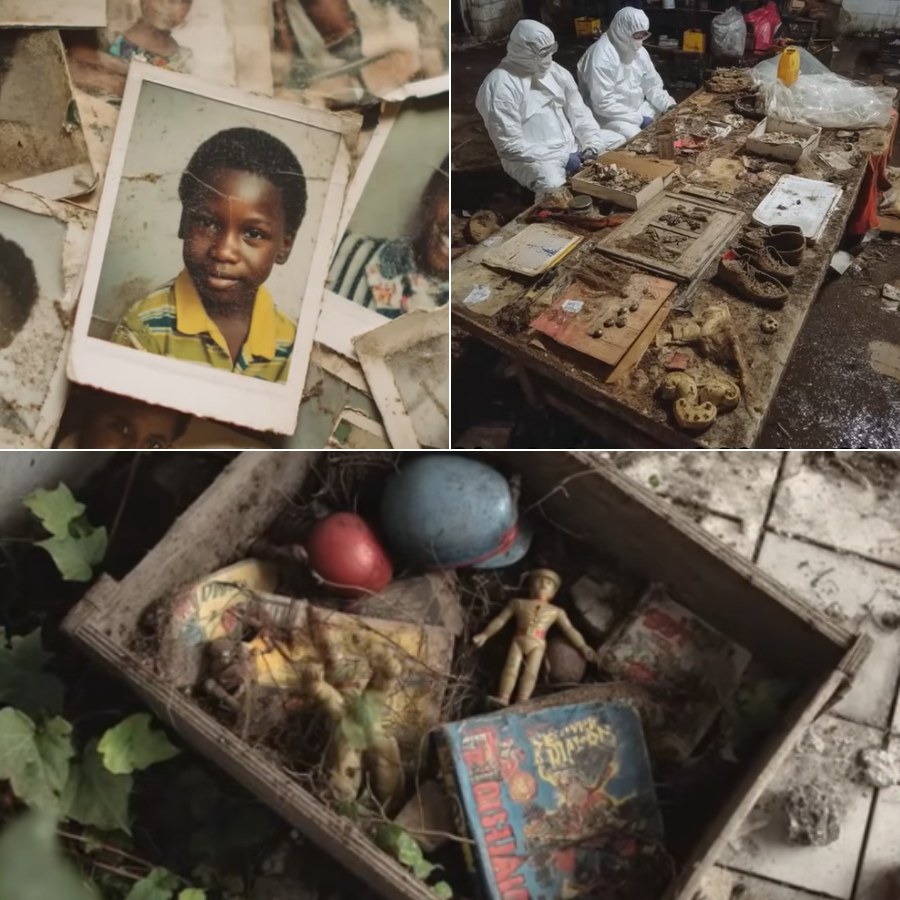
The summer heat had a way of settling over Atlanta like a heavy hand, pressing into the skin, slow and relentless. That year—1979—it came early and stayed late, turning the air thick and hard to breathe. In the Black neighborhoods south of downtown, the heat clung to cracked sidewalks and narrow streets lined with shotgun houses, to rusted fences and basketball hoops nailed crookedly above garage doors. It shimmered over the asphalt where kids played hopscotch and dodgeball, the chalk lines already faint under a hundred scraped sneakers.

On one such street, three blocks from a tired little playground with peeling blue swings and a dented slide, Isaiah Thomas walked home from the late shift at the textile mill, his work shirt damp with sweat and the smell of cotton dust clinging to his skin. He was thirty-two, solidly built, his shoulders permanently squared from years of lifting, hauling, and supervising others who did the same. His hands were big, calloused things, but they were gentle when they touched his son’s face, careful when they smoothed the collar of a school shirt or ruffled a stubborn curl.
Most evenings, the sound that greeted him as he turned onto his block was the same: a burst of laughter, high and bright, and the thud of sneakers on the cracked sidewalk as Malik barreled toward him like a small comet.
“Daddy!”
Every time, Isaiah’s heart did the same thing—it lifted, rose against the anchor of his own tiredness, and he would bend, arms opening, bracing for the impact of that ten-year-old body slamming into his chest.
That summer, the ritual was unchanged. But other things had begun to shift, so subtly at first that the adults only felt it like a faint vibration underneath the normal rhythm of their days.
A boy down on Auburn Avenue was late coming home from the corner store. A girl from over near the old rail yard didn’t make it to choir practice. A mama down the street paced her porch until two in the morning because her son wasn’t in his bed. There were police reports, the usual murmured reassurances from the officers: “Kids roam around, ma’am. He’ll turn up. She probably with friends.”
The first flyers went up in grocery store windows and on church bulletin boards—grainy black-and-white photos photocopied at the library, names spelled carefully, ages underlined. Someone taped one to the telephone pole at the end of Isaiah’s street. He’d paused to read it, his lunchbox in his hand, his brow furrowing.
“Another one,” he’d said to Sarah that night as they lay in bed, the window fan clacking as it pushed around warm air.
“I know,” she’d whispered. “Sister Louise mentioned it at prayer meeting. They say the police ain’t doing much.”
Isaiah had turned onto his side to look at her in the dim glow from the streetlight outside. Sarah’s face, once round with easy laughter, was more serious these days, lines etching themselves slowly into the corners of her eyes.
“It’s probably like Officer says,” he’d murmured, half believing it himself. “Kids get ideas, wanna run, think they grown. They come back when they see the world don’t care ‘bout ’em like home does.”
Sarah had stared at the ceiling. “Maybe,” she’d said. “But it feels wrong, Isaiah. Feels…off.”
It was a feeling she couldn’t quite name—a prickle at the base of her neck, a wrongness in the way the mothers spoke to one another now. Their voices sounded like stretched fabric, ready to tear.
On a sweltering Tuesday in late July, the air so thick it felt like a wet blanket laid over the city, Malik came running into the kitchen where Sarah was washing dishes. He was all elbows and knees, forever in motion, his hair a halo of tight curls, his eyes bright and restless.
“Ma, can I go to the playground?” he asked. His hands were already on the door frame, his body leaning away, as if his question was only a formality and the rest of him had already started running.
Sarah turned, wiping her hands on a towel. “Who you going with?”
“Derrick and T-Ray,” Malik replied. “We gonna see who can jump off the swing from the highest.”
“You better not break your neck trying to be a fool,” Sarah scolded, though her mouth twitched. “What I tell you about them swings?”
“Don’t stand up and lean back,” he recited, rolling his eyes.
“Mm-hmm. And what else?”
“Be back before the streetlights come on.”
“And?”
“And don’t talk to nobody I don’t know. Not even if they got ice cream or a dog or whatever.”
“Good.” She walked over and caught his chin in her fingers, forcing his eyes fully to hers. “You hear me, Malik? Don’t let nobody get you off that playground. You get that uneasy feeling in your belly, you listen to it, you hear? You come home.”
“I will,” he said, wriggling free, impatient. “Can I go now?”
Sarah hesitated for half a second, that old nameless prickle at the back of her neck surfacing. But she looked at him—her boy, who’d been good about his rules, who never stayed out late, who loved drawing superheroes more than he loved anything else—and she nodded.
“Go on,” she said. “But you better be back before them streetlights even think about flickering.”
“I will!” Malik yelled, already halfway out the door. “Bye, Ma!”
She watched him go, his skinny legs pumping, his T-shirt darkened with sweat between his shoulder blades. At the gate, he turned and waved once, a quick flick of his hand, then vanished up the block toward the playground.
Sarah went back to her dishes, humming under her breath. After a while she dried her hands and went into the small room Malik called his “studio,” smiling at the chaos he left behind. Pages covered in pencil sketches littered his desk and the floor—towering skyscapes with bridges and flying cars, heroes with capes that spread like wings, villains with angular faces and complicated gadgets. He had a way of filling the page until no corner was empty, like he was afraid of leaving blank space.
On one wall, a crooked row of his favorite drawings hung from tape: a hero with his own face, a city that looked like their neighborhood but gleaming and clean, a family standing together on a hill, the father’s hand resting on the son’s shoulder. She touched that last picture with the tips of her fingers, tracing the drawn outline of Isaiah’s jaw.
The fan hummed. Somewhere outside, a dog barked, a car backfired, a child laughed. It was all so ordinary that when the first sliver of unease slid into Sarah’s stomach hours later, she almost swatted it away like a fly.
The sun drooped low, painting the row of houses in amber. The streetlights buzzed, flickered, then blinked to life one by one. Sarah glanced at the clock above the stove and frowned. Malik should have come barreling through the door fifteen minutes ago, breathless, asking what was for dinner, begging for a second helping.
She went to the porch, wiping her damp hands on her dress. The air had cooled slightly, but the humidity still sat heavy on her chest. She stared down the block in the direction of the playground. Kids were still outside, lingering in the last scraps of light, but Malik was not among them.
“Malik!” she called, cupping her hands around her mouth. Her voice carried, but no answering shout came. A few neighbors on their porches glanced over, then went back to their conversations.
Maybe he’s with Derrick, she thought. Maybe they stopped at the store. Maybe.
She walked up the street, the hem of her dress brushing her calves, her heart beating a little faster. At the playground, the swings creaked in a lazy breeze, chains complaining softly. Two little girls were sliding down the metal slide, squealing. Derrick and T-Ray were nowhere to be seen.
“Y’all seen Malik?” she asked the girls.
They shook their heads, all wide eyes and shy silence.
Sarah’s gaze swept the ground, irrationally expecting to see some obvious clue: his sneakers, his backpack, his favorite red cap. All she saw was litter—a crushed juice box, a candy wrapper, an empty chip bag fluttering near the fence. She stepped closer to the swings, reached out and touched one chain. It vibrated under her fingers like it still remembered the weight of someone.
A buzzing noise started low in her ears and grew. She hurried to Derrick’s house, then to T-Ray’s. Both boys were home, already in for dinner.
“Yes, ma’am, we was playing,” Derrick told her, eyes dropping to the floor. “But Malik left before us. Said his mama was gonna get mad if he ain’t get home quick.”
“What time?” Sarah asked. Her voice didn’t sound like her own.
“’Fore the lights came on,” Derrick said. “Maybe…forty-five minutes ago?”
Sarah’s stomach turned to ice.
By the time Isaiah came home that night, his work boots dragging, his shirt clinging to his back, the house felt wrong. It was too quiet. The sound of the fan in the living room, of the clock ticking in the kitchen, seemed unnaturally loud.
He pushed open the front door and felt it immediately—that tension, like a wire drawn tight and humming.
“Sarah?” he called. “I’m home.”
She appeared from the hallway, her face ashy, eyes bright in a way that scared him.
“Malik ain’t home,” she blurted, before he could even set down his lunchbox.
Isaiah’s mind took a strange detour. For a split second, he pictured Malik simply asleep in his bed, or sneaking in the backyard, working on a secret drawing. But then the words settled. Ain’t home.
“What you mean?” he asked slowly.
“He went to the playground. He ain’t come back.” Her hands trembled as she gestured; he saw then that she still held the dish towel she’d been twisting for who knew how long. “I done walked the whole neighborhood. Talked to all his little friends. Nobody seen him since before the streetlights came on.”
He stepped past her into Malik’s room, as if his son might materialize if only he looked hard enough. The bed was made, the pillow dented from the night before. The superheroes on the wall stared back at him, frozen mid-flight.
Isaiah turned back to her, and something inside his chest squeezed so tight he could hardly breathe.
“Call the police,” he said.
They came—eventually. Two officers, one younger, one older, uniforms smelling faintly of cigarettes and coffee. They took notes, asked questions.
“When exactly did he leave the house?”
“Who was he with?”
“Was he upset about anything? School? Friends? Y’all been arguing?”
Isaiah answered through gritted teeth, fists clenched on his knees. Beside him on the couch, Sarah sat rigid, her hands clasped so tightly in her lap that her knuckles stood out white.
“He don’t run off,” Isaiah kept saying. “He ain’t that kind of boy. You hear me? Something happened to him.”
Captain Frank Brody arrived later, his presence announced by the subtle straightening of the younger officers’ shoulders. He was in plain clothes, his badge clipped to his belt, his tie loosened around a neck that had seen too many late nights and too much liquor. He listened to Isaiah’s story with weary patience, nodding at the right moments, his eyes scanning the modest living room.
“Mr. Thomas,” he said at last, voice gravelly from years of barking orders and barking into radios, “most kids his age, they get turned around in the summer. Lose track of time. Try to stay out longer with their friends. We see this kind of thing a lot. Nine times out of ten, they walk back through that door in the morning, sheepish, with some story ’bout staying at a friend’s house.”
Isaiah stared at him. “He ain’t most kids,” he replied, each word sharp. “He know better than to stay out all night. He got school in a few weeks. He know we don’t play that.”
“I understand you’re worried.” Brody held up a hand, as if fending off Isaiah’s rising anger. “We’ll put out a bulletin. Keep an eye out. I can have a squad car do an extra patrol of the area tonight. But at this point he’s not been gone that long. We don’t want to cause a panic when it’s likely he’s just…taken a detour.”
“A detour?” Sarah’s voice cracked on the word. “He is ten years old. Ten. My baby don’t take detours. Someone took him.”
Brody’s eyes flicked to her, then away. For a fleeting second, irritation crossed his face—how many times, his expression seemed to say, have I seen this? Kids disappearing only to show up after we’ve used half the department’s manpower searching for them. But he smoothed it over quickly, resuming his practiced calm.
“We’ll look into it,” he said. “If he ain’t turned up by morning, we’ll escalate. You got my word.”
Isaiah wanted to believe him. Wanted to trust in the weight of that badge, in the authority it represented. But underneath the captain’s words there was a hollowness, like a drumbeat heard from far away.
After the officers left, Isaiah did not sit. He went back out into the night with a flashlight and a stack of hastily made flyers, the ink still drying. He called Malik’s name down alleys and into abandoned lots, his voice growing hoarser as the hours stretched. Garbage bins, behind bushes, under porches—he checked them all with a dread he couldn’t name, every shadow a threat.
By dawn his legs were rubber, his eyes burning. Sarah lay on the couch, too wrung out to cry anymore, clutching Malik’s favorite T-shirt to her chest. The house smelled like stale coffee and fear.
Malik did not come home that morning. Or the next. Or the next.
The pattern that had once been deniable now roared to the forefront of the city’s consciousness. Another missing child. Another. The number crept upward, quietly at first—three, five, eight. Flyers multiplied. The faces on them were mostly Black, mostly from the same grid of neighborhoods, though different blocks, different corners, different playgrounds.
There was a rhythm to the days now in those neighborhoods—a strange, grief-struck choreography. Mothers counted their children every time they stepped outside. Fathers walked them to school and back again, eyes scanning the street like soldiers on patrol. Kids who once roamed freely now stayed close to their porches, darting nervous glances at slow-moving cars.
The police fielded calls, took reports. They interviewed neighbors and teachers, checked bus schedules and school attendance records. But fewer than the parents wanted, more than the captain considered necessary. They were understaffed, they said. Overworked. The city had other problems—drugs, gangs, robberies that made headlines, that brought political pressure. And there was, though no one wrote it down, an unspoken calculation made in the halls of power: which victims mattered enough to devote scarce resources? Which neighborhoods could be allowed to police themselves?
In community centers and church basements, the parents gathered. Under fluorescent lights that buzzed faintly, folding chairs arranged in anxious circles, they traded stories. Their words overlapped, the details echoing one another in chilling ways.
“Yes, ma’am, my boy was just going to the store.”
“Last time I seen her, she was on the corner with her jump rope.”
“He don’t run off. He ain’t ever done that.”
Isaiah sat among them, Malik’s school picture in his hand. It was a small, glossy rectangle that had already begun to curl at the edges from being clutched and pressed and shown to strangers. His son’s smile—wide, slightly crooked—seemed almost accusatory now. Where were you when I needed you, Daddy?
He pinned flyers to bulletin boards, to telephone poles, to the walls of the laundromat where women watched their clothes spin with dull, haunted eyes. He spoke to anyone who would listen, and many who didn’t want to.
“Twenty-eight,” someone said in December, when a light dusting of snow made the city look softer than it was. “They say twenty-eight kids gone.”
“God have mercy,” an older woman whispered, crossing herself.
Twenty-eight. The number sat heavy in Isaiah’s mind like a stone dropped in deep water. Twenty-eight names that he knew now, first and last, learned the way he’d once memorized box scores and mill shift schedules. Twenty-eight faces, each with their own smile, their own quirks, all blending into a single anguished chorus.
The city’s mood shifted with each new disappearance. What had been a low murmur of concern became a hissed anger, a shouted accusation. Protests were organized, calling for more resources, for federal involvement. News vans, slow to arrive at first, finally rolled into the neighborhoods they’d previously ignored, cameras capturing tearful mothers clutching photos, pastors thundering from church steps.
City leaders convened a task force under intense public pressure. Press conferences were held, with glossy posters of missing children lined up like gravestones behind the podium. Captain Brody stood under harsh TV lights, sweat gleaming at his temples, and spoke of “all available resources” being used, of “coordinated efforts” and “leads that are being actively pursued.”
Isaiah listened to these statements with a bitterness that tasted like metal in his mouth. At the precinct, he’d been given the runaround more times than he could count.
“We’re doing what we can, Mr. Thomas.”
“We got nothing solid yet.”
“We have other cases too, you understand.”
He understood too well. He understood that when children from more affluent neighborhoods went missing, entire departments mobilized. Calls went out to federal agencies. The news coverage was relentless, the pressure suffocating. Here, in his part of the city, it seemed as if his son and the others had vanished into a void where urgency moved slower and concern was rationed.
That winter, the first snowflakes that drifted down onto the city’s roofs and streets brought no sense of calm. Behind closed doors, families huddled around radios and television sets, hoping for news that rarely came. Isaiah sat at his kitchen table late into the nights, the lamp casting a pool of yellow light over stacks of newspaper clippings. He had begun to cut and collect every article related to the missing children, no matter how small.
He bought a binder—then another, then another. Each child got a section. A picture. A name written in careful block letters at the top of a page. Any detail he could gather: where they’d last been seen, what they’d been wearing, what their teachers said about them. It was a strange ritual, part coping mechanism, part vow.
“If they won’t put it together,” he muttered to himself one night as he slid another article into a plastic sleeve, “then I will.”
Sarah watched him from the doorway, her arms wrapped around herself despite the warmth from the stove.
“You can’t fix this, Isaiah,” she whispered. “You can’t fix this with paper.”
“I ain’t trying to fix it,” he replied without looking up. “I’m trying not to let ’em disappear twice. First from the streets, then from people’s minds.”
She didn’t argue. She just nodded once and turned away, going to Malik’s room, where she sat on his bed and inhaled the faint, fading scent of him from his pillow.
Time, which had once moved like a steady stream, fractured. Days blurred. Weeks collapsed into one another. Christmas lights went up and came down. Children still living opened presents; their parents watched them with a gratitude tinged with guilt. Isaiah went to work when he could, his body moving through the motions of supervising machines and men while his mind stayed in 1979, trapped in loops of what-ifs.
The years that followed did something cruel. For the city at large, the pain of that summer and winter began to dull, the sharp edge worn down by new crises, new fears. The headlines moved on. The task force, once trumpeted from podiums, slowly lost funding, then staff, then official priority. Politicians changed. Brody retired, his file on the missing children gathering dust in storage.
For the families, nothing faded. Their grief did not dissipate; it simply changed shape, becoming a low, constant ache they carried like an extra limb. They learned how to move through grocery stores without breaking down at the sight of their child’s favorite cereal. They learned how to answer the question “How many kids you got?” with careful evasions. They learned how to smile in photos where one person was always missing.
Sarah did not learn how to live with it. Not really. The woman who once sang at the top of her lungs while frying chicken on Sunday afternoons began to speak less and less. She slept fitfully. Some days she forgot to eat. The doctors talked about stress, then about depression, then about her weakened immune system, as if her body had decided the world wasn’t safe anymore and was slowly retreating.
One bleak winter eight years after Malik disappeared, Isaiah held her hand in a hospital room that smelled of antiseptic and resignation. Machines beeped quietly. Snow gathered on the window ledge outside. The city had moved on to the late ’80s, to new skyscrapers and new mayors, but for Isaiah, time circled back again and again to that summer night.
“Did you find him?” Sarah asked once, her voice a dry rasp, eyes glassy with medication.
“No,” Isaiah whispered, throat thick. “Not yet.”
She turned her head toward him, and in that moment some of the fog cleared from her gaze. He saw the woman he’d married at nineteen, the girl who’d danced with him on their block at a neighborhood barbeque, the young mother who’d laughed until she cried when Malik’s first word was “no.”
“Keep looking,” she said. “For him. For them.” Her fingers squeezed his with surprising strength. “Don’t let ’em forget our babies, Isaiah. Promise me.”
“I promise,” he said.
She died a week later.
After the funeral, after the casserole dishes had been returned and the last sympathetic neighbor had squeezed his shoulder and said something they thought comforting, Isaiah sat alone at his kitchen table. Malik’s binders were stacked neatly in front of him. He reached out and opened the one with his son’s name on it. Under the first plastic sleeve—Malik’s school picture—he slipped in the obituary clipping with Sarah’s photograph.
“Y’all stay together,” he murmured, voice breaking, “at least on this page.”
Their daughter, Imani, left for college soon after. She loved her father fiercely, but the house had become a mausoleum, each room echoing with ghosts. Her leaving broke something in Isaiah and healed something else; he wanted her free, wanted her to live a life not entirely defined by a brother she barely remembered and a mother consumed by grief. They talked on the phone, sometimes for hours, her voice a tether that kept him from drifting too far into his own darkness.
Meanwhile, the city kept reshaping itself. Old factories closed, their hulking skeletons left behind in forgotten industrial corridors. New businesses rose downtown. The neighborhoods where the twenty-eight had vanished changed slowly, then abruptly—storefronts boarded up or painted fresh, houses renovated or demolished, playgrounds replaced with parking lots.
The one where Malik had disappeared went first. Isaiah watched as bulldozers tore up the swings, the slide, the patch of grass where his son had once raced his friends. In its place came a rectangle of cracked asphalt and numbered spaces.
“Just like that,” he muttered, standing across the street with his hands shoved in his pockets. “Like it never happened.”
He went home and added a new page to Malik’s binder—an old photograph of the playground, taken one summer by a neighbor, taped next to a grainy newspaper picture of the fresh parking lot. Underneath, he wrote in careful black ink: THEY ERASED THE PLACE BUT NOT THE MEMORY.
By 1999, Isaiah was fifty-two. His hair had thinned and gone mostly gray, his back ached on rainy days, his hands trembled slightly when he held a coffee cup. But his mind was sharp, and his vow to Sarah still burned with undimmed intensity.
He had become, without meaning to, an archivist of tragedy. The spare bedroom of his small house was now a makeshift library. On the shelves, twenty-eight binders, each with a name on the spine, stood shoulder to shoulder like headstones living in plastic and paper. On the wall was a map of the city, worn at the edges, with small colored pins marking where each child had been last seen.
Sometimes, at three in the morning when sleep eluded him, Isaiah would stand in front of that map, eyes passing from pin to pin as if reciting a rosary. He could walk the city in his mind, tracing paths along streets that no longer existed in their old form.
“They tried to forget you,” he’d murmur to the pins, to the binders, to the ghosts. “But I didn’t.”
He visited the precinct periodically. The officers changed. New faces behind the front desk, new detectives assigned to cold cases. Some treated him with patience, some with annoyance, some with that particular blend of pity and discomfort reserved for people whose pain made others feel guilty.
“Any news on the ’79 cases?” he’d ask.
“Nothing new, Mr. Thomas. They’re…they’re cold.”
He hated that word. Cold, like something put away in a freezer, like the feelings around those cases had been deliberately chilled to make them easier to handle. For him, nothing about it was cold. It was all fire in the blood.
Then came the autumn of 1999, gentler than usual. The summer heat lifted its hand early, and cool breezes wandered down the streets. People spoke of the new millennium like it was a door opening, promising fresh starts, new possibilities, all that talk of Y2K and computers crashing half a world away from his quiet house.
On the south side of the city, in an industrial zone nobody had bothered to beautify for decades, a crew of city contractors gathered around a chain-link fence topped with barbed wire. Beyond it stood the old Acme Consolidated Textiles warehouse, a hulking brick relic whose windows were mostly broken, jagged teeth of glass catching the weak autumn light.
“Can’t believe they finally tearing this old thing down,” one of the workers, Jimmy, muttered, stamping his boots against the morning chill.
“Cost more to keep patching it up, they say,” his partner Earl replied, adjusting his hard hat. “City wanna put in some fancy lofts or some mess. You know how it is. Knock down what we had, build something for somebody else.”
Inside, the air was thick with dust and the smell of mold. Pigeons fluttered out of the rafters when the crew stepped in, their wings sending flakes of old paint drifting like tired snow.
Their job wasn’t glamorous—hazardous material assessment, structural clearance, inventory of anything that might be of value before the bulldozers came. They picked through piles of scrap metal and old wooden pallets, shined flashlights into corners where rats skittered away.
By mid-morning, Earl and Jimmy had made their way to a ground floor section marked on the old blueprint as administrative offices. What they found instead looked more like a collapsed cave. Sections of the ceiling had come down long ago, burying desks and filing cabinets under heaps of brick and plaster.
“Smells like death in here,” Jimmy grumbled, pulling his dust mask up higher.
“Everything smell like death in this place,” Earl shot back, though his own nose wrinkled. He wedged his crowbar under a cracked beam and pried. Bricks tumbled, clattering to the floor.
As the debris shifted, something unexpected emerged: the edge of a steel surface, dull with rust, precise where everything else was broken.
“What the hell?” Jimmy crouched, brushing away crumbling mortar. “This ain’t on the plans.”
They cleared more rubble, revealing a door—a heavy, steel-reinforced slab set into what should have been an exterior wall. There was no handle, no lock, no obvious way to open it, just a spiderweb of blackened lines along the edges.
“Looks welded,” Earl said slowly. “Like somebody didn’t want nobody going in there.”
“Or out,” Jimmy replied, forcing a laugh that died quickly.
Protocol demanded that they stop and call the foreman, who in turn called the works department, who in turn notified the police. It was the kind of bureaucratic relay that usually took days to produce results. But someone in the chain understood that sealed, hidden doors in long-abandoned buildings could mean legal liability, or something worse, and the response came faster than usual.
That afternoon, under a sky that had begun to cloud over, a small caravan arrived: two police cruisers, a fire department truck with cutting equipment, a city inspector in a tired suit. They gathered around the discovered door like doctors around a mysterious wound.
The fire crew ignited their torches, the hiss of gas and flare of blue-white flame filling the stale air. The steel glowed, then softened, the welded seams reluctantly surrendering to the heat. The smell of burning metal mingled with something else, something older and less definable, seeping out in faint wisps whenever the torch cut through another section.
When at last the door groaned and swung inward, the first officer to step forward froze. The beam of his flashlight pierced darkness and sliced into a narrow corridor, just wide enough for one person at a time. The walls were concrete, close and sweating with decades of trapped air.
“Jesus,” someone muttered behind him. “It’s like a tomb.”
They followed the corridor to another door, this one wooden, swollen slightly from age but unlocked. An officer reached out and pushed.
The room beyond had no windows. Its ceiling was low, its walls bare. But it was full—full of shelves, makeshift constructions of old crates and planks, all arranged with care. And on those shelves lay objects that stopped every breath in the room.
A small teddy bear with one eye missing, its remaining button eye staring accusingly. A set of plastic blocks in primary colors, a few pieces scattered on the floor as if knocked over by impatient hands. A red toy car, chipped and scratched, its paint dull with dust but still recognizable. A baseball cap with a frayed brim. A dress with a pattern of tiny flowers, faded but still sweet.
Beside each item, propped carefully, were photographs. Some were standard school pictures, kids smiling awkwardly in front of generic backgrounds. Others were clearly snapshots: a boy on a battered bicycle, a girl blowing out birthday candles, siblings wrestling on a worn couch. Each photo did what photos always do—it froze a moment of life. And in that room, those preserved moments felt like ghosts.
On a table in the center of the room rested several thick notebooks, their covers plain and utilitarian. A detective with twenty years on the force, who had seen more than his share of awful, picked one up with hands that trembled despite himself.
He opened to the first page. Lines of cramped, sweeping handwriting marched across it. Names. Descriptions. Dates. Locations. Notes written with an obsessive attention to detail.
“Call it in,” he whispered. “Call everybody.”
News of the discovery did not stay contained for long. Something like this had its own momentum, slipping through official channels, leaking into conversations, finding its way to eager ears. By the end of the week, the city pulsed with rumors.
A secret room. Children’s things. Records.
In his small house, Isaiah was making himself instant coffee, staring at Malik’s binder, when the phone rang. He almost didn’t pick up; half the calls he got these days were wrong numbers or telemarketers. But something—habit, a flicker of intuition—made him grab the receiver.
“Hello?”
“Mr. Thomas?” The voice on the other end was unfamiliar, masculine, calm. “My name is Captain Rhodes. I’m calling from the police department. We’ve…we’ve had a development in the 1979 missing children cases.”
Isaiah’s knees drained of strength so suddenly he had to sit. He clutched the receiver with both hands.
“What kind of development?” he managed, though his throat felt packed with cotton.
“There’s been a discovery at an old warehouse. Items recovered that may relate to multiple victims, including your son. We’d like to meet with you as soon as possible.”
Isaiah didn’t remember the rest of the conversation in clear order. He remembered words—warehouse, belongings, records—but they floated, disconnected from any coherent narrative. When he hung up, his hand shook so badly that he had to set the receiver down twice before it settled correctly on the cradle.
He sat there for a long time, staring at the phone, listening to the quiet of his house. Part of him had expected this moment for years; another part had convinced him it would never come.
When he finally stood, he went to Malik’s room. The superheroes on the wall had faded at the edges, the tape yellowing. Dust lay on the desk where Malik’s pencils still sat in an old mug. Isaiah stood in the doorway, afraid of disturbing anything, as if his son had just stepped out for a moment and might burst back in if everything remained as it was.
“Looks like they found something, boy,” he said softly. His voice cracked. “Don’t know if I’m ready for what it is.”
The next days were a blur of meetings and sterile rooms. The warehouse had been sealed as a crime scene; families were not allowed inside, only shown photographs of items recovered.
In a conference room, Isaiah sat at one end of a long table, while across from him detectives laid out pictures. Their faces were set in careful neutrality, expressions they’d practiced, the ones meant to say: we are professionals, but we care.
“We believe this may be related to your son,” said one—a man in his forties with a close-cropped haircut and sad eyes. “My name is Detective Vincent Holloway. I’m leading the task force on this.”
Isaiah didn’t respond at first. His gaze had locked on the image closest to him: a red toy car, tiny on the glossy photo paper, its paint chipped in a very particular way along one side. Malik had once dropped it down the stairs and cried when it dented.
His breath hitched. “That’s…that’s his,” he whispered, one fingertip hovering just above the photo, afraid to touch it, as if he might smear the past.
“There’s also this.” Holloway slid another picture forward. A comic book, the cover worn, a hero in a bright costume bursting through an explosion, the edges curling from use. “We found it on the same shelf.”
“That’s his favorite,” Isaiah said. He couldn’t see the room for a moment. All he saw was Malik on his stomach on the living room carpet, flipping those very pages, narrating the action aloud in a dramatic voice.
Holloway let the silence sit for a bit, then spoke again, gently. “Mr. Thomas, I also wanted to ask you for something else. I’ve been told you’ve kept quite an archive related to the 1979 cases.”
Isaiah blinked, dragged back to the present. “My binders,” he said.
“Yes, sir. Your binders.” There was no condescension in Holloway’s voice, only a strange respect. “We could use your help. Whoever did this, they kept records.” He tapped the image of a notebook on the table. “Ledgers. We’re going through them now. But you…you know these kids. Where they lived, who their people were. That knowledge could be invaluable.”
Isaiah looked up slowly. In Holloway’s face he saw something he had not seen often in uniforms: recognition. Not pity, not discomfort, not impatience. Recognition that he, Isaiah, was more than just a grieving father in the file—he was a repository of information they needed.
“I’ll help,” Isaiah said. “Any way I can.”
The task force took over a floor of a downtown building, setting up a command center that hummed with a kind of electric tension. Whiteboards covered in timelines and names lined the walls. Maps with color-coded pins were pinned up next to blown-up photocopies of ledger pages.
The ledgers themselves—faded, their pages brittle at the edges—were treated like sacred texts, handled with gloves, copied carefully. Analysts hunched over them, deciphering the cramped handwriting, transcribing, underlining, circling.
Isaiah found himself a corner of the room with a table and a stack of copies. He spent hours there, a bottle of water untouched at his elbow, Malik’s binder open beside him. Whenever he saw an initial or description that nudged a memory, he would lean toward Holloway or one of the analysts.
“This here,” he’d say, tapping a line with his pen. “‘Boy, 9, skinny, left eye slightly lazy, last seen near peach-colored house by the laundromat.’ That sound like Booker Washington’s boy, James. They lived in a peach house right off Candler.”
“Can you mark that?” an analyst would ask, pushing a sticky note toward him.
Isaiah would write down the full name, the address, anything he could recall. Sometimes he had to stop, close his eyes, breathe through the rush of grief that came with remembering these children not as entries on a page but as real people who had once run past him on the sidewalk, who had once shared cookies at church picnics with Malik.
The ledgers were clinical and deranged all at once. Some entries read like surveillance reports:
“Subject: male, approx. 10. Pattern: walks alone from school to corner store 3x week. Weakness: lingers to look at comic books in window. Family: mother works evenings, sister sporadic supervision.”
Others veered into something more florid:
“The small one in red jacket moves like a bird, quick darting motions, eyes always scanning. There is a particular fragility to him, as if the world has not yet imprinted its full weight. Beautiful.”
Isaiah wanted to throw up when he read those. Sometimes he had to stand, step away, go down the hall and splash cold water on his face.
“They talk about our babies like they collections,” he muttered one day, hands gripping the sink. “Like they stamps or butterflies.”
Holloway joined him later in the break room, leaning against the counter. “That’s exactly how it looks,” he said quietly. “Whoever kept those ledgers…it’s like a catalog. A record of acquisitions.”
“They call him anything yet?” Isaiah asked, his voice flat. “This…whoever.”
“Among ourselves?” Holloway nodded. “We’ve been calling him the Keeper.”
Isaiah huffed a bitter breath. “Keeper of what? Pain?”
“Souvenirs,” Holloway said. “Moments. Control.” He paused. “But he slipped. He thought welding that room shut would hide it forever. He thought nobody would ever knock that building down. Time caught up.”
As the weeks went on, a picture began to form, faint at first, then clearer, like a photograph developing in a tray of chemicals.
The Keeper had known the neighborhoods well. His entries referenced specific corners, specific fences, specific dogs that barked at trespassers. He knew the rhythms of families—who worked double shifts, who left their kids with older siblings, which churches let children walk home alone after Sunday school.
He was patient. Some entries described watching a child for weeks before making any move, noting patterns and waiting for the right combination of vulnerability and opportunity.
The linguists brought in to analyze the writing noted certain peculiarities: old-fashioned turns of phrase, a formal way of referencing things, hints of biblical or moralistic language. They suggested the writer might be from a particular generation, perhaps someone who’d grown up in a very religious household, possibly Southern born and raised.
The historians Holloway consulted about the strange symbol that appeared in the margins of some pages—an interlocking design like a stylized compass—eventually traced it back to an obscure fraternal organization that had once had a lodge in the city. The group had disbanded decades earlier, its building turned into a parking deck, but membership records survived in basement archives and dusty boxes.
One afternoon, Holloway spread photocopies of those membership rolls across the table next to the map and the ledgers. Names stared up at him in faded type.
“Looking for a needle in a haystack,” one of his colleagues murmured.
Holloway shook his head. “Nah. We got magnets now.”
He circled the years 1975–1980. The organizations had been dwindling, their membership older, mostly men who belonged to a certain generation and demographic. Among the names, one caught Isaiah’s eye as he passed by with a cup of coffee.
“Hold up,” Isaiah said, setting the cup down. He bent closer, squinting. “That one. Arthur…Lee…Covington.”
“You know him?” Holloway asked, alert.
“Not personally,” Isaiah said. “But I know the name. He used to run some kinda delivery outfit back in the day. White guy, kinda quiet. Had a truck with his name painted on the side: ‘Covington Courier.’ I remember ’cause he used to be all over the neighborhood, dropping off boxes at stores, at the church, at people’s houses who ordered stuff. You know, before the big companies took over.”
Holloway’s gaze shifted to the map. “If he had a delivery route that covered these areas…” He traced lines with his finger. “He’d have reason to be everywhere we’ve got pins.”
They dug further. Old business licenses confirmed Covington’s company, now long defunct. City directories placed him at an address not far from the warehouse in ’79. Employment records, where they could find them, painted a picture of a man who kept mostly to himself, paid his bills, never raised much attention.
Fiber analysis from the warehouse yielded another thread. The twine used in some of the macabre arrangements on the shelves—a toy car carefully tied to a block, a schoolbook wrapped like a gift—came from a particular type of industrial cord. Only a few businesses in the city had purchased it in bulk during the mid-’70s. Covington’s delivery company was one.
The more they looked, the more the strands converged on that name.
He was still alive. Living just outside the city in a small, overgrown property he’d purchased in the early ’80s, right around the time the disappearances had ceased. No wife in recent records, no children, no close family listed. A ghost of a man who’d never had a reason to come to police attention.
Surveillance began. Isaiah wanted to be there when the team first set up across from Covington’s property, but Holloway, after some debate with his superiors, only allowed him a limited view. They showed him photographs instead: a narrow, sagging house, paint peeling, surrounded by trees that had been allowed to grow wild.
“He tends his yard?”
“Only just enough not to get cited,” an officer said. “No neighbors close enough to complain.”
They watched Covington come and go. He moved slowly, the stiffness of age in his joints, but there was a sharpness to his gaze when he scanned his tree line that made the hair on the back of one officer’s neck stand up.
“He’s still looking around like he’s hiding something,” the officer muttered.
They obtained a warrant. On the day they went in, the sky was low and gray, the air heavy.
Isaiah stood in the makeshift staging area a block away, feeling out of place among the tactical vests and radios, but also feeling, for the first time in twenty years, that he was standing at the threshold of something more solid than hope.
“You sure you want to be here?” Holloway asked quietly.
“No,” Isaiah said. “But I need to be.”
The entry team moved with practiced efficiency. They knocked hard, announced themselves. There was a delay, then the shuffle of footsteps, then the door creaked open on a chain.
An old man’s face peered out: pale, sagging, eyes surprisingly alert. “Yes?” he said, voice mild.
“Mr. Covington?” Holloway stepped forward, badge visible. “We have a warrant to search your property.”
Covington blinked once, slowly. His gaze moved from the badge to the officers behind Holloway, to the distant figure of Isaiah standing beside a patrol car. Something—almost like recognition—flickered in his eyes.
“Well,” he said. “I suppose you’re rather late.”
The calmness of it unsettled even the veteran officers.
They secured him without incident. No struggle, no shouting. He allowed himself to be led to a chair at his kitchen table, hands cuffed in front of him, watching as strangers moved through his house.
It was neat. Too neat. Surfaces clear, books arranged by size and color, a faint antiseptic smell under the usual old-house must. There were no photographs on the walls, no mementos. The place felt like a hotel room where someone had lived for years but never really settled.
They found the locked door in the basement almost immediately. It was a simple wooden thing, but the lock was sturdy, newer than the door itself.
Inside was a room that echoed the one in the warehouse, scaled down. Shelves lined the walls, though these held fewer items—less a museum than a chapel. A girl’s hair ribbon. A marble. A baseball card. Some of the objects were clearly old, saved from the ’79 era. Others were newer, more recent. A plastic bracelet from a fair. A Pokemon card.
On the desk sat a typewriter, its keys well-used. Next to it, a lined notebook lay open, the ink fresh on the last page. The handwriting was the same as in the ledgers.
“Subject: male, approx. 8, walks home from bus stop alone. Too much space between him and the house. Pattern repeats. The parents trust the distance more than they should.”
Holloway stared at that sentence, a cold fury sliding through him.
“He never stopped,” he said.
They collected the notebook, the typewriter, the items, each tagged and bagged. Upstairs, Covington sat, their movements reflected in the dull surfaces of his eyes.
Holloway sat across from him at the kitchen table for the first interview. Isaiah, by agreement, remained just outside the room, listening through the crack in the door.
“Mr. Covington,” Holloway began, tone even, “we’ve found items in your home that match evidence from a major crime scene. We’ve also connected you to a warehouse where children’s belongings were stored alongside detailed records. You understand what that implies?”
Covington smiled faintly, a small twist at the corner of his mouth.
“You found my work,” he said.
“Your work,” Holloway repeated, fighting to keep his voice flat.
“That’s what it is,” Covington continued. “No one cared about those neighborhoods. Children flitting about like leaves, no one paying proper attention. I noticed. I preserved what would otherwise have been lost.” He looked momentarily offended. “You call it something else. Evil. Monster. But I brought order to chaos.”
Isaiah, outside the door, dug his fingers into the doorframe until his knuckles ached. He wanted to burst in, to shout, to wrap his hands around that fragile throat. But he stayed rooted, struggling to hear every word.
“Did you write these ledgers?” Holloway asked, sliding a photocopy of a page across the table.
Covington’s eyes traveled over it, softened almost. “Of course. Took years to keep them properly. A life’s work.”
“Why keep the children’s belongings?” Holloway pressed.
Covington tilted his head. “You’re a detective, are you not? Don’t you keep files? Records? You like to look back, see the pattern. Understand.”
“What happened to the children?” Holloway asked. The question was blunt, cruel, necessary.
“Gone,” Covington said lightly. “The moment is what mattered.”
Over hours, over days, he talked in circles. He admitted to being the Keeper without using the word, admitted the ledgers were his, admitted to taking children without ever using the word “kidnap.” He referred to them as “subjects,” “instances,” “events.”
He never expressed remorse. At most, he seemed mildly annoyed they’d interrupted the continuation of his observations.
The ledgers, combined with his admissions and the physical evidence from the warehouse and his home, gave prosecutors a spine to build cases on. They followed the clues in the journals to remote patches of woods and forgotten riverbeds where, with cadaver dogs and ground-penetrating radar, they found shallow graves stained into the earth twenty years earlier.
Not all the twenty-eight were located. The earth kept its secrets, the river swallowed evidence beyond retrieval. But some children were brought home, in the only way that was now possible.
In a lonely copse of trees off a service road Isaiah had never driven before, forensic teams unearthed remains that matched Malik’s age and size. His confirmation did not come from sight—nothing was recognizable in that way—but from dental records and, eventually, from DNA.
Sitting in a quiet room with Holloway beside him, Isaiah listened as a medical examiner walked him through the findings.
“We’re as certain as modern science can be,” she said gently.
Isaiah nodded. He felt empty, like someone had scooped out his insides and left only a husk. He had imagined this moment so many times that the reality felt both surreal and anticlimactic.
“Can I see him?” he whispered.
The bones lay neatly arranged on a metal table, a puzzle completed. Isaiah stood at the doorway, unable to take a step closer. Instead, he gripped the frame, his vision swimming.
“I’m here,” he said, voice breaking. “I’m here, son. Took me twenty years, but I’m here.”
He wept then, not the wild, shaking sobs of the night Malik disappeared, but a quieter, deeper thing. Hardly any sound came out at all; his body simply folded in on itself, finally surrendering to a grief that had been held in suspension for two decades.
The trial of Arthur Lee Covington began the following year, in a courtroom packed beyond capacity. Families filled the benches, their faces a mosaic of sorrow, anger, and wary hope. Reporters jostled for space in the back. Sketch artists moved their pencils quickly over pads to capture a man whose face had already been plastered across newspapers and television screens.
Covington sat at the defense table, thinner than before, his hair whiter, but his posture upright. He watched the proceedings with an air of detached curiosity, as if he were an observer at a lecture rather than the focal point of a city’s righteous fury.
The prosecution laid out its case methodically. They presented the ledgers, the items from the warehouse, the artifacts from his home, the fiber connections, the business records, the fraternal lodge rosters, the forensic analyses. Experts testified about his handwriting, his patterns, his movements.
Parents took the stand, one after another, recounting the worst days of their lives. Their stories were different and the same; the details varied, but the arc was identical: a routine day, a child’s promise to return, a sunset that turned into a nightmare that never ended.
When Isaiah’s turn came, he walked to the witness chair with a slowness that had nothing to do with age and everything to do with the weight he carried. He sat, the courtroom lights bright on his lined face, and looked briefly at the jury, at the judge, and finally, briefly, at Covington.
Their eyes met. Isaiah expected to feel a surge of murderous rage, but what he felt instead was something colder and more vast—a kind of stunned recognition of the depth of emptiness that could live in a human being.
“Mr. Thomas,” the prosecutor said gently, “can you tell the court about your son Malik?”
Isaiah’s hand tightened on the edges of the witness chair. He drew a breath.
“Malik was ten,” he began. “He liked drawing more than anything. Superheroes mostly. Cityscapes. He used to tell me he was gonna make his own comic books one day.” He paused, swallowing hard. “He laughed loud. You could hear him up and down the block. He was…light. That’s what he was. Light in our house.”
He spoke of the day Malik disappeared, of the search, of the years that followed. He spoke, briefly but with a devastating calm, of the warehouse, of the toy car and the comic book, of the day they told him they’d found bones.
Then the prosecutor laid a photocopy of a ledger page in front of him, protected in plastic.
“Do you recognize anything on this page?” he asked.
Isaiah looked down. His eyes tracked the lines of text, then stopped.
“Subject: MT. Male, 10. Lives on Maple Street. Walks to playground three blocks away after school. Returns home to mother before dark. Observations suggest particular resilience. Beautiful line to the neck. Promising acquisition. Must wait for optimal moment.”
Isaiah’s jaw clenched. His hand shook as he pointed to the initials.
“That’s him,” he said, his voice rough. “That’s my boy. That’s how this man wrote about him. Like he was some…object.”
“Do you believe this entry refers to your son Malik?” the prosecutor asked, though everyone in the room already knew the answer.
“Yes,” Isaiah replied. His eyes flashed, and he finally turned his full gaze on Covington. “You watched him,” he said, directing his words at the defendant now, though the judge shifted uneasily. “You watched my boy. You knew my wife trusted him to be three blocks away and back. You knew I was at work, trying to put food on that table. You wrote about his…his neck like a line on a painting.” His voice broke, then hardened again. “You took him, and you wrote in your little book like it was some damn art project.”
The judge banged his gavel once. “Mr. Thomas, direct your responses to the attorneys, not the defendant.”
Isaiah nodded slowly, tearing his gaze away from Covington. “Yes, Your Honor.”
The defense tried to poke holes where they could. They argued that the ledgers were “fantasies,” that there was no direct witness to the abductions. They suggested the items in the warehouse could have been “collected” after the fact, that Covington was an obsessive, not a murderer.
But the weight of the evidence was too great. The patterns too consistent. The remains in the ground and the objects on the shelves and the words on the pages formed a net from which there was no escape.
The jury deliberated for less time than many expected. When they returned, the courtroom held its breath.
“On the charge of murder in the first degree…” the foreperson read, voice steady.
“Guilty.”
“On the charge of kidnapping…”
“Guilty.”
“On the charge of…”
Each word fell like a stone.
Covington showed no visible reaction. If anything, he looked bored. It was Isaiah who reacted instead—not with a cheer, not with relief, but with a long, shuddering exhale, as if a band around his chest had been slightly loosened.
The judge, expression grave, read out the sentence: life imprisonment without the possibility of parole, multiplied across counts until it might as well have been an eternity.
When it was over, when the courtroom emptied, when reporters shouted questions that he ignored, Isaiah stepped outside into the thin sunlight. The city around him buzzed with traffic and voices and cell phones and all the modern sounds of a world that had moved on without him. For a moment, he felt unmoored.
Holloway joined him on the courthouse steps. They stood side by side, the detective’s suit rumpled, Isaiah’s shoulders slumped but unbroken.
“It’s done,” Holloway said.
“Is it?” Isaiah asked. His voice was not bitter, just tired.
“As much as it can be,” Holloway replied.
Isaiah nodded slowly. “I thought I’d feel…different.”
“How do you feel?”
Isaiah looked out at the city—the buses, the people, the distant outline of the skyline that had grown taller since 1979.
“Quieter,” he said after a moment. “Like…like a machine they left running in the back of my mind finally shut off.” He paused. “But Malik’s still gone. Sarah’s still gone. All them kids, all them years…no sentence changes that.”
“No,” Holloway said. “It doesn’t.”
They stood in silence for a while longer. Eventually, Isaiah turned to the detective.
“Thank you,” he said simply.
Holloway shook his head. “You helped us,” he replied. “We should’ve listened sooner. Should’ve listened in ’79.”
In the months that followed, the city grappled with that precise truth. There were official reviews of the 1979 investigations. Committees convened, reports drafted. Words like “systemic bias” and “resource allocation failures” appeared in dry fonts on thick paper.
Captain Frank Brody, now a tired old man with a stoop, was pulled reluctantly back into public view. He sat before a panel and answered questions about why certain leads hadn’t been followed, why parents’ concerns had been dismissed, why the disappearances hadn’t been connected sooner.
He spoke of understaffing, of a different era’s understanding of serial crime, of political pressure that had pushed other priorities. Some of what he said was true. None of it felt like enough.
Outside official circles, the conversations were harsher, more honest. In barbershops and beauty salons, on church steps and front porches, people said what they’d always known.
“If them kids had been from Buckhead, they’d have brought in the damn army.”
“They ain’t care ’cause it was us. Our babies. Our streets.”
“Twenty-eight kids, and they shrugged. You can’t tell me that ain’t about race and money.”
Isaiah did not attend the hearings. He had spent enough years banging his head against those walls. Instead, he focused on something else.
In the room that had once been Malik’s, the binders still stood in their neat row. Some now had an extra page: the location where remains had been found, the date of burial. Others remained stubbornly incomplete, their endings blank.
Isaiah looked at them and knew that his task, the one Sarah had pressed into his hands with her last strength, was not finished. The city had been forced, finally, to remember. Now someone had to make sure it never forgot again.
He worked with other parents, with pastors and advocates, to create a small foundation—nothing fancy, nothing rich, but determined. They lobbied for changes in how missing children’s cases were handled, especially for children of color and those from poor neighborhoods. They pushed for automatic escalations, for faster media alerts, for better communication between agencies.
When reporters called—sometimes years after the trial, whenever another child went missing and someone wanted an “angle”—Isaiah would sit at his kitchen table and talk. Not for long, not always willingly, but he talked. He told them about Malik’s laughter, about the binders, about the warehouse. He told them that, as far as he was concerned, the story didn’t end with a guilty verdict.
“This ain’t just about one man,” he’d say into the receiver. “It’s about a city that didn’t listen until it was too late. You wanna honor my boy and all the others? Don’t make the same mistake again.”
He visited Malik’s grave regularly. It was a modest stone, nestled in a row of others at a cemetery on the edge of the city. The first time he saw Malik’s name cut into marble, his knees had gone out from under him. Over time, the sight brought a different kind of pain, one he could almost bear. There was comfort, in a warped way, in having a place to stand and speak.
He would bring fresh flowers, sometimes the wild kind that grew by the roadside, sometimes the store-bought bouquets that felt too stiff and bright. He’d sit on the grass, knees popping if he stayed down too long, and talk.
“Imani got promoted,” he’d say. “She doing good. You’d be proud.”
or
“Remember that red car you liked? I still got it. They gave it back to me after the trial. Sits on my dresser. I look at it when I don’t know what else to look at.”
He told Malik about the kids at the community center who now had ID kits and lesson sessions about safety, about the posters in police stations reminding officers that “Every Missing Child Matters,” about Holloway coming by for coffee sometimes, both of them older now, their bodies slower but their minds stubborn.
“Lot of things ain’t changed,” he’d admit. “World still got monsters. But maybe now…maybe folks will look harder when the first one goes missing. Maybe they’ll listen when mamas say, ‘Something wrong.’”
He never remarried. There were women who cared about him, who offered comfort in their own ways, but his life felt too full of ghosts to invite anyone in that deep again. He had his work, his binders, his occasional visits from Imani and her kids—grandchildren who climbed into his lap and asked, very carefully, about the uncle they’d never met.
“Was he funny?” they’d say.
“Funniest.”
“Did he like cartoons?”
“He liked drawing ’em more than watching ’em.”
In the quiet moments, when the house was still and the clock ticked steadily, he’d sometimes hear the echo of a boy’s laughter in his mind, bright and flashing, just outside his field of vision.
He knew, now, where Malik’s last steps had taken him. He knew the face and the twisted mind of the man who had watched from the shadows. He knew, in a way that still made his stomach knot, how close the predator had been all along.
But he also knew something else—that a father’s refusal to forget had helped crack a code in old notebooks, had helped give shape to a monster hiding in plain sight. That his stubborn grief, which had once felt like a useless burden, had become a tool. That the twenty-eight children of 1979 were no longer just whispers in certain neighborhoods; their story had become part of the city’s narrative, a cautionary tale and a demand.
On the twentieth anniversary of Covington’s conviction, the city dedicated a small memorial in a park not far from where Malik had vanished. It wasn’t the old playground—that had long since been lost to asphalt—but a newer space where children climbed and swung under their parents’ watchful eyes.
The memorial was simple: twenty-eight stylized figures carved into a curved wall, each representing a child, their silhouettes facing toward the playground. Below them, an inscription:
FOR THE CHILDREN WE LOST IN 1979
MAY WE NEVER AGAIN BE SILENT
Isaiah stood before it with Imani on one side and Holloway on the other, his grandchildren weaving in and out of their legs, not fully understanding but sensing the gravity in the air.
He raised a hand and touched the cool stone, fingers resting on one of the small carved figures.
“Hey, boy,” he murmured under his breath. “You got friends here now. Folks know your names.”
The wind shifted, carrying the shrieks and laughter of children across the grass. For a moment, the sound hurt. Then, unexpectedly, it soothed.
Because that was what they had fought for, in the end. Not just justice for what had been done, but the right for children to shout and run and play without disappearing into a void of indifference. For their laughter to be a soundtrack of life, not the opening note of a tragedy.
Isaiah closed his eyes briefly, the sun warm on his face, and let the sound wash over him. It did not erase the past; nothing could. But it braided itself into his memories, the bright threads of now weaving through the dark strands of then.
After all the binders, after the warehouse and the ledgers and the courtroom, what remained was simple and stubborn: a father’s love stretched across time, refusing to let silence have the last word.