What You’re Looking At
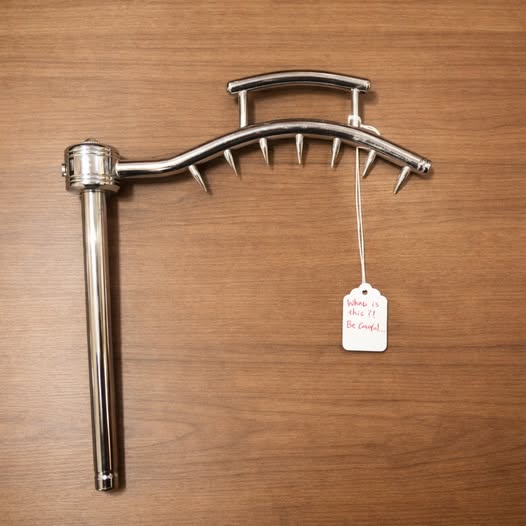
This item is best described as an adjustable roast/ham holder (meat clamp) mounted to a carving board—a purpose-built serving and carving station designed to secure a roast, ham, turkey breast, or large joint of meat while you slice it.
Common Names
- Roast holder / roast clamp
- Ham holder / ham carving board
- Meat carving board with spikes
- Carving board with adjustable spike grips
- Carving station (mid-century style)
How It’s Built (Based on the Photos)
- A hardwood carving board with a juice groove and carved well to catch drippings
- An upright stainless (or chrome-plated) post that mounts into/onto the board
- A horizontal arm with multiple sharp downward spikes to pin the meat
- A height/position adjustment mechanism so the spike bar can be raised, lowered, or repositioned
- Side handles/rails for lifting and serving

Primary Purpose and Why It Exists
The core function is simple: stop the roast from sliding while you carve.
Key benefits:
- Stability: the spikes anchor the meat so it won’t rotate or skid
- Cleaner slicing: steadier meat means more even, thinner slices
- Safety: less chance the knife slips because you’re not chasing a moving roast
- Less mess: the board’s channel and recessed area help collect juices and drippings
How It’s Used (Step-by-Step)
- Mount/lock the upright post into the board (or confirm it is firmly seated).
- Place the roast/ham on the board in the carving well.
- Lower the spiked bar so the spikes press into the top of the meat.
- Adjust the bar so it holds firmly—secure, not crushed.
- Carve slices while the meat remains pinned in place.
- Raise the bar to reposition for the last slices, if needed.
When This Type of Tool Became Popular
While carving aids have existed for a long time, this board-mounted, adjustable spike-grip style is most strongly associated with mid-20th-century home entertaining, especially roughly the 1950s–1970s. That period saw a surge in specialized serving tools meant to make hosting look effortless and refined.

Who Created It (Inventor / Maker)
There is no single universally credited inventor for “the carving board with adjustable spike grips.” Instead, it appears to be an evolved design combining:
- older butcher-style meat clamps and holding forks, and
- household carving boards with juice wells,
into one integrated “carving station.”
In practice, many versions were produced by different manufacturers (often without prominent branding on the clamp itself), so the “creator” is typically a manufacturer or design house, not one famous individual—unless a stamped mark or label is present on the metalwork or underside of the board.
Typical Foods It Was Made For
- Ham (especially baked/holiday hams)
- Rib roast / beef roast
- Pork loin
- Turkey breast and other large poultry portions
- Any roast that tends to roll or slide as it’s sliced
Care and Handling Notes
- The spikes are sharp by design: handle by the bar/handle, not the points.
- Hand-wash and dry promptly to protect the wood and prevent metal spotting.
- Condition the wood periodically with a food-safe oil to reduce drying and cracking.
- Store with the spike bar raised (or covered) to avoid accidental contact.
Why Collectors Like Them
- Distinctive mid-century “host” aesthetic (wood + polished metal)
- Practical, display-worthy, and conversation-starting
- Often made in heavy, durable materials meant to last decades