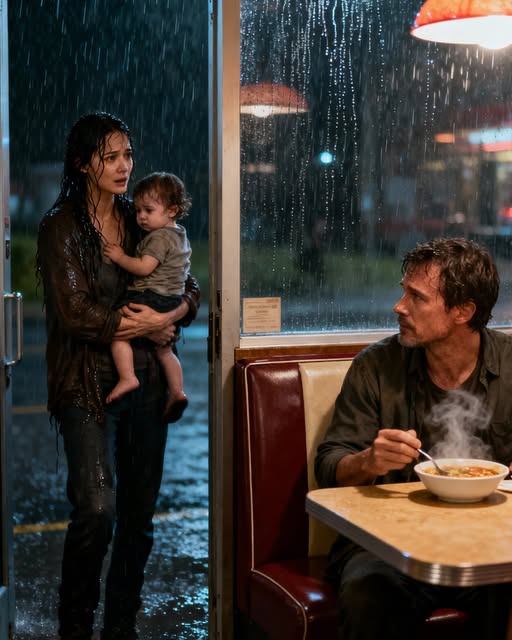
Single Dad Thought He’d Eat Alone — Until a Mother Said, “My Son’s Hungry, Can We Stay a While?
PART 1: THE EMPTY SEAT
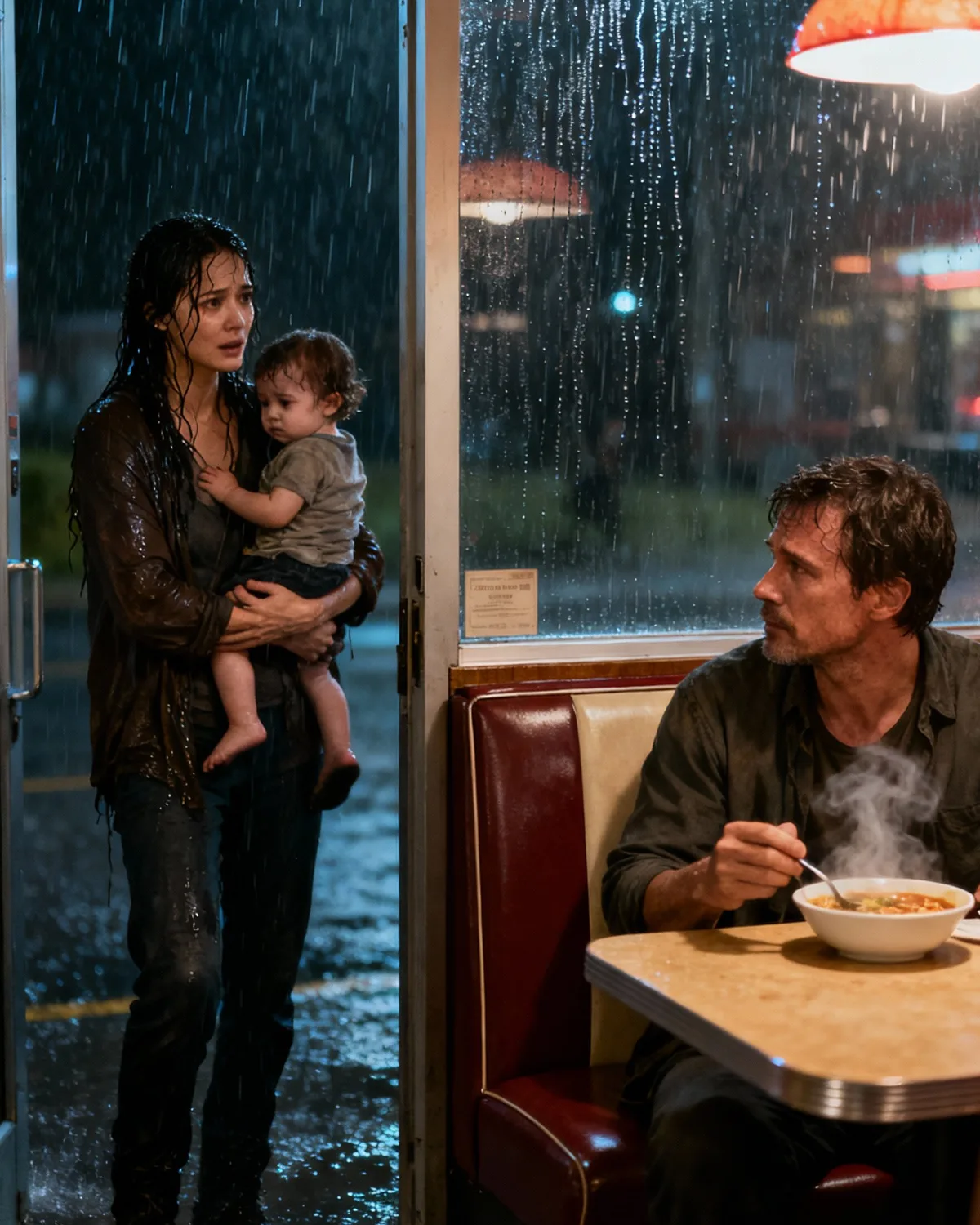
The diner on Maple Street had been standing longer than most of the people who still remembered why it mattered.
Forty years of burnt coffee, squeaky vinyl booths, and regulars who didn’t need menus. Tom Hayes knew that because he’d grown up inside those red booths—back when his own father would bring him in on Saturday mornings, smelling like motor oil and aftershave, promising pancakes if Tom behaved.
Now, at fifty-three, Tom sat in the same place by the window.
Only this time, the seat across from him was empty.
It was a Tuesday evening in late autumn, the kind where the sky turned purple too early and streetlights flickered on before anyone felt ready. Rain tapped softly against the glass, blurring the neon pharmacy sign across the street into pink and blue smears.
Tom wrapped his hands around his coffee mug, letting the warmth seep into his palms.
Earlier that night, he’d picked up his son Lucas from his ex-wife’s place. Their custody schedule was precise—every other week, no flexibility—but tonight had gone sideways fast. Lucas had gone quiet in the car. Pale. Warm to the touch.
By the time they reached Tom’s apartment, the boy was burning with fever.
Tom had done what he always did. Called the pediatrician. Gave medicine. Tucked Lucas into bed with his favorite stuffed bear—the one missing an eye—and sat there longer than necessary, watching his chest rise and fall until the fear eased just enough to breathe.
“Probably just a virus,” the doctor had said. “Rest and fluids.”
So Tom came to the diner alone.
He’d ordered the meatloaf special—Lucas’s favorite—planning to take it home in case his son woke up hungry. He’d ordered pot roast for himself. And apple pie. Because eating alone in a diner felt less hollow than eating alone in an apartment that still echoed with the life he used to share.
Diane brought his coffee without a word.
She’d worked here since Tom was in high school. She didn’t ask where Lucas was. Some questions didn’t need answers.
Tom stared out at the rain, thinking about his son curled up in too-big sheets, and felt the familiar weight settle on his shoulders.
Three years since the divorce.
Three years of learning how to braid hair from YouTube. Of missing soccer games that fell on the wrong weekends. Of loving his kid fiercely—and still feeling like he was always one step behind life.
The loneliness crept in on nights like this.
Not loud. Not dramatic.
Just heavy.
The bell above the door chimed.
Tom glanced up without thinking.
A woman stood just inside the entrance, shaking rain from her coat. Dark hair pulled back loosely. Tired eyes. The kind of face that hinted at beauty worn down by responsibility rather than age.
She looked around the diner.
It was nearly empty—Tom by the window, an elderly couple near the back, a truck driver at the counter nursing black coffee.
In her arms, she carried a small boy. Maybe three years old. Blond hair. Big eyes far too serious for someone so young.
Tom watched her shoulders sag.
She whispered something to the child. He nodded.
They moved toward a booth near the door, but the woman didn’t sit. She stood there, scanning the menu on the wall with an expression Tom recognized immediately.
He’d worn it himself once.
The look of someone quietly calculating what they could afford.
Diane approached her, order pad ready. Tom couldn’t hear the words, but he saw the woman shake her head. Say something brief. Diane nodded and walked away.
The woman set the little boy down on the bench. He leaned into her instantly, gripping her sleeve like an anchor.
She wrapped an arm around him and stared out into the rain.
Tom’s food arrived.
Perfect meatloaf. Thick gravy. Mashed potatoes piled high. The pot roast smelled like his grandmother’s kitchen. The apple pie waited patiently, ice cream melting at the edges.
Tom picked up his fork.
Then stopped.
He remembered his father’s voice from years ago, rough and steady.
You don’t need to fix the whole world, Tom. But if you can make one person’s day a little easier—well, that matters.
Tom stood up.
His heart beat faster, the way it always did when he stepped beyond comfort and into uncertainty. He lifted the meatloaf plate and crossed the diner.
The woman looked up, wary but polite.
“Sorry to bother you,” Tom said gently. “I ordered this for my son, but he’s sick at home. It’s just going to go to waste.”
He held out the plate.
“I thought… maybe your boy’s hungry.”
For a moment, she just stared.
Tom almost pulled back.
Then the little boy’s eyes locked onto the food.
“Mama,” he whispered. “I’m hungry.”
Something in the woman’s face cracked—just for a second.
“That’s… very kind of you,” she said, voice catching.
“Please,” Tom said quickly. “Diane’s been making this recipe for forty years. It’d be a crime to throw it out.”
She nodded.
“Thank you.”
Tom set the plate down—and then surprised himself.
“I’ve got way too much food over there,” he said. “And I hate eating alone. If you’d like… you’re welcome to join me.”
He smiled, a little awkward.
“I’m Tom. Completely harmless. Just a dad missing his kid.”
The woman studied him. Careful. Measuring.
“I’m Grace,” she said finally. “This is Eli.”
“Nice to meet you,” Tom said. “The booth by the window’s the best seat.”
Grace hesitated.
Then she gathered their things and followed him.
And just like that, an empty seat wasn’t empty anymore.
PART 2: THE SPACE BETWEEN STRANGERS
Grace slid into the booth slowly, careful not to wake Eli too much. The vinyl seat creaked under their weight. Tom noticed how she positioned her body instinctively—half turned toward her son, one arm resting protectively along the back of the seat, as if the world might still try to take something from her if she looked away too long.
Eli climbed up onto the seat, still clutching his little toy car. He stared at the meatloaf as though it might vanish if he blinked.
“Go on,” Grace murmured. “Say thank you.”
“Thank you,” Eli said softly, then waited.
Grace cut the meat into small pieces before handing him the fork. Only when he took the first careful bite did she let herself breathe.
His entire face changed.
Not dramatically. Not loudly.
Just a small widening of the eyes. A satisfied hum.
“It’s good,” he said seriously. “Really good.”
Grace smiled—a real smile, not the tired one she’d worn when she walked in. Tom felt something loosen in his chest.
He nudged his own plate toward the center of the table.
“Please help yourself. There’s plenty.”
Grace hesitated, then took a small bite of the pot roast. She closed her eyes for half a second, like someone remembering something they hadn’t had in a long time.
“This is… amazing,” she said quietly. “Thank you. Truly.”
Tom waved it off. “It’s just dinner.”
Grace shook her head. “It’s not just dinner to us.”
They ate in a comfortable silence for a moment. Not awkward. Just gentle. The rain tapped steadily against the window, and the diner hummed softly around them.
Diane appeared, refilling Tom’s coffee and setting a glass of milk in front of Eli without being asked. She glanced at Grace and gave her a small, kind nod—the kind women give each other when they recognize exhaustion without explanation.
“How old is your son?” Grace asked.
“Seven,” Tom said. “Lucas. He’s got a fever tonight.”
“That’s hard,” Grace said. “Being away from him when he’s sick.”
Tom nodded. “I only get him every other week. Nights like this are rough.”
Grace studied him for a moment, then looked down at Eli.
“I was married once,” she said. “Eli’s father left when he was a baby. It’s just been the two of us ever since.”
“That can’t be easy.”
She gave a small laugh. “Some days are fine. Some days feel like climbing a hill with no top.”
Tom understood that kind of honesty.
“Today looks like one of the harder days.”
Grace exhaled slowly, as if deciding whether to tell the truth.
“My car broke down this morning,” she said. “I had to take the bus to work. Left Eli with a neighbor. By the time I picked him up, it was late—and I realized I’d left my wallet at home. All I had was bus fare.”
She stopped herself, embarrassed.
“I’m sorry. I don’t know why I’m telling you this.”
“Because sometimes it helps to say it out loud,” Tom said gently. “And because I’ve been there.”
He didn’t rush. Didn’t interrupt.
“After my divorce,” he continued, “there were nights I ate peanut butter sandwiches so Lucas could have new shoes.”
Grace looked at him then—really looked at him.
Recognition passed between them. Quiet. Immediate.
“It gets better,” Tom said. “Not all at once. But you find a rhythm. And your son—he’s going to remember that you showed up. That you kept going.”
Grace swallowed hard.
“Sometimes I worry I’m not doing enough.”
“You’re here,” Tom said. “You’re feeding him. You’re protecting him. That’s not ‘not enough.’ That’s everything.”
Eli yawned, a huge, dramatic yawn that made Grace laugh despite herself. He leaned against her, eyes heavy.
“Someone’s tired,” she said, brushing his hair back.
Tom caught Diane’s eye and quietly asked her to box up the remaining food. When she returned, he slid the containers toward Grace.
“For later,” he said. “Or tomorrow.”
Grace stared at them, tears welling.
“You don’t have to—”
“I know,” Tom said. “But I want to.”
She wiped her eyes.
“I don’t know how to thank you.”
“You already did,” Tom replied. “You stayed.”
They talked a little longer—about work, about kids, about how places like this diner were disappearing. About nothing important and everything that mattered.
When they stood to leave, Tom insisted on paying.
At the door, Grace turned to him.
“Thank you,” she said. “For the food. And for treating us like people.”
“You are people,” Tom said. “Good ones.”
Grace smiled—a smile that made her look lighter.
As she stepped into the rain with Eli asleep against her shoulder, Tom felt something warm settle in his chest.
Not hope.
Something quieter.
Belonging.
PART 3: WHAT REMAINS
Life didn’t change overnight.
It almost never does.
The next morning, Tom woke to the sound of his alarm and the pale light of dawn pressing through the blinds. Lucas was already awake, sitting up in bed, color back in his cheeks, clutching his stuffed bear like a trophy.
“No fever,” Tom said after checking him. Relief loosened something tight in his chest.
“Can we have pancakes this weekend?” Lucas asked.
Tom smiled. “Absolutely.”
He packed lunches, tied shoes, dropped Lucas off at school. He went to work. He graded papers. He attended meetings that felt longer than necessary. From the outside, nothing looked different.
But something was.
It showed up in the quiet moments.
When Tom stood at the sink washing dishes that evening, he found himself thinking about Grace’s voice. The way she’d said it’s not just dinner to us. The way Eli had waited before taking his first bite, as if hunger had taught him manners more carefully than comfort ever could.
Tom returned to the diner the following Tuesday.
Same booth. Same waitress. Same menu.
He didn’t expect to see Grace and Eli again. He knew better than that. Lives intersect briefly. People pass through each other’s days like weather.
But still—he looked.
They weren’t there.
He felt a small pinch of disappointment, quickly swallowed by reason. Maybe they were busy. Maybe things had improved. Maybe they’d simply gone somewhere else.
He hoped—quietly—that things were easier for them.
Weeks passed.
Autumn deepened into winter. The trees shed their leaves. Lucas started practicing for the school holiday play. Tom volunteered to help with set design, gluing cardboard stars late into the evening while other parents chatted nearby.
One night, as Tom tucked Lucas into bed, the boy said, “Dad?”
“Yeah, buddy?”
“That little kid at the diner… Eli. Is he okay?”
Tom paused.
“I think so,” he said honestly. “I hope so.”
Lucas nodded, satisfied. “You were nice to him.”
Tom swallowed. “So were you.”
That winter, Tom began doing small things differently.
He tipped a little more when he could. He lingered instead of rushing away. He asked how people were—and waited for the answer.
He didn’t tell the story about the diner. Not to friends. Not to coworkers. It felt too personal, like something fragile that didn’t belong to an audience.
Some moments aren’t meant to be repeated. They’re meant to be lived.
Spring came quietly.
One afternoon, months later, Tom was walking home from the grocery store when he saw a woman across the street struggling to manage a stroller and a bag of groceries at the same time.
He crossed without thinking.
“Need a hand?” he asked.
She hesitated—then nodded.
Afterward, she thanked him like it mattered. And maybe it did.
Because kindness works that way. It spreads not loudly, but steadily. Like roots under soil.
One rainy evening, Tom returned to the diner with Lucas.
They slid into the booth by the window.
“Dad,” Lucas said, pointing. “That’s where the little kid sat.”
Tom smiled. “Yeah. It is.”
Diane brought their food and poured coffee. She paused, glanced at Tom, then said softly, “You know… that night? You did a good thing.”
Tom shrugged gently. “It didn’t feel big.”
She nodded. “Those are usually the ones that matter most.”
They ate. They talked. Lucas laughed with his mouth full and Tom pretended to scold him, just like his own father used to do.
And somewhere—not far away, he hoped—Grace and Eli were doing the same. Eating dinner. Laughing. Surviving. Growing.
Tom never saw them again.
But sometimes, when the diner door chimed and rain streaked the windows just right, he half-expected to look up and see them standing there—tired, hungry, hopeful.
And maybe that was the point.
Not every connection is meant to last forever.
Some are meant to remind us who we are.
That a single meal can mean safety.
That a stranger’s table can feel like refuge.
That being human—really human—doesn’t require fixing a life.
Just sharing space.
Just staying a while.
And on the nights when Tom felt the old loneliness creeping back, he remembered his father’s words, and added one of his own:
You don’t have to change the world.
But you can change someone’s evening.
And sometimes… that’s enough.
THE END