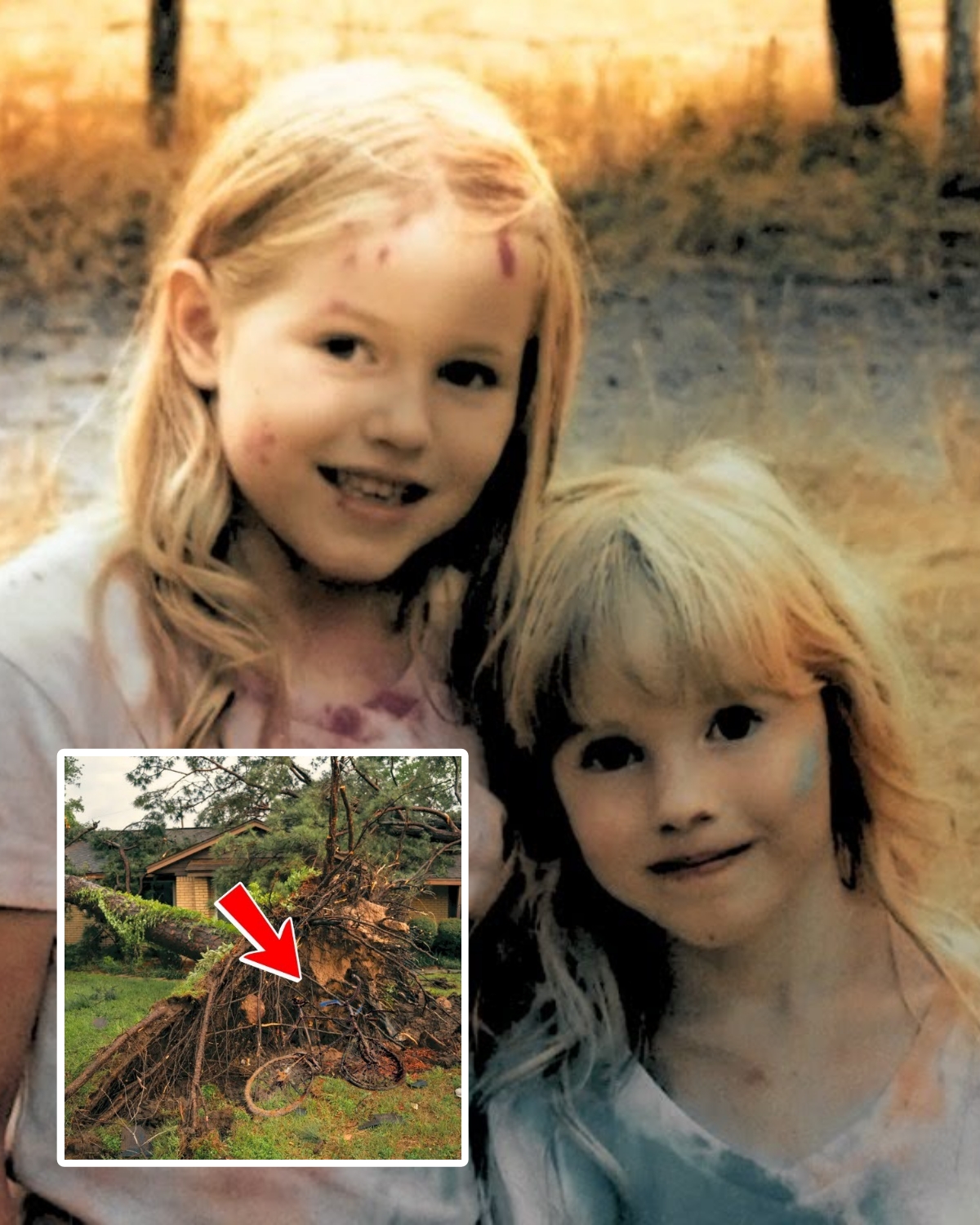
The wind did not merely blow through the town of Oakhaven in March of 2024; it screamed. It was a visceral, predatory howl that clawed at the siding of houses and bent the power lines until they hummed with the tension of a violin string about to snap. For three days, the sky was the color of a fresh bruise, dumping a deluge of rain that turned the local river into a churning, coffee-colored beast.
When the storm finally broke, it left behind a silence so absolute it felt heavy, like a physical weight pressing against the eardrums. The air was thick with the scent of ozone, shredded pine, and the raw, mineral smell of wet earth. Along the swollen riverbank, a sentinel had fallen—a massive, ancient oak that had stood for over a century. Its roots, now ripped from their dark sanctuary, twisted into the damp air like the gnarled fingers of a giant reaching for a god that had abandoned it.
A cleanup worker named Elias, clad in a mud-splattered neon vest, was the first to see it. He had been clearing the smaller branches with a chainsaw when he caught a glimpse of something that didn’t belong to the forest. It was a flash of pale, sickening pink wedged deep within the root ball, choked by clay and rotting leaves.
Elias knelt, the mud soaking through his work pants. He brushed away the debris, expecting trash—a discarded soda crate or a piece of farm equipment. Instead, he found a ghost.
It was the rusted frame of a child’s bicycle. The white paint on the fenders was dulled by decades of burial, and the handlebar grips were cracked and brittle, resembling sun-bleached bone. But it was the star-shaped stickers, clinging stubbornly to the metal despite twenty-three years in the dark, that made the air leave Elias’s lungs.
Every person over the age of thirty in Oakhaven knew that bike. It had been the pride of eleven-year-old Haley Mercer—a birthday gift she had ridden with the reckless exuberance of a child who believed summer was an eternal state of being.
Elias straightened, his breath hitching as he looked toward the river. The current was still high, tugging at the bank as if trying to reclaim what the oak had coughed up. He called for his supervisor, his voice sounding thin and fragile in the vast, post-storm quiet. Within the hour, a small crowd of workers and local volunteers had gathered at the yellow tape. They stood in a semi-circle, their murmurs low and jagged.
“That’s the Mercer girl’s bike,” whispered a woman, clutching her raincoat to her throat.
The words didn’t just drift; they cut. They moved through the group like a cold front, turning the humid afternoon into a winter’s chill. This wasn’t just debris. It was a relic of a wound that Oakhaven had tried to stitch over with silence and time.
In the summer of 2001, the disappearance of Haley Mercer and her fourteen-year-old sister, Brooke, had been the only thing that mattered. The town had been a fever dream of flashlight beams, barking bloodhounds, and the hollow, rhythmic thud of helicopters. Hundreds had marched through the brambles; thousands of candles had melted onto the pavement of the town square. But the girls had simply… evaporated.
The posters had eventually yellowed and peeled. The FBI agents had packed their bags. The official file had been moved to a metal cabinet labeled Cold, where it sat for two decades, gathering dust while the Mercer family gathered ghosts.
Now, as the bike was carefully extracted, its rusted chain dangling like a broken limb, the town felt the first stitch pop. The fallen oak had given up the soil, but it had also surrendered a secret. The mystery wasn’t just buried in the earth; it was buried in the people. And the storm had just started the unearthing.
Clare Donovan sat at her kitchen table, her fingers tracing a chip in the rim of a mug filled with cold coffee. The radio on the counter was a low hum of static and local news, but the announcer’s voice had just spiked, sharp enough to pierce her thoughts.
“…discovery made by cleanup crews near the Blackwood River…”
Clare’s gaze drifted to the window. Across the street, the old Mercer house stood like a tombstone, its siding graying, its windows staring blankly at a world that had moved on. In 2001, Clare had been nineteen, a girl on the cusp of a life she hadn’t yet figured out. She remembered that final morning with a clarity that felt like a haunting.
The sun had been a white-gold fire on the pavement. She had been washing her car when the sisters wheeled past. Brooke had been in the lead, her long brown hair a silken banner behind her, her legs pumping with the grace of a girl who was nearly a woman. Haley had been trailing, her small frame leaning into the pedals of that pink-and-white bike, her laughter ringing out like a bright ribbon.
Clare had waved. She had smiled. She had watched them turn toward the old logging trail that led to the river. It was the last time anyone would admit to seeing them alive.
For weeks afterward, Clare had been the star witness, the one who provided the “last known” coordinate. She had walked the woods until her boots fell apart, fueled by the desperate, naive hope that she could find the laughter she’d heard that morning. But as the years turned into decades, that memory became a burden. Every time she saw a pink bike, every time she heard a girl’s high-pitched giggle, the shadow in her chest grew.
The radio announcer continued, his voice tight with the gravity of the news. Clare set the mug down, her heart drumming a frantic, uneven rhythm against her ribs.
“It’s happening,” she whispered to the empty kitchen.
Outside, the mail truck rattled past. A neighbor’s dog barked at a passing squirrel. To the rest of the world, it was a Tuesday. But to Clare, the air felt thick, charged with the electricity of a coming storm—not one of rain, but of reckoning. She thought of Lorna Mercer, the girls’ mother. Lorna had fled town three years after the disappearance, unable to breathe in a place where every grocery clerk’s “How are you?” felt like an accusation of survival.
If Lorna heard this—and she would—she would come back. And when she did, the silence that had protected the monsters of Oakhaven would finally be shattered.
The bus hissed to a stop at the corner of Main and Elm, venting a cloud of steam into the damp morning. Lorna Mercer stepped onto the cracked pavement, her knees aching from the long ride. She was sixty-three, but the mirror told her she was a hundred. Her hair, once the same rich chestnut as Brooke’s, was now a stark, brittle gray.
She stood for a moment, letting the scent of the town wash over her. It was exactly as she feared: wet pine, river silt, and the stagnant smell of old secrets. Oakhaven hadn’t changed; it had just rotted.
Lorna walked with a limp she’d acquired in a different life, her boots clicking a lonely rhythm on the sidewalk. She didn’t look at the people she passed, though she felt their eyes. She felt the heavy, suffocating weight of their pity and the sharper edge of their curiosity.
She made straight for the police station.
Inside, the air smelled of stale coffee and damp paper. A young officer, a boy who hadn’t even been born when her world ended, looked up from the front desk.
“Can I help you, ma’am?”
“I’m Lorna Mercer,” she said. Her voice was thin, but it didn’t tremble.
The boy’s expression shifted instantly—a cocktail of shock, awe, and dread. He stood up so fast his chair hit the wall. “Yes, ma’am. Of course. The Chief is in the back.”
Minutes later, she was standing in a sterile evidence room. On a stainless-steel table sat the bicycle. Up close, it was worse than the photos. It looked tortured. The rust was a deep, angry orange, and the mud was caked into the gears like dried blood.
Lorna reached out, her hand hovering inches above the handlebar. She could almost feel the warmth of Haley’s palms on the rubber. She remembered the day they bought it. Haley had picked it because of the stars. “They look like they’re falling, Mom,” she had said. “So the bike goes faster.”
A sob rose in Lorna’s throat, a jagged thing she had kept caged for twenty-three years. She swallowed it down, her jaw tightening. She hadn’t come back to cry. She had come back to finish this.
“Where was it found exactly?” she asked, her eyes never leaving the bike.
The Chief of Police, a man named Miller who had been a rookie on the original search, sighed. “Right by the old oak at the bend, Lorna. About a mile from the logging trail entrance. It was under the roots. It’s been there since the day they went missing.”
Lorna turned to him, her eyes burning with a sudden, fierce light. “The original search teams checked that bend. I was there. We dragged that part of the river. We walked that bank a hundred times.”
“I know,” Miller said quietly. “But the oak… it was huge. The roots were deep. If someone pushed that bike into the soft mud right under the trunk…”
“Someone,” Lorna repeated. The word was a curse. “Not an accident. Not a runaway. Someone.“
While Lorna stood over the remains of her daughter’s joy, a mile away, a man named Thomas Whitaker was dying of a different kind of rot.
Thomas was seventy-four, a retired park ranger with skin like cured leather and eyes that had seen too much of the dark under the canopy. He walked into the police station an hour after Lorna arrived, his hands trembling as he clutched a faded green cap.
He didn’t wait for an invite. He sat down in the lobby and waited until Chief Miller came out.
“I saw them,” Thomas said, his voice a gravelly rasp.
Miller stopped in his tracks. “Thomas? You saw who?”
“The Mercer girls. That Saturday. June 16, 2001.”
The room went cold. “Thomas, your statement back then said you were off-duty, that you were home all day.”
Whitaker looked at the floor. “I was on suspension. Drinking. If I’d admitted I was out on the trails, I’d have lost my pension. I’d have lost everything.” He looked up, and the sheer, agonizing guilt in his eyes was enough to make Miller flinch. “I saw them on the old logging trail. But it was later. Four o’clock. Long after the official timeline said they were gone.”
“Four o’clock?” Miller breathed. “We stopped looking in that area because we thought they’d moved toward the highway by then.”
“They were on the trail,” Whitaker whispered. “And they weren’t alone. They were talking to a man on an ATV. I thought… I thought it was just a neighbor. I was drunk, Miller. I just wanted to get back to my cabin before anyone saw me. But I saw the bike. The pink one. It was leaning against the trees.”
Lorna emerged from the evidence room, her face a mask of cold fury. She had heard him.
“Who?” she demanded, stepping toward the old ranger. “Who was on the ATV, Thomas?”
Whitaker flinched, his eyes filling with tears. “I didn’t see his face clear. But the ATV… it was red. It had a custom rack on the back. Only one man in this town had a rig like that back then.”
Lorna felt the world tilt. She knew that machine. She had seen it parked in her own driveway more than once.
“Travis Keen,” she whispered.
The name Travis Keen was a ghost that had haunted the periphery of the Mercer case for years, but it had never quite manifested. In 2001, Travis had been a logger, a man with a quick temper and a penchant for being where he shouldn’t be. He’d been a friend of Lorna’s boyfriend at the time, a man named Jesse who had since died of an overdose in a motel three counties away.
Travis had an alibi. His brother, Silas, had sworn they were fixing a generator at the family farm all afternoon. Without physical evidence or a witness to break the timeline, the police had been forced to move on.
But the timeline was no longer airtight.
By noon the next day, the state police and a dive team were back at the river. If the bike was there, the girls were close.
Lorna stood on the bank, a spectral figure in a black coat. She watched as the divers disappeared into the murky, swirling water. The current was still treacherous, but they worked with a grim determination.
A shout went up from the water’s edge. A diver surfaced, holding something small and rectangular. It was a tin lunchbox, the kind with a faded cartoon character on the lid. The clasp was rusted shut, but when the investigator pried it open on an evidence cloth, the contents were a punch to the gut.
A hair ribbon, once yellow, now a muddy brown.
A Polaroid of a golden retriever, the edges curled and blackened.
And a silver bracelet with tiny, delicate charms. It bore the initials B.M.
Lorna collapsed to her knees in the mud. The bracelet had been a gift for Brooke’s fourteenth birthday. She had promised never to take it off.
“They were here,” Lorna sobbed, her face in her hands. “My babies were here.”
The investigators didn’t stop. With the river giving up its secrets, they moved to the land. They brought in cadaver dogs—sleek, serious animals that didn’t care about the passage of twenty years.
While the dogs worked the woods, Miller and a deputy drove out to a dilapidated trailer on the edge of the county line. Silas Keen was sitting on his porch, a shotgun across his lap, looking like a man who had been expecting the devil to show up at his door.
“He’s not here,” Silas said before Miller even got out of the car.
“Where is he, Silas?”
“He’s been gone since the storm. Said he had to check on the old hunting cabin.” Silas’s voice broke. He looked at the shotgun, then at the dirt. “He made me lie, Miller. He told me if I didn’t, he’d put me in the ground next to them.”
Miller didn’t need to ask who “them” was. He radioed for backup and a helicopter.
The hunting cabin was a skeletal ruin deep in the pine barrens, a place where the sun struggled to reach the forest floor. It was a four-mile hike from the nearest road, a place designed for hiding.
When the tactical team arrived, the air was deathly still. The cabin’s roof had partially collapsed, and the porch was a tangle of rot and briars.
They found Travis Keen inside. He wasn’t hiding. He was sitting on a crate in the center of the room, staring at a small, scuffed pink shoe that sat on the floorboards in front of him.
He looked up as the red dots of laser sights danced across his chest. He didn’t look like a monster. He looked like a man who had been hollowed out by his own shadow.
“The oak fell,” Travis said, his voice a dry whisper. “I knew when the oak fell, it was over.”
He didn’t resist as they cuffed him. He didn’t even look at the officers. He kept his eyes on that shoe—the canvas faded, the laces gone, but still unmistakably the shoe of a little girl who had just wanted to go to the river.
The final confession took eighteen hours. Travis Keen sat in the interrogation room, his hands shackled to the table, and finally unspooled the horror of June 16, 2001.
He had intercepted them on the trail. He’d been high on amphetamines and whiskey, a lethal combination of boredom and predatory instinct. He’d offered them a ride to the “secret swimming hole.” They knew him; they trusted him.
It hadn’t been a planned murder. It had been a struggle, a moment of panic when Brooke realized his intentions weren’t innocent. She had fought like a lioness to protect her sister. Travis had struck her—too hard, he claimed—and she had fallen, her head hitting the jagged rocks of the riverbank.
Haley had screamed. She had tried to run. But she was eleven, and the woods were deep.
He told the police where to find the rest.
The graves were in a stand of pines a half-mile from the cabin. They were shallow, dug in haste and desperation. The girls were lying side by side, their remains entwined as if they were still trying to protect one another in the dark.
Lorna Mercer refused to stay away. She stood at the edge of the clearing as the forensics team carefully brushed away the earth. She didn’t scream this time. She stood with a terrifying, silent dignity, watching as her daughters were finally lifted into the light.
As the sun began to set, casting long, bloody shadows through the pines, Lorna walked to the edge of the pit. She looked down at the empty earth, then up at the sky.
The storm of 2024 was over. The air was clear and cold.
Six months later, the town of Oakhaven gathered one last time at the riverbank.
A new monument stood where the old oak had fallen. It wasn’t a statue of a saint or a plaque with a list of names. It was the bicycle.
The town had voted to have it encased in a clear, weatherproof resin block, mounted on a base of river stone. It stood as a permanent reminder of what happens when a community chooses silence over the truth.
Lorna Mercer stood before the monument. She looked older, her frame thinner, but the haunted look in her eyes had been replaced by a weary peace. She didn’t live in Oakhaven anymore—she had moved to the coast, where the sound of the ocean drowned out the whispers of the past. But she had come back for this.
She placed a hand on the cool resin, her fingers tracing the star stickers that would now be preserved forever.
“They’re home,” she whispered.
Behind her, Clare Donovan watched the river flow by. The water was calm now, a silver ribbon winding through the trees. The secrets were out. The monster was in a cage. But as the wind stirred the leaves of the young saplings planted along the bank, Clare knew the town would never truly be the same.
The roots of the old oak were gone, but the story it had hidden was now part of the soil. Oakhaven would grow, and time would pass, but the silence was gone. And in the quiet of the afternoon, if you listened closely, you could almost hear the faint, ghostly ring of a bicycle bell, and the sound of two sisters laughing as they raced toward the sun.
The gavel did not crack like thunder; it sounded more like a bone snapping in a cold room.
In the autumn of 2024, the county courthouse was a fortress of flashbulbs and grief. Travis Keen sat at the defense table, his skin the color of parched parchment, refusing to look at the gallery where Lorna Mercer sat in the front row. He had traded his confession for the removal of the death penalty, a bargain that felt like a secondary theft to the people of Oakhaven. He would grow old in a concrete box, breathing air that didn’t smell of pine, while the girls he took remained frozen at eleven and fourteen.
As the bailiffs led him away for the final time, Travis paused. For a fleeting second, his eyes met Lorna’s. There was no apology in them, only a hollow, cavernous fear. Lorna didn’t flinch. She watched him go with the steady, predatory gaze of a woman who had outlived her own heart.
By the spring of 2025, the “Mercer Woods,” as the locals had begun to call the stretch of forest near the river, looked different. The state had cleared the underbrush, turning the site of the shallow graves into a memorial grove.
Clare Donovan found herself there often. The guilt that had shadowed her for two decades hadn’t vanished, but it had changed shape. It was no longer a sharp, jagged thing that caught in her throat; it was a quiet weight, a reminder of the fragility of a moment. She worked with the local historical society to ensure the girls’ story was told accurately—not as a tabloid tragedy, but as a cautionary tale of how silence can be as lethal as any weapon.
One afternoon, she ran into Lorna near the resin-encased bicycle. Lorna was holding a small, weathered book—Brooke’s diary, recovered from the cabin ruins and painstakingly restored by forensic archivists.
“She wrote about you, you know,” Lorna said, her voice caught in the breeze. “A week before… she wrote that the girl next door had a cool car and a smile that made her feel like being a grown-up wouldn’t be so bad.”
Clare felt a tear track through the dust on her cheek. “I just wish I’d looked closer that day, Lorna. I wish I’d seen the ATV.”
Lorna reached out, her hand surprisingly strong as she squeezed Clare’s arm. “We all have ‘I wishes’ enough to drown this river, Clare. But the storm gave us the truth. We don’t have to carry the lies anymore. That’s the only mercy we get.”
As the sun began to dip behind the horizon, casting the river in shades of molten copper, the two women stood in silence. The town of Oakhaven was finally breathing again. The grocery store lines were no longer filled with hushed rumors, and the “Missing” posters had finally been replaced by flyers for school plays and bake sales.
The bicycle in the resin block caught the final rays of light, the stars on its frame gleaming with an artificial, eternal brightness. It was a scar made of metal and plastic, but it was a closed scar.
Lorna turned to walk back toward her car, her step lighter than it had been in a generation. She stopped at the edge of the woods and looked back one last time. In the dappled shadows of the new oaks, for just a heartbeat, the light played a trick on the eyes. It looked like two figures—one tall and lithe, one small and energetic—vanishing into the golden haze of the trees, finally free to finish the ride they had started so long ago.
The river flowed on, indifferent and steady, carrying the sins of the past away into the deep, unblinking sea.
The year 2074 arrived in Oakhaven not with a storm, but with a soft, pervasive amber light that settled over the valley like a blanket of dust.
Fifty years had passed since the Great Unearthing, and the town had transformed from a jagged wound into a sanctuary. The riverbank was no longer a place of dread; it was a sprawling public park, the “Mercer Greenway,” where the trees planted in the wake of the trial had grown into a canopy so thick it swallowed the sound of the nearby highway.
At the heart of the grove stood the block of resin. The bicycle inside had finally begun to surrender to the physics of time; the pink paint had turned a ghostly, translucent gray, and the star stickers were now mere shadows of shapes.
But the stone pedestal was polished smooth by the touch of thousands of hands. It had become a local rite of passage—not one of ghost stories or dares, but of remembrance. Parents brought their children here, not to frighten them, but to teach them that a community is only as strong as the truths it is willing to protect.
Clare Donovan was ninety-two when she made her final trek to the river. She moved with a silver-tipped cane, her breath hitching in the humid air, but her mind remained as sharp as the shards of the old oak.
Most of the players in the drama were long gone. Lorna Mercer had passed away in a cottage by the sea two decades prior, her ashes scattered in the Atlantic so she would never be tethered to the mud of the Blackwood River again. Travis Keen had died in a prison infirmary, forgotten by a world that had no more room for his name.
Clare sat on a bench facing the water. The river was lower now, its banks reinforced with stone and moss, but the song it sang was the same—a low, rhythmic pulse that spoke of the eternal return.
She watched a young girl, perhaps eleven years old, pedal past on a sleek, modern bike. The girl slowed as she reached the resin block, tapping the surface of the plastic with a finger before speeding off again, her laughter trailing behind her like a bright, invisible ribbon.
Clare closed her eyes. In the theater of her memory, the colors were still vivid. She could still see the white-gold fire of the 2001 sun on the pavement. She could still see Brooke’s hair and hear Haley’s giggle. For half a century, the town had debated whether the discovery of the bike had been a miracle or a curse. To Clare, it was neither. It was simply the earth refusing to be a tomb for a lie.
The “Mercer Law,” passed in the late 2020s, had changed how the state handled missing persons, ensuring that no case was ever truly “cold” as long as a family remained to ask questions. Oakhaven had become a model of civic transparency, a place where the police and the people lived in a fragile, hard-won trust.
The tragedy had become the town’s foundation. Like the roots of the fallen oak that had once clutched the bicycle, the story of the sisters was woven into the architecture of the place. It was in the names of the scholarships, the murals on the brick walls of Main Street, and the quiet vigilance of neighbors who looked out for one another with an intensity born of old regrets.
As the sun began to slip behind the ridge, Clare stood up. She felt a phantom warmth on her shoulder, like a small hand resting there for a moment of balance. She didn’t turn around. She didn’t need to.
“You’re okay now,” she whispered into the twilight.
The wind stirred the leaves of the towering oaks, a sound like a thousand whispers. The river moved on, dark and deep, carrying the reflection of the first evening stars. The mystery was gone, the justice was served, and the silence was finally, mercifully, at rest.
Oakhaven was no longer the town that lost two girls. It was the town that found them. And in the long, silver shadows of the evening, that was enough.
The final light of 2074 faded, leaving the grove in a state of violet grace.
Clare Donovan took one last look at the silhouette of the rusted bicycle, now a strange, skeletal art piece within its crystalline tomb. She realized then that the story had never truly been about the bike, or the storm, or even the man in the cage. It was about the stubbornness of the light. It was about how truth, once planted, possesses a biological urge to reach the surface, no matter how many tons of earth or years of silence are piled upon it.
She turned her back to the river and began the slow walk home. Behind her, the resin block caught the very last glint of the moon, looking for all the world like a heart of ice beginning, finally, to melt.
The legacy of the Mercer girls was no longer a weight the town carried; it was the ground they walked upon—solid, known, and finally peaceful.
The wind sighed through the heavy branches of the hundred-foot oaks, a long, exhaled breath that seemed to signal the end of a century-long vigil. The river, the woods, and the people of Oakhaven were quiet. The debt was paid. The girls were home.
THE END