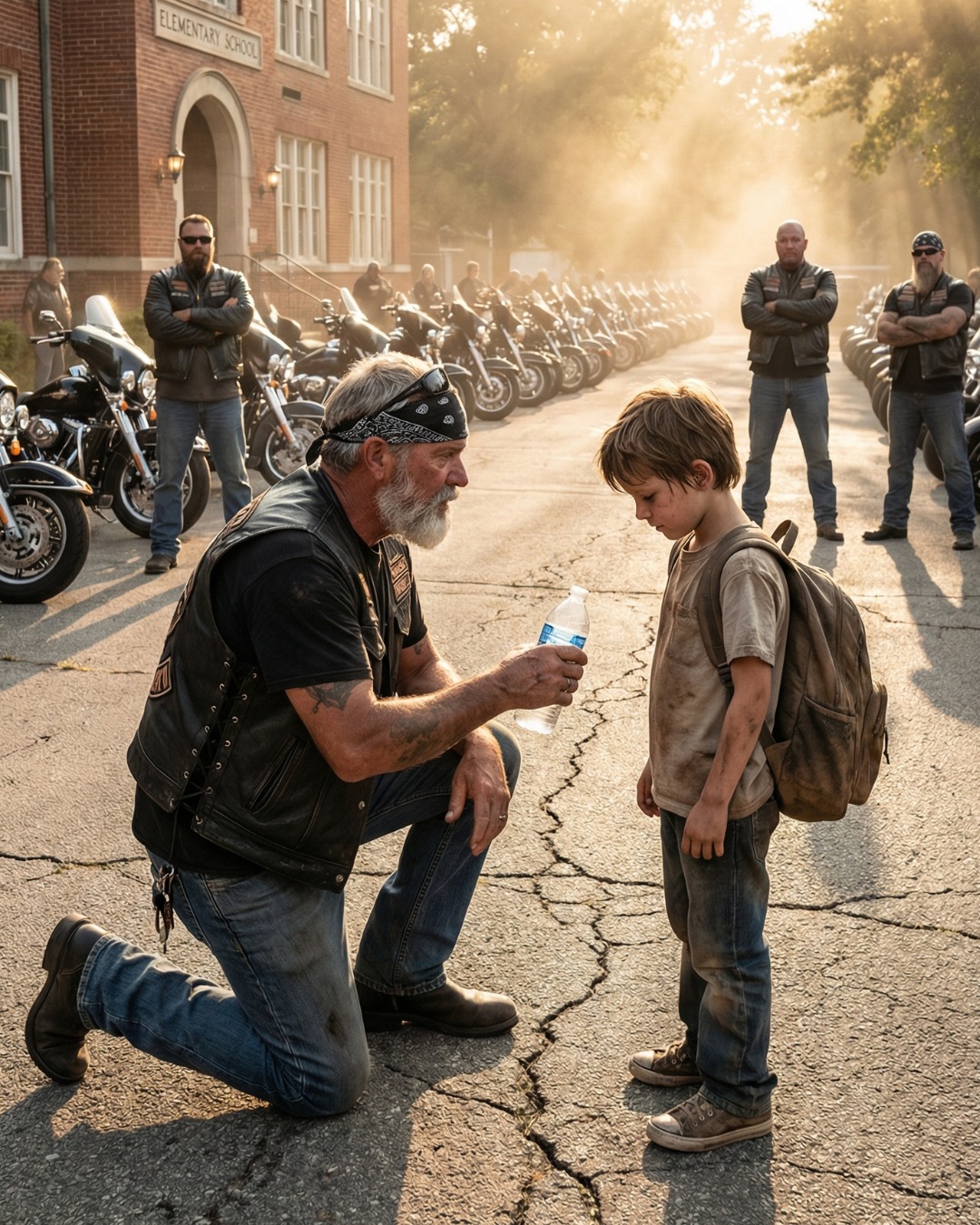
A small boy waited by himself for three endless days, believing someone would come for him. Then the distant roar of hundreds of motorcycles rolled into town, turning a forgotten vigil into something that would change his life forever.
The heat in southern Arizona didn’t arrive gently. It settled over the land like a sentence already decided, pressing down on the cracked concrete steps of Desert Ridge Elementary until the air shimmered and the world felt slightly unreal.
Along the side of the building, where a narrow strip of shade clung stubbornly to the wall, an eight-year-old boy named Noah Bennett sat with his back against the brick, his sneakers swinging just above the ground. His arms were wrapped around a backpack that had once been black but had faded into a dull gray, the color of something worn thin by being left behind too often.
Noah had learned that waiting wasn’t passive. It took effort. He scanned the parking lot the way sailors once watched the horizon, studying every passing car, hoping one might slow, turn, and make everything right again. Each time nothing happened, he tightened something inside himself, telling quiet stories about delays, forgotten phones, emergencies adults never explained.
The first day, he was sure his uncle would be late. The second day, after the teachers’ cars disappeared and the flag’s shadow crept across the ground, he understood that explanations weren’t coming as reliably as the sun.
By Friday, he stopped inventing reasons because imagining hope hurt more than accepting absence. Instead, he focused on small truths: the wall was warm, the zipper on his bag still snagged, the wind carried the smell of dust and sage from the hills beyond town.
Inside the school, lights shut off in tidy rows. Alarms armed themselves without emotion. Principal Harold Whitman, whose office walls were lined with plaques about leadership and community responsibility, locked the front doors at exactly 4:30 p.m. and drove away without ever glancing toward the steps where Noah sat so still he blended into the building.
By then, hunger wasn’t sharp, just constant. Noah had eaten his last lunch on Wednesday and carefully folded the empty wrapper into his bag. He drank from the outdoor fountain until it was shut off for the weekend, when thirst became heavier, something that made swallowing deliberate.
That night, he slept near the back entrance, curled between a storage shed and the wall, using his backpack as a pillow. When he woke Saturday morning to a campus that felt abandoned instead of quiet, something inside him settled into a calm that frightened him. It felt like the calm that comes when you stop expecting rescue.
Cars passed beyond the fence. A woman walking her dog slowed, glanced at him, then looked away. Noah was learning that responsibility was something adults carried selectively.
By Saturday afternoon, he talked softly to himself, rehearsing what he might say if someone finally asked where he’d been. Gratitude, he knew, was often expected even when survival was all you’d managed.
Just after three, the sound arrived.
At first it blended with the highway, then multiplied, deep and heavy, making the ground feel alive. Noah stood, gripping the fence, as motorcycles appeared—one, then many—moving with purpose. Across the street, in the empty lot of a long-closed grocery store, they gathered, engines idling like restrained thunder.
At the center was Lucas “Stone” Maddox, his gray-streaked hair pulled back, his eyes focused on the school. He’d heard about Noah through a rider who’d stopped for water on Thursday, then passed again Friday night and seen the same small shape still there. Calls had been made—to the district, child services, police—but answers never came. By Saturday morning, Lucas stopped asking permission.
When he approached the fence, Noah tensed, but Lucas crouched several feet away, hands visible.
“Hey,” he said gently. “I’m Lucas. What’s your name?”
“Noah,” he answered after a pause.
“How long you been here?”
“Since Wednesday. My uncle was supposed to get me.”
Lucas closed his eyes briefly. Behind him, riders quietly coordinated supplies.
“You hungry?”
Noah nodded.
Water came first, then food simple enough not to overwhelm him. Lucas positioned himself so cameras couldn’t see Noah’s face.
Police arrived quickly this time. Officer Rachel Kim, who had driven past the school more than once that week, stepped out, authority strained.
“You need to step back,” she said.
Lucas looked at her calmly. “What’s his last name?”
She couldn’t answer.
Administrators and city officials arrived, speaking in procedures. Then a district employee admitted that reports had been filed and quietly deprioritized because acknowledging a missing child would trigger audits during a funding review.
Neglect had been a choice.
Child services moved fast once cameras rolled. That night, Noah was placed in emergency care, clutching his backpack, looking back at Lucas through the car window as Lucas raised his hand in promise.
The investigation was brutal. Resignations followed. Policies were rewritten. Then came the final truth: Noah’s uncle had left him deliberately, trusting the system to absorb him without consequence.
It didn’t.
Months later, after hearings and evaluations, Noah moved into Lucas’s home—not for drama, but for steadiness. The adoption took time, but waiting no longer meant being forgotten.
Years later, people talk about the motorcycles. Noah knows better. What changed his life wasn’t noise or power. It was presence—the decision not to look away.