I returned to the United States earlier than planned because for once in my life instinct overruled calculation, and that single impulsive choice exposed a truth so brutal and comprehensive that it rewrote everything I believed about my marriage, my family, and the meaning of protection. I had imagined that surprising my wife would be harmless, even romantic, a moment of laughter or mock annoyance followed by relief, because she was eight months pregnant and I had spent far too much time convincing myself that distance could coexist with devotion. I was wrong in ways that still wake me in the middle of the night.
My name is Michael Dawson, and for most of my adult life I have been praised for building an aerospace manufacturing company from nothing but stubbornness and capital discipline. I knew how to negotiate hostile rooms, how to dominate silence, how to read weakness before it announced itself. What I did not know, or refused to admit, was how little those skills mattered inside my own home.
The flight from San Francisco to New York felt endless, not because of turbulence but because my mind would not stop replaying the last call I had with my wife Rachel, her voice slower now, breaths deeper, laughter softer, and I told myself she was safe, that the estate in Connecticut was managed properly, that the people I paid to oversee our home understood their responsibilities. I told myself that absence was temporary and therefore forgivable.
The driver pulled through the gates just after midday, the hour when wealth hides behind manicured hedges and quiet feels intentional, and I entered through a side door because I wanted to hear my wife before she saw me, believing that love could still be surprised if handled gently.
What I smelled instead stopped me cold.
Bleach, ammonia, and something sour layered beneath it that did not belong in a house preparing for a newborn. The sound came next, a rough repetitive scrape followed by strained breathing, and with each step toward the foyer my disbelief grew heavier than fear.
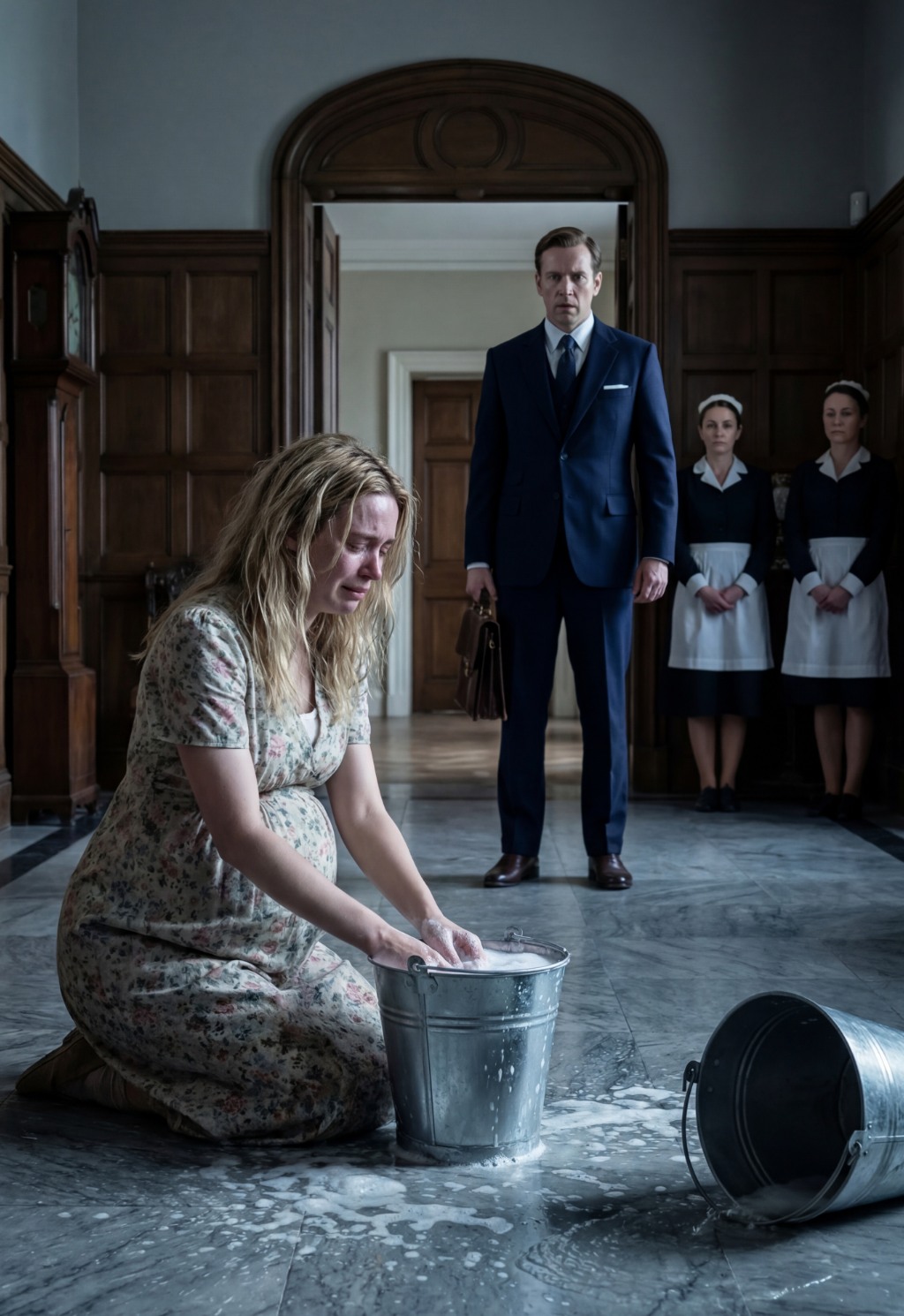
Sunlight spilled across polished marble, the floor slick with gray water, and in the center of it my wife knelt on bare knees that were visibly swollen, her belly heavy and low beneath a loose shirt darkened with sweat. She scrubbed the floor with a stiff brush, her body rocking with effort, whispering apologies under her breath as if the house itself demanded repentance.
In the sitting room beyond her, seated comfortably with crossed legs, was the household supervisor Susan Miller, holding a cup of tea and watching daytime television. Another staff member laughed quietly at something on screen, neither of them reacting to the pregnant woman scrubbing stone a few feet away.
Susan spoke without turning her head. “You missed a section near the staircase, Rachel. If it dries unevenly you will need to redo everything tomorrow.”
Rachel nodded, murmured that she was sorry, and shifted forward. Her knee slipped slightly, and I felt something fracture inside my chest.
“What is going on here,” I demanded, my voice louder than I intended, sharper than the walls deserved.

The room froze. Rachel looked up, and the expression on her face was not relief. It was terror. She tried to stand, failed, and collapsed sideways with a cry that tore straight through me. I was on the floor beside her before anyone else moved, pulling her into my arms while she shook and apologized and begged me not to be angry, not with her, because she was trying, because she knew she had not finished yet.
Her hands were raw, skin split around the knuckles, reeking of chemicals strong enough to sting my eyes. I asked who had told her to do this, who had decided that a woman weeks from labor belonged on her knees, and Susan answered calmly, as if this were a scheduling clarification.
“She wanted to be useful,” Susan said. “Structure helps people like her. Idleness leads to problems.”
I dismissed her immediately. There was no discussion, no courtesy, no room for appeal. The staff scattered in confusion and fear as I carried my wife upstairs, her body limp with exhaustion, her voice barely audible as she asked who would check the list now, who would decide if she had earned rest.
I bathed her, dressed her, and held her until sleep finally claimed her, and only then did I return downstairs, driven by a certainty that this was not an isolated cruelty but a system.
I found the notebook hidden beneath a console table. It was thick, organized, and merciless. Each page listed tasks, penalties, calorie restrictions, and reminders written in a firm unfamiliar hand. Beneath many entries were smaller notes in Rachel’s writing, apologizing, promising improvement, thanking whoever had imposed the rules for their patience.
There were references to her past, a minor arrest from years before that she had trusted me with, twisted into threats about custody and stability. There were warnings about stress harming the baby if expectations were not met. And tucked into the back was a letter printed on legal letterhead from Stonebridge Legal, a firm infamous for operating where ethics ended.
This was not housekeeping.
This was leverage.
The next morning I confronted my mother Diane, and what I expected was denial or deflection. What I received was certainty. She believed she had done the right thing. She believed that breaking my wife into compliance was necessary to protect a legacy built on control and appearances. She spoke calmly about discipline, about hierarchy, about the dangers of softness.
When she threatened my reputation and my company in the same breath, I understood that cruelty does not always announce itself loudly. Sometimes it wears perfume and speaks gently.
I cut her out that day.

It was Rachel who revealed the final truth weeks later, her voice shaking but clear, when she told me that some entries in the notebook appeared on days when neither Susan nor my mother had been present. Cameras had been installed quietly. Someone else had been watching.
The investigation uncovered surveillance devices hidden in vents and detectors, all transmitting to a server owned by a shell corporation tied to Robert Knox, a competitor I had defeated in a deal months earlier. He had lost billions and responded by weaponizing my family.
I destroyed him legally and publicly. Evidence dismantled his empire piece by piece. But victory meant nothing compared to the work of rebuilding my wife’s sense of safety, of proving daily that love is not earned through suffering.
We left the estate. We left the city. Our son was born in a small hospital surrounded by trees and quiet. When I held him, I understood how close I had come to losing everything by believing that providing was the same as protecting.
Power, when unchecked, seeks silence. Love that does not pay attention is neglect disguised as intention. I learned too late, but not irreversibly, that no success matters if the people who trust you are left unguarded.
I will never make that mistake again.