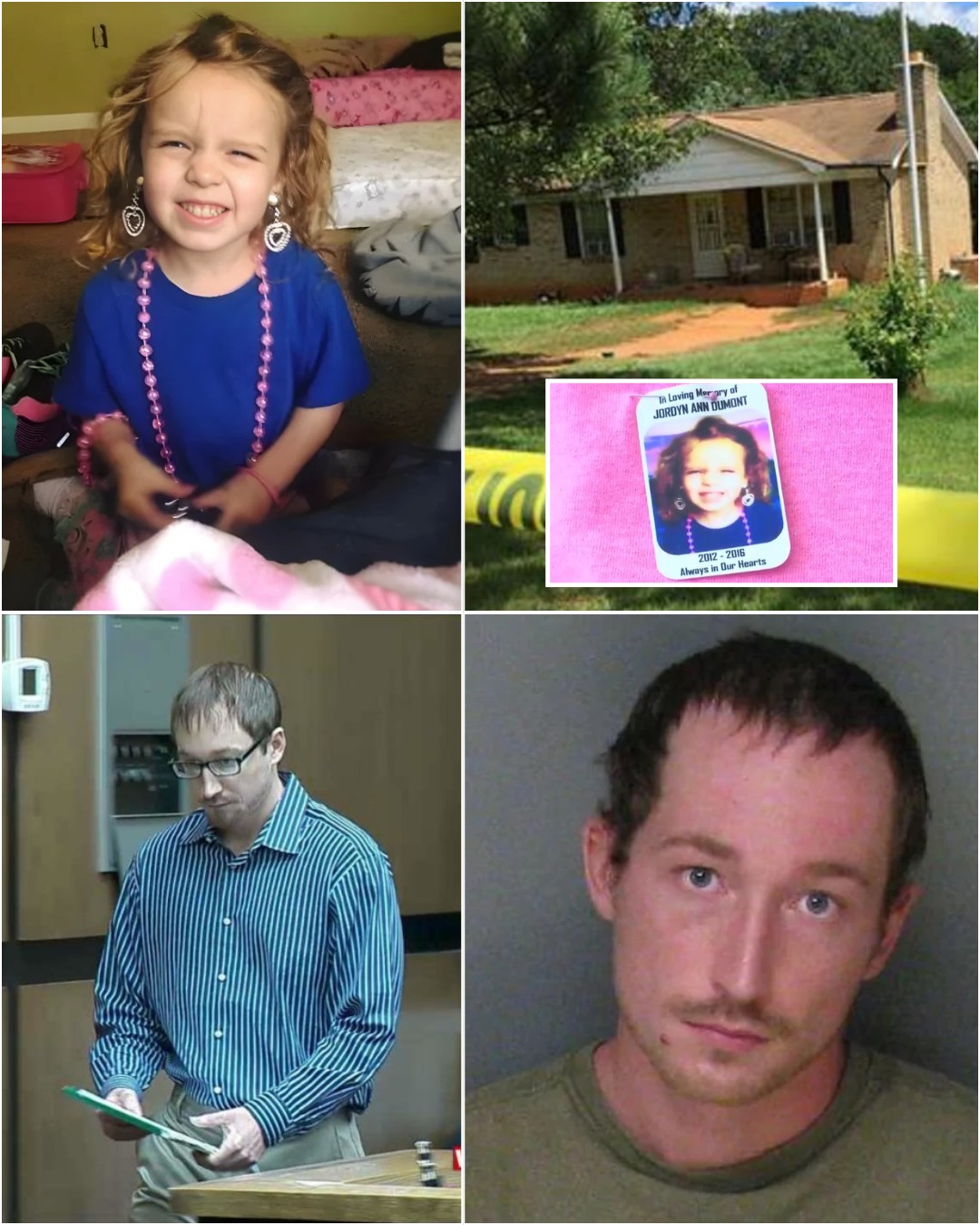
It’s 11 AM on August 16, 2016. Officer Christopher McAulay is pushing through dense brush 500 feet from a house on Bess Town Road. He’s searching for a missing three-year-old. The heat is oppressive. Sweat drips down his face. He notices something unnatural—broken tree limbs arranged deliberately. Dry leaves piled where they shouldn’t be. Black cloth visible underneath.
A white sock with bright-colored stripes protrudes from the pile.
Flies cover it.
McAulay uses a stick to move the leaves. His heart stops. There’s a small hole dug into the ground. Inside, wrapped in a fitted black sheet, is Jordyn Ann Dumont. She’s wearing a long-sleeve shirt that reads “Best Big Sister.” Blue jeans. Socks. Her body is already cold.
Less than 24 hours earlier, her mother’s boyfriend had called 911 to report her missing. He said she vanished during naptime. The front door was wide open, he claimed. She just walked away.
But Jordyn didn’t walk away.
Someone carried her lifeless body into these woods. Someone dug this hole. Someone covered her with branches and leaves. Someone who knew exactly where to hide her—because he lived 500 feet away.
The Little Girl Who Loved Mickey Mouse
Jordyn Ann Dumont is born on September 7, 2012, in Hawaii. Her father, Joshua Kinnett, remembers the moment he holds her for the first time. She has a distinctive birthmark shaped like Hawaii—a permanent reminder of where she entered the world. Her mother, Jaylene Dumont, had met Joshua in Hawaii the previous year. The relationship is passionate but unstable from the start.
Jordyn grows into a little girl full of life and energy. She loves coloring, painting, and blowing bubbles in the backyard. Every morning, she watches Mickey Mouse Clubhouse. Her favorite movie is Hotel Transylvania—she watches it with her father at least 200 times. Joshua loses count after that. He doesn’t mind. Each time, Jordyn laughs at the same jokes. Points at the same characters. Asks the same questions.
“Daddy, watch with me,” she says. Always the same words. Always that smile.
But the instability between Joshua and Jaylene grows worse. They fight. They separate. They try again. Finally, they break apart for good. Jaylene keeps Jordyn. Joshua moves away, his heart breaking every day he doesn’t see his daughter.
Then Jaylene meets William Joseph McCullen.
The Man at the Gas Station
Jaylene is working at a gas station when McCullen walks in. He works for a concrete company. He’s 24 years old. He tells his sister Crystal that he’s found the love of his life. Crystal is happy for her brother. She doesn’t know that within two years, her brother will be arrested for murder.
McCullen has inherited a house with his sister—a property on Bess Town Road in Bessemer City, North Carolina. He and Jaylene move in together in early November 2015. Jordyn comes with them. She’s three years old now. The house becomes her home.
In 2015, Jaylene and McCullen have a daughter together. They name her Angel. Jordyn becomes a big sister. She wears her “Best Big Sister” shirt with pride.
But something is wrong in the house on Bess Town Road.
Police are called to the address on November 3, 2015—just days after McCullen and Jaylene move in. McCullen reports a trespass issue. His sister and her associates have been living at the house. They don’t want to leave. Police come. They sort it out.
Nine days later, police return. Jaylene calls about someone refusing to leave the house. The persons leave before police arrive.
The same day, McCullen calls again. He’s concerned the people from earlier might come back.
The next day, November 13, McCullen calls with more information about the previous day’s incident.
Four calls in 11 days.
This is just the beginning.
The 16 Visits
Between November 2015 and August 2016, police respond to the Bess Town Road home 16 times. Sometimes it’s about stolen property. Sometimes it’s about people who won’t leave. Sometimes it’s about violence.
In February 2016, police are called about a stolen vehicle. It’s not found.
In March 2016, Jaylene reports larceny of lawn equipment. Police determine it’s a property dispute—a civil matter.
In April 2016, someone comes to retrieve medication. McCullen and Jaylene won’t let him in.
On May 14, 2016, police respond to an argument between two babysitters at the house. The reporting person is concerned for the children. Police investigate. They find no issues with the children.
But the most important visits happen on June 2 and June 6, 2016.
Joshua Kinnett, living out of state, hasn’t heard from Jaylene in a while. He’s worried about his daughter. He calls Gaston County Police and asks them to check on Jordyn’s welfare. An officer goes to the house. Jaylene tells the officer she doesn’t want any contact from Joshua. The officer checks on the children. He finds no issues. He returns to the residence a short time later to follow up. Still no issues discovered.
Four days later, on June 6, Joshua calls again. This time, he’s received a letter from Gaston County Department of Health and Human Services. Something is happening with DSS. He’s terrified. He begs police to check on Jordyn again. An officer goes to the house. He checks on the children. He finds no issues.
Ten weeks later, Jordyn is dead.
What the Neighbors Saw
Michael and Nicole live right next door to the house on Bess Town Road. They don’t want Channel 9 to use their last names when they’re interviewed after Jordyn’s death. They’re crying. Nicole can barely speak.
“There’s no way possible I could put into words what I’m feeling right now except I wish I could turn back time,” Nicole says through tears.
Because about a month before Jordyn dies, Michael and Nicole see something that will haunt them forever.
Jordyn has two black eyes.
“Fresh man, cause you know, a couple of days after they turn blue. Fresh they don’t do that. They turn red. So you know they were fresh,” Michael tells reporters.
They ask McCullen what happened to the little girl.
“The kid fell down,” he says.
Michael gives him the benefit of the doubt. He’s a neighbor. You don’t want to assume the worst about your neighbors. You want to believe people are good. You want to believe children are safe.
But Nicole doesn’t take McCullen’s word for it. She asks Jordyn directly.
“The little girl told me that her momma blacked her eye because she was mad at her daddy,” Nicole says.
Nicole and Michael don’t call police that day. They don’t call DSS. They convince themselves it’s probably nothing. Maybe the little girl is confused. Maybe she fell and doesn’t remember. Maybe they’re overreacting.
They don’t call anyone.
Another neighbor, Dusty Connard, watches the violence unfold from her own front porch. She can hear Jaylene begging McCullen to stop hitting her. The sounds carry across the yards. Dusty calls police four times in the past six months because of fighting at the home.
One day, Dusty sees McCullen hit Jordyn across the chest with such force that the little girl falls off the porch. McCullen drags her inside.
Dusty doesn’t know if she calls police about this specific incident. Records show multiple calls, but the details blur together.
Another neighbor tells police about a day when Jaylene comes running to his house. McCullen has hit her with an ashtray. She’s bleeding profusely—blood all over the floor and everywhere.
These neighbors see pieces of the horror. None of them see the full picture. None of them know that on August 15, 2016, something will snap inside William McCullen that will end a three-year-old’s life.
The Five DSS Visits
Between March and May 2016, the Gaston County Department of Social Services conducts five visits to the Bess Town Road home. They’re investigating reports of violence. Of drug use. Of dangerous living conditions.
In May 2016, Joshua calls DSS. He tells them Jaylene has reported that McCullen is abusing her. Joshua is terrified his daughter is experiencing the same treatment. He hasn’t been allowed to see Jordyn for 18 months. He’s desperate. He begs DSS to protect his little girl.
DSS investigates.
On May 20, 2016—less than 12 weeks before Jordyn is killed—DSS closes the case. Their report states they found “no evidence that children lacked supervision or were impacted by parental substance abuse.”
No evidence.
No issues.
Case closed.
A DSS worker will later resign after Jordyn’s death. Officials cannot elaborate on the resignation due to a gag order in the case. But the message is clear: someone failed to see what was happening. Someone missed the signs. Someone closed a case that should have stayed open.
Joshua is furious when he learns DSS closed the case. “They either turned a blind eye or they just didn’t see it,” he will later say.
Jordyn has less than three months to live.
August 15, 2016: The Day Everything Ends
It’s early morning on August 15, 2016. Jaylene leaves for work, leaving McCullen to care for both three-year-old Jordyn and one-year-old Angel. This isn’t unusual. McCullen often watches the girls while Jaylene works.
What happens between early morning and 3:30 PM will be pieced together later through confession, autopsy reports, and forensic evidence. But one thing is certain: at some point during that day, William Joseph McCullen loses his temper with Jordyn.
Later, he will tell investigators multiple versions of what happens. First, he says he’s playfully swinging Jordyn when she slips and hits her head. When confronted with the extent of her injuries, he admits he throws her across the room. Then he admits he punches her.
“All she said is no, and she don’t backtalk a lot, but that always made me mad,” McCullen tells investigators.
He tries to spank her. She refuses. She rolls onto her back. He punches her in the stomach. Not once. Not twice. Multiple times.
Jordyn doesn’t cry during the beating, McCullen claims. She screams.
The medical examiner will later count at least 60 bruises on Jordyn’s body. At least 10 contusions to her chest and abdomen. Six to her right arm. Fourteen to her left arm. The blows to her stomach are so forceful they cause internal bleeding. Her liver is lacerated. Organs are damaged. There’s bleeding between her skull and scalp. Vomit is found in her mouth and nose.
Jordyn Ann Dumont, 32 pounds and 3 feet 2 inches tall, bleeds to death internally.
McCullen claims he finds her unresponsive. He says he attempts CPR. It doesn’t work. Of course it doesn’t work. Jordyn’s organs are destroyed. Her tiny body has suffered trauma no child should endure.
McCullen makes a decision.
He carries Jordyn’s body into the woods—about 500 feet from the house. He digs a small hole. He wraps her in a fitted black sheet. He covers her with branches and dry leaves. He arranges everything carefully, deliberately, to hide what he’s done.
Then he goes back to the house. He waits. He prepares his story.
At approximately 3:30 PM, William Joseph McCullen calls 911.
The 911 Call
“My oldest daughter, I was taking a nap, I just woke up and I can’t find her anywhere,” McCullen tells the 911 operator.
The operator asks questions. McCullen explains that he put three-year-old Jordyn down for a nap. He fell asleep himself. When he woke up, the front door was wide open. Jordyn was nowhere to be found.
The operator asks McCullen to check under beds. To look throughout the house. McCullen is gone for just 30 seconds. He returns to the phone.
“She’s gone,” he says.
When responding officers arrive at the Bess Town Road home, they’re shocked by what McCullen tells them—or rather, what he doesn’t tell them. He hasn’t even contacted Jaylene to inform her that her daughter is missing.
Her daughter has been “missing” for hours, and McCullen hasn’t called her mother.
Officers immediately find this suspicious.
A massive search operation is launched. Highway Patrol helicopters circle overhead. Fire and rescue crews arrive. Community volunteers pour into the area. Everyone is searching for a three-year-old girl with a birthmark shaped like Hawaii, wearing jean shorts and a Mickey or Minnie Mouse t-shirt.
But when investigators enter the family home, they stop searching for a missing child.
They start investigating a crime scene.
Inside the House
Officer Christopher McAulay steps into the house on Bess Town Road. The smell hits him immediately. It’s overwhelming—a strong odor of fecal matter, rotten meat, and spoiled milk permeating the air.
The bathroom is filthy. Officers move through the house, documenting everything. When they search Jordyn’s bedroom, they freeze.
Blood is smeared across the walls.
They ask McCullen about the blood.
“It belongs to either me or Jaylene, not Jordyn,” he says.
But search warrants will later show police discover small amounts of blood throughout the house. They don’t yet know whose blood it is. They just know a child is missing and there’s blood everywhere.
During questioning at the police station, McCullen makes comments that raise suspicions. He names bogus suspects, trying to distract police. He changes his story. He fidgets.
Then he says something chilling: “I hope you find it.”
Not “her.” IT.
Investigators notice scratches on McCullen’s legs that appear consistent with moving through brush. They ask him about the scratches. He deflects. He changes the subject.
It’s only while at the station that McCullen finally calls Jaylene to inform her that her daughter is missing.
Hours after the 911 call. Hours after the massive search began. Only when police are questioning him does he bother to tell Jaylene.
The Night Falls
As darkness falls on August 15, 2016, the search is suspended. Volunteers go home, exhausted and heartbroken. Helicopters return to base. Fire and rescue crews take a break. The plan is to resume at dawn.
Somewhere in those woods, wrapped in a black sheet and covered with branches, Jordyn lies cold and alone.
McCullen goes home. He knows exactly where she is. He put her there.
At dawn on August 16, the community turns out in large numbers to help search. They walk through fields. They check ditches. They call Jordyn’s name, hoping for an answer that will never come.
Around 11 AM, officers move toward wooded areas approximately 500 feet from the family home.
That’s when Officer McAulay notices the broken tree limbs. The dry leaves piled unnaturally. The black cloth underneath.
The white sock with bright-colored stripes, covered with flies.
He uses a stick to investigate. He uncovers the small hole. Inside is Jordyn Ann Dumont, wrapped in a fitted black sheet, wearing her “Best Big Sister” shirt, blue jeans, and socks.
She’s been dead for 24 to 36 hours.
The medical examiner will determine she died from blunt force trauma. The injuries are extensive, catastrophic, unsurvivable. The medical examiner will also note that some bruises are in varying stages of healing —indicating prolonged abuse, not just one violent episode.
But here’s what investigators don’t know yet: Where is William Joseph McCullen?
PART 2
The Manhunt
Shortly after Jordyn’s body is found on the morning of August 16, 2016, investigators go to arrest McCullen. They arrive at the Bess Town Road home. He’s not there. They search the property. Nothing.
Two hours pass.
They find him in the woods without shoes, claiming he slept there overnight.
The same woods where Jordyn’s body was hidden.
McCullen is arrested for first-degree murder. He’s taken to the police station. And then something unexpected happens: McCullen requests to speak with investigators. He makes a full confession.
But his confession will change. Multiple times. Each version reveals more horror than the last.
The Confessions
Initially, McCullen tells investigators he was playfully swinging Jordyn when she slipped and hit her head. It was an accident, he claims. He panicked. He didn’t know what to do.
Investigators show him the autopsy findings. At least 60 bruises. Lacerated liver. Internal bleeding. Organ damage. These injuries are not from a fall.
McCullen changes his story.
He admits he threw Jordyn across the room. He punches her three times in the stomach, he says. Not more. Just three times.
Investigators push back. The injuries are too extensive for three punches.
McCullen admits more. He tried to spank Jordyn and she refused. “All she said is no, and she don’t backtalk a lot, but that always made me mad,” he tells them.
When Jordyn refuses the spanking, she rolls onto her back. McCullen punches her in the stomach. Multiple times. He hits her with such force that he lacerates her liver, causes massive internal bleeding, damages her organs.
“She screamed,” McCullen says. Not cried. Screamed.
Later, he finds her unresponsive. He claims he attempts CPR. When it doesn’t work, he makes a decision: he will hide her body in the woods. Why? Because he thinks “it would be easier for Jaylene to believe her daughter was missing rather than dead”.
This logic is chilling. McCullen believes it’s better for a mother to spend the rest of her life wondering what happened to her child—to imagine endless scenarios of abduction, trafficking, suffering—than to know the truth.
But perhaps the most disturbing part of McCullen’s confession is what he says about his role as a father. Despite admitting he beat Jordyn to death, despite admitting he previously struck her with a drumstick on her feet and hit her wrists, McCullen claims he always felt like a good father to both Jordyn and Angel.
A good father.
Detective Matt Sampson notices something during the interrogation. McCullen keeps referring to Jordyn as “it” rather than “her”. “I hope you find it,” McCullen had said earlier. Not “her.” IT.
Sampson will later tell the jury this is a sign McCullen knew Jordyn was already dead.
What the Autopsy Reveals
Dr. Jonathan Privette performs the autopsy on Jordyn Ann Dumont. What he finds is catastrophic.
At least 60 bruises cover Jordyn’s tiny 32-pound body. At least 10 contusions to her chest and abdomen. Six to her right arm. Fourteen to her left arm. The blows to her stomach are so forceful they cause internal hemorrhaging. Her liver is lacerated. Multiple organs are damaged.
There’s bleeding between her skull and scalp. Vomit is found in her mouth and nose.
But here’s what makes this case even more heartbreaking: some of the bruises are in varying stages of healing. This isn’t just one violent episode. This is prolonged abuse. Jordyn has been suffering for weeks, possibly months. The bruises tell a story of repeated beatings, of escalating violence, of a little girl who had no one to protect her.
Dr. Privette determines the cause of death: blunt force trauma. Jordyn bled to death internally from the beatings.
She was three years old.
The Community Responds
The night after Jordyn’s body is discovered, hundreds of community members attend a candlelight vigil. They hold candles. They cry. They pray. Many of them had participated in the search, hoping to find Jordyn alive. Now they’re mourning her death.
Local residents organize fundraisers. They sell hotdog plates, raising $1,500 in sales and nearly $1,000 in donations to help cover funeral costs. The community rallies around Joshua Kinnett, Jordyn’s biological father who traveled from out of state to bury his daughter.
Joshua stands at the vigil, numb with grief. He hasn’t been allowed to see Jordyn for 18 months. He called DSS. He called police twice in June to check on her welfare. He begged everyone to protect his daughter.
And they closed the case. They found “no issues.”
Now his daughter is dead.
The Neighbor’s Guilt
After Jordyn’s death, neighbors Michael and Nicole can barely speak to reporters. They’re overcome with grief and guilt. About a month before Jordyn died, they saw her with two black eyes—fresh injuries that were red, not yet turned blue.
They asked McCullen what happened. “She fell down,” he said.
They gave him the benefit of the doubt.
Nicole asked Jordyn directly. The little girl said her mother gave her the black eyes “because she was mad at her daddy”.
Nicole and Michael didn’t call police. They didn’t call DSS. They convinced themselves it was probably nothing. Now they have to live with that decision for the rest of their lives.
“If anybody sees a child with a black eye and you’ve been told they fell down don’t take it for granted,” Nicole tells reporters through tears.
Another neighbor had called police four times in six months because of fighting at the home. She witnessed McCullen hit Jordyn across the chest so hard the little girl fell off the porch. She saw McCullen drag Jordyn inside.
Another neighbor saw Jaylene run to his house, bleeding profusely after McCullen hit her with an ashtray.
The violence was visible. Neighbors saw it. Police responded 16 times to the home in less than a year. DSS conducted five visits in three months.
And still, Jordyn slipped through every crack in the system.
July 2018: The Trial Begins
Nearly two years after Jordyn’s death, William Joseph McCullen’s trial begins in Shelby, North Carolina. Jordyn’s biological father, Joshua Kinnett, attends every day. Jaylene Dumont does not appear in court.
The jury hears graphic testimony about Jordyn’s injuries. Dr. Privette takes the stand and describes the 60+ bruises, the lacerated liver, the internal hemorrhaging. He explains that some bruises were in varying stages of healing—proof of prolonged abuse.
The jury watches McCullen’s recorded confession. They hear him explain how he punched Jordyn multiple times in the stomach because she said “no” and it “made him mad”. They hear him admit to hitting her with a drumstick. They hear him describe hiding her body in the woods because it would be “easier” for her mother.
Detective Matt Sampson tells the jury about McCullen’s use of the word “it” instead of “her” when referring to Jordyn. This dehumanization, Sampson explains, shows McCullen knew she was already dead.
The prosecution presents evidence of the 16 police visits to the home. The five DSS visits. The neighbors who saw black eyes and bruises. The system’s repeated failures to protect Jordyn.
McCullen’s defense team faces an impossible task. Their client has confessed—multiple times, with varying levels of detail, but always admitting he killed Jordyn. The physical evidence matches his confession. The autopsy confirms the brutality.
McCullen chooses not to testify. His defense calls no witnesses.
There’s nothing they can say. No defense they can mount. The evidence is overwhelming. The confession is clear. Jordyn’s injuries speak for themselves.
After closing arguments, the case goes to the jury.
22 Minutes
The jury deliberates for just 22 minutes.
Twenty-two minutes to decide a man’s fate. Twenty-two minutes to review all the evidence, discuss the testimony, reach a unanimous verdict.
The brevity of their deliberation speaks volumes. There’s no doubt. No debate. No disagreement.
William Joseph McCullen is guilty.
The jury finds him guilty of first-degree murder by torture and felony murder. The murder by torture charge is particularly significant—it recognizes that Jordyn didn’t just die from one violent act. She was tortured. She suffered. The beatings were prolonged and intentional.
Under North Carolina law, first-degree murder carries an automatic sentence: life in prison without the possibility of parole.
McCullen will die in prison. He will never see freedom again. He will never hold his daughter Angel. He will never have another chance to hurt a child.
Joshua Kinnett watches as the verdict is read. Finally, there’s justice for Jordyn. But justice doesn’t bring her back. Justice doesn’t erase the 18 months Joshua wasn’t allowed to see his daughter. Justice doesn’t change the fact that the system failed to protect her.
The Lawsuit
The day after McCullen’s conviction in July 2018, Joshua Kinnett files a wrongful death lawsuit. He sues both William Joseph McCullen and Jaylene Dumont, accusing Jaylene of failing to provide a safe home and participating in the abuse.
Jaylene has not been charged criminally in her daughter’s death. But Joshua and his attorney, David Teddy of Teddy, Meekins & Talbert in Shelby, argue she was negligent in her role as Jordyn’s biological mother. She failed to protect Jordyn from McCullen’s violence. She allowed the abuse to continue.
“You can’t put a price on the life of a child, but when someone acts in the manner that McCullen acted, there needs to be some local accountability in Gaston County for the community,” David Teddy says.
Joshua knows from the outset he will likely never collect any money from McCullen or Jaylene. Neither has significant assets. McCullen is in prison for life. But the lawsuit isn’t about money—it’s about accountability. It’s about forcing the court to officially recognize Jaylene’s role in Jordyn’s death.
In February 2020, Superior Court Judge W. Robert Bell awards Joshua $12 million in a default judgment following a bench trial. The breakdown: $3 million in compensatory damages and $9 million in punitive damages.
Judge Bell finds that Jaylene contributed to Jordyn’s death through negligence. Even though she wasn’t charged criminally, the civil court holds her accountable. She failed to provide a safe home. She knew about McCullen’s violence—neighbors had seen him hit her with an ashtray, causing profuse bleeding. She knew about the dangerous living conditions—drugs, alcohol, violence. And she did nothing to protect her daughter.
“We felt like we needed to make a statement, and we did,” David Teddy says.
But Joshua’s legal fight isn’t over. He also files a lawsuit against the North Carolina Department of Health and Human Services. DSS conducted five visits to the home between March and May 2016—just three months before Jordyn’s death. They investigated reports of violence, drug use, and dangerous living conditions. Joshua specifically called them in May, expressing concerns after Jaylene reported McCullen was abusing her.
DSS closed the case on May 20, 2016, reporting they found “no evidence that children lacked supervision or were impacted by parental substance abuse”.
Twelve weeks later, Jordyn was dead.
In the wake of her death, a DSS worker resigned. Officials could not elaborate due to a gag order, but the resignation speaks volumes about the agency’s failures.
Joshua’s lawsuit against the state settles for $250,000. It’s not nearly enough—nothing could be—but it’s acknowledgment that the system failed Jordyn.
Jordyn’s Law
In 2017, North Carolina Senator Kathy Harrington introduces legislation named in Jordyn’s memory: Jordyn’s Law. The law requires the Department of Social Services to contact non-custodial parents when investigations reveal abuse or neglect.
This simple requirement could have saved Jordyn’s life.
Joshua had been calling DSS, begging them to investigate. He told them he suspected Jordyn was being abused. But because he was the non-custodial parent—because he didn’t have custody and was living out of state—DSS didn’t keep him informed about their investigation or their decision to close the case.
If Joshua had known DSS found “no issues” and closed the case, he could have pushed back. He could have demanded further investigation. He could have filed for emergency custody. He could have done something.
Instead, he was kept in the dark. He called police twice in June 2016 asking them to check on Jordyn’s welfare. Both times, officers found “no issues.” He trusted the system to protect his daughter.
The system failed.
Jordyn’s Law aims to provide transparency and allow non-custodial parents to advocate for their children’s safety. It’s a small change, but it could prevent future tragedies. It could give other fathers like Joshua a chance to save their children.
The law passes. It’s named after a three-year-old girl who loved Mickey Mouse and Hotel Transylvania. A little girl who blew bubbles in the backyard. A little girl with a birthmark shaped like Hawaii.
A little girl who deserved so much better.
The Questions That Remain
Years after Jordyn’s death, questions still haunt this case.
Why did neighbors see Jordyn with two black eyes a month before her death and not report it? Why did they accept McCullen’s explanation that she fell? Why did Nicole, who actually asked Jordyn what happened and heard the little girl say her mother gave her black eyes, not call police?
Why did DSS conduct five visits to the home and find “no evidence” of abuse or neglect when the conditions were so obviously dangerous? When neighbors were calling police about violence? When Joshua was specifically reporting his concerns about abuse?
Why did the DSS worker who resigned after Jordyn’s death have access to the case? What did that worker see—or fail to see? Officials can’t comment due to the gag order, but the resignation suggests guilt, recognition of failure.
Why did police respond to the Bess Town Road home 16 times in less than a year and never remove the children ? The calls included reports of violence, concerns about children’s welfare, and visible injuries. At what point should officers have said enough is enough?
Why was Jaylene never charged criminally? The civil court found she was negligent and contributed to Jordyn’s death. Neighbors saw McCullen hit her with an ashtray, causing profuse bleeding. If she was being abused herself, why didn’t she leave and take her daughters with her? If she wasn’t being abused—if she was participating in the abuse, as Joshua’s lawsuit alleged—why wasn’t she prosecuted?
And perhaps the most haunting question: How many times did Jordyn scream before she died?
McCullen said she screamed during the final beating. Not cried. Screamed. Did neighbors hear? Did anyone call for help? Or did Jordyn’s screams go unanswered, like so many cries for help throughout her short life?
Where They Are Now
William Joseph McCullen is serving life in prison without the possibility of parole. He will never leave prison. He will never hurt another child.
Jaylene Dumont’s current whereabouts are unknown. She did not appear at McCullen’s trial. She owes Joshua Kinnett $12 million in civil damages—money she will almost certainly never pay.
Angel, Jordyn’s younger sister, was in the home when Jordyn was killed. She was just one year old. After Jordyn’s death, sources indicate the Department of Social Services took custody of Angel. Her current whereabouts and well-being are not public information.
Joshua Kinnett has become an advocate for child welfare reform. He speaks publicly about the system’s failures that cost his daughter her life. He honors Jordyn’s memory by fighting to ensure other children don’t fall through the same cracks.
Neighbors Michael and Nicole still live with the guilt of seeing Jordyn’s black eyes and not reporting it. “I wish I could turn back time,” Nicole said. But time only moves forward. The past can’t be changed. Jordyn can’t be saved.
The DSS worker who resigned after the case has not been publicly identified. But that person lives with the knowledge that they closed a case 12 weeks before a three-year-old was beaten to death.
And somewhere in North Carolina, Jordyn Ann Dumont rests in peace. She’s no longer being beaten. No longer screaming. No longer afraid.
But she’s also no longer watching Mickey Mouse Clubhouse. No longer painting or blowing bubbles. No longer watching Hotel Transylvania with her father for the 201st time.
She’s simply gone.
The Bigger Picture
Jordyn’s case is not unique. Every year, children die at the hands of parents and caregivers despite multiple reports to Child Protective Services. Every year, caseworkers close investigations prematurely. Every year, neighbors see bruises and convince themselves it’s probably nothing.
The system is overwhelmed. DSS workers carry impossible caseloads. They’re underpaid, overworked, and often poorly trained. They make split-second decisions about children’s safety with incomplete information. Sometimes they get it wrong.
But the consequences of getting it wrong are catastrophic.
Jordyn had every red flag: a violent home, police called 16 times, five DSS visits, visible injuries, a biological father begging for intervention. If Jordyn couldn’t be saved with all those warning signs, how many other children are falling through the cracks?
Jordyn’s Law is a step forward. Requiring DSS to contact non-custodial parents during abuse investigations increases transparency and gives more people the ability to advocate for children’s safety. But it’s not enough.
We need better funding for Child Protective Services. We need lower caseloads so workers can thoroughly investigate every report. We need better training so workers can identify abuse even when it’s being hidden. We need stronger laws that allow removal of children from dangerous homes before it’s too late.
And perhaps most importantly, we need a cultural shift. We need neighbors to call police when they see a child with black eyes—even if the parent says the child fell. We need teachers, doctors, and family members to report suspected abuse, even if they’re not 100% certain.
Because Jordyn is dead. And Michael and Nicole have to live forever knowing they saw her black eyes and did nothing.
The Final Truth
On August 15, 2016, three-year-old Jordyn Ann Dumont is beaten to death by her mother’s boyfriend. She suffers at least 60 bruises. Her liver is lacerated. Her organs are damaged. She bleeds to death internally.
Her killer wraps her in a black sheet and hides her body in the woods 500 feet from her home.
He calls 911 and reports her missing.
The community searches for her, hoping she’s lost, hoping she’s alive.
Less than 24 hours later, an officer finds her body under a pile of leaves and branches.
Her killer confesses. A jury convicts him in 22 minutes. He’s sentenced to life in prison without parole.
These are the facts.
But here’s the truth that’s harder to face: Jordyn didn’t die because one man lost his temper. She died because an entire system failed to protect her. Neighbors failed to report abuse. Police responded 16 times but never removed the children. DSS conducted five visits and closed the case. A biological father begged for help and was ignored.
Jordyn’s death was preventable. Every expert who has reviewed this case agrees: she should have been removed from that home months before she died. The warning signs were everywhere.
But everyone—neighbors, police, DSS workers—gave the adults in Jordyn’s life the benefit of the doubt. Everyone wanted to believe the best. Everyone convinced themselves the situation wasn’t as bad as it seemed.
And Jordyn paid the price.
She was three years old. She loved Mickey Mouse. She blew bubbles in the backyard. She wore her “Best Big Sister” shirt with pride.
She deserved a life full of love, laughter, and safety.
Instead, she got 22 minutes of justice and a law named in her memory.
It’s not enough. It will never be enough.
But it’s all we can give her now.