Mum Welcomes Baby in the Ocean at 2am After Choosing an Unassisted Sea Birth
A mother of five has sparked global debate after giving birth to her baby in the sea in the early hours of the morning — without doctors, midwives, or medical equipment.
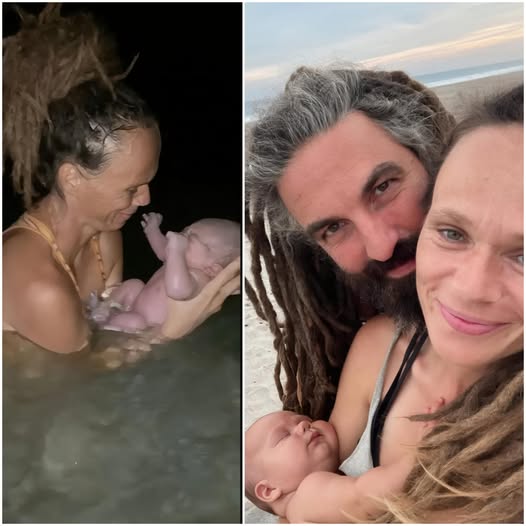
Josy Cornelius welcomed her son, Maui, into the world at around 2am while standing in the Caribbean Sea off the coast of Nicaragua. The birth marked the second time the 38-year-old has chosen what is known as a “free birth,” a practice that involves labour and delivery without professional medical assistance — a decision some experts warn carries serious risks.
Maui was born on September 11, 2023, after Josy temporarily relocated her family to Nicaragua specifically for the birth. The newborn joins his four older siblings: an 11-year-old sister and three brothers aged seven, three, and two.
Josy is a strong advocate for free birth and believes deeply in a woman’s right to plan her pregnancy and delivery according to her own values — even if it means travelling across the world to do so.
“Women should plan birth the same way they plan their dream wedding,” she said. “No distance is too far, no cost is too high, and no detail is too specific when it comes to creating the birth you want.”
Footage of Maui’s arrival quickly gained attention online. In a video shared on Josy’s Instagram account, which amassed nearly 19,000 views and more than 900 likes, she can be seen cradling her newborn while still standing in the ocean. In another clip, she smiles alongside her husband, Benni, 43, as they paddle together in the water, moments after their son’s birth.
Josy previously welcomed another child in the sea in 2022 at Playa Majagual, Nicaragua — a birth she also documented publicly. That experience, she says, inspired her to plan her next ocean birth years in advance.
“The preparation for this birth took over 70 weeks,” she explained. “Our first ocean baby was only five days old when I already knew the next one would be born in the Caribbean Sea.”
Two months before her due date, Josy and her family moved to a small island to prepare for the birth. With someone managing their farm back home and Josy working remotely, the move was carefully planned.
“There’s so much organisation behind a birth like this,” she said. “We spent eight weeks there before and after the birth. I worked online, cared for my clients, and made sure everything was aligned. No investment was too great to make this moment happen.”
She described the Caribbean as the perfect setting for birth — calm, warm, and private.
“The ocean there feels different,” she said. “The waves are gentle, the colours are brighter, and there are quiet beaches where you can be completely alone. Everything was exactly how we planned it — except for the baby deciding to arrive in the middle of the night.”
While many social media users praised Josy’s determination and described her birth as inspiring, others voiced serious concerns. Critics questioned the safety and hygiene of ocean births, warning about bacteria, temperature changes, and the unpredictability of open water.
“Is the sea even sanitary?” one commenter asked. Another wrote: “Going from a warm womb straight into cold ocean water sounds shocking for a newborn.”
Medical professionals have also expressed caution. Although exact figures are unknown, free births remain rare worldwide, though interest in them appears to be growing. In a widely reported case in 2018, a baby in California was stillborn after a prolonged unassisted labour.
Labour and delivery nurse Liesel Teen, founder of Mommy Labor Nurse, previously warned that unassisted births — especially in the ocean — carry additional risks, including infection, temperature exposure, and unpredictable environmental conditions.
Josy, however, says she remains unfazed by criticism.
“I don’t engage with the hate,” she said. “It only shows how little people understand. The world isn’t ready to rethink birth yet, but that doesn’t mean it’s wrong.”
She also argues that salt water has long been used in water births, noting that midwives often add salt to birthing pools.
“Salt water supports the body,” she said. “Contractions in water are completely different. They’re gentler, more intuitive. Birth has been treated like a medical emergency for far too long. It isn’t an illness.”
Josy brings her own medical background into her confidence. She previously worked in medical technology with a focus on cardiology and later volunteered in a children’s clinic specialising in premature and high-risk infants, where she also completed intensive care training.
Today, she supports other women as a doula under the name @OceanBirthMom on Instagram. In 2023 alone, she worked with 119 families and remains convinced that natural, unassisted birth offers the safest experience for both mother and baby.
Josy and Benni originally emigrated from Germany, where they met and welcomed their first child together. Reflecting on her journey, Josy says each of her children represents a different chapter of her life.
“I have five children born in five different regions of the world,” she said. “My last three were born in just three years. I feel completely blessed — and complete.”