The Iron Grave on Willow Hill
Margaret Ellis had walked past that grave for nearly thirty years.
Thirty years of early morning strolls, hands tucked into her cardigan, the quiet crunch of gravel beneath her shoes, the same winding path cutting through Willow Hill Cemetery. It had become her ritual after her husband passed—a way to feel close to something, even if she couldn’t quite name what.
But there was always that grave.
The one no one stopped at.
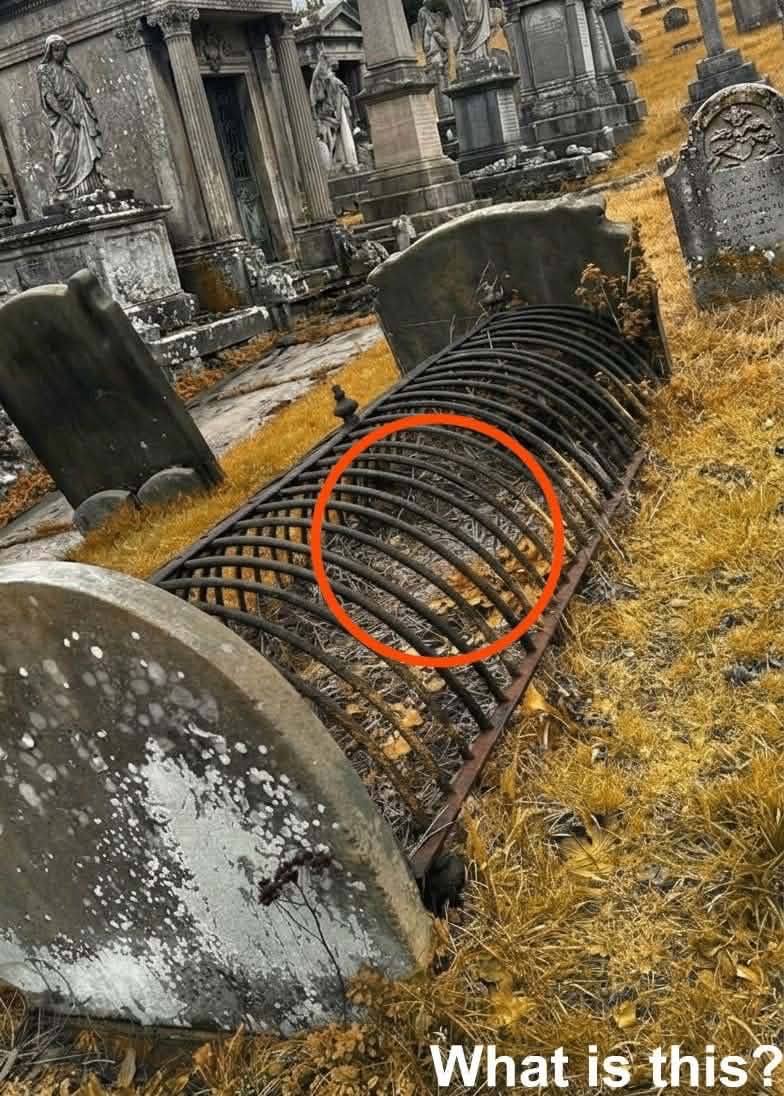
The one covered by a rusted iron cage, bent slightly from age, its curved bars pressing down over the earth like a ribcage. Not decorative. Not respectful. Almost… restraining.
Even now, at seventy-two, Margaret felt a chill crawl up her spine every time she approached it.
Strange, isn’t it?”
The voice startled her.
Margaret turned to see Harold Benton, the cemetery groundskeeper. He’d been tending Willow Hill longer than she could remember—thin, quiet, always watching more than he spoke.
She nodded toward the grave.
“What is it?”
Harold hesitated. That alone unsettled her.
“You don’t really want to know,” he said.
Margaret gave a small, stubborn smile.
“At my age, I’ve earned the right to know a little more than I’m told.”
Harold exhaled slowly, glancing around as if the dead themselves might be listening.
“That,” he said quietly, “is what they used to call a mortsafe.”
A Forgotten Fear
The word meant nothing to Margaret.
Harold explained slowly, like someone reopening a wound.
“In the 1800s, before modern laws… before donated bodies… medical schools needed cadavers. But there weren’t enough.”
Margaret’s stomach tightened.
“So people stole them.”
He nodded.
“Grave robbers. Resurrectionists, they were called. Fresh graves were the most valuable. Families—especially those with money—would place iron cages like this over graves to protect the bodies until… well…”
“Until what?” Margaret whispered.
“Until the bodies decomposed enough to no longer be useful.”
Silence fell between them.
Margaret stared at the iron cage again. It suddenly felt heavier. Not just metal—but fear, grief, desperation… all trapped within its bars.
But something didn’t sit right.
“If that’s all,” she said slowly, “why is this the only one left?”
Harold didn’t answer.
Margaret felt cold.
“So they never found her?”
Harold shook his head.
“Not at first.”
Her voice dropped to a whisper.
“Then when?”
“A week later. Not far from here.”
He pointed toward a cluster of older graves beneath a crooked oak tree.
“They found her body… above ground.”
Margaret’s hands began to tremble.
“Her fingernails…” Harold said slowly, “were broken. Torn. There was dirt packed into her mouth… her lungs.”
Margaret staggered back.
“No…”
“They realized then,” he said, voice barely audible, “she had been buried alive.”
She clawed her way out,” Margaret whispered.
Harold nodded once.
“But she didn’t survive long after. Exposure. Exhaustion.”
Margaret’s eyes filled with tears.
“So they buried her again…”
“Yes.”
“And the cage?”
Harold looked directly at her now.
“That wasn’t to keep people out.”
Margaret’s breath stopped.
“It was,” he said quietly, “to keep her in.”
The Final Walk
Margaret never walked the same path again.
Not because she was afraid.
But because she understood something now—something most people spent their entire lives avoiding.
We fear death.
But what people feared more, back then… was something far worse.
Being forgotten.
Being trapped.
Being unheard.
As she passed Willow Hill one last time, she paused at the iron grave.
For the first time, she didn’t feel fear.
Only sorrow.
And a quiet, lingering question—
How many stories, like Eliza’s, were still buried beneath the earth…
Waiting…
Not to be freed—
But simply…
to be known.