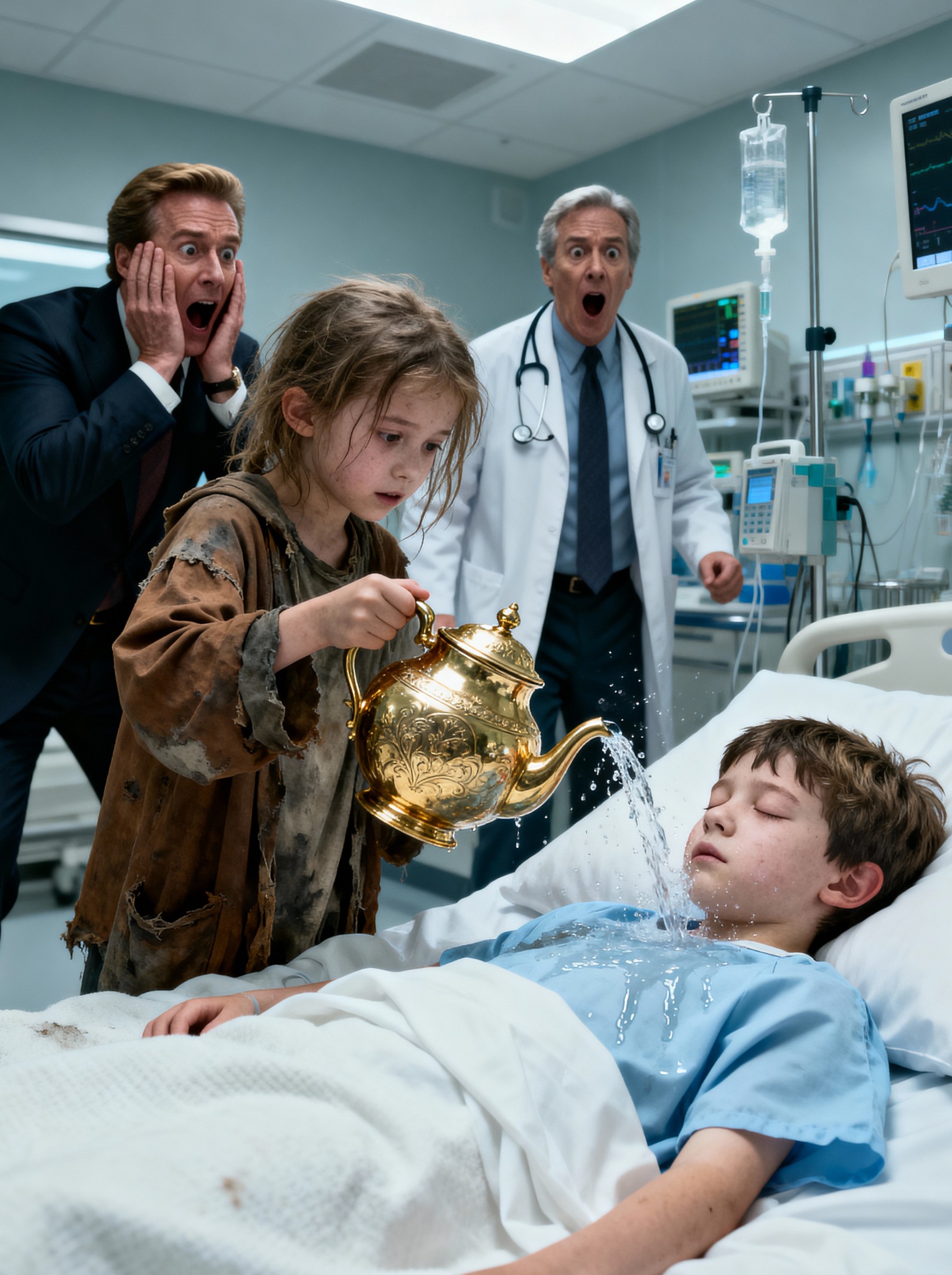
The fluorescent lights of Riverbend Children’s Hospital in Austin Texas cast a pale sheen over the polished floor. The scent of disinfectant blended with the bitter trace of stale coffee that had been reheated too many times. It was past midnight, yet the corridor outside Room 417 remained awake with the soft hum of machines and the occasional squeak of a nurse’s shoes.
Brandon Keller sat in a stiff plastic chair beside his son’s bed. His tie was loosened, his shirt wrinkled, his eyes swollen from nights without real sleep. He kept his hand wrapped around his little boy’s fingers, afraid that if he let go, something terrible might slip away with that simple motion.
Lucas Keller was four years old. He should have been running through parks and arguing over bedtime stories. Instead, he lay beneath thin hospital blankets, wires taped to his chest, a breathing mask covering half his face. Every breath sounded like a question the world refused to answer.
Dr. Raymond Ivers stood near the foot of the bed, reviewing a tablet with practiced composure. His voice was gentle but heavy, the kind of tone doctors use when hope has grown fragile.
“Mr. Keller,” the doctor said, choosing each word carefully, “we have repeated every available protocol. We have consulted specialists from three states. Lucas has a condition so rare that we only found a handful of recorded cases. None of them responded to treatment in a lasting way.”
Brandon swallowed hard and felt the room tilt beneath him.
“So what happens next,” he asked, forcing himself to speak calmly.
Dr. Ivers hesitated, then sighed.
“At this stage, our goal is comfort. I estimate a few days, perhaps a week if his body holds steady. I am truly sorry.”
Brandon stared at his son, whose small chest rose and fell under the blanket.
“There has to be something else,” Brandon said. “I have money. I can fly in anyone. I can buy any machine. Just tell me what to do.”
The doctor shook his head slowly.
“We have already contacted the best facilities in the country. Sometimes medicine reaches a wall. When that happens, all we can do is stand with the family.”
After Dr. Ivers left, Brandon leaned forward and pressed his forehead to the back of his son’s hand.
“How am I supposed to tell Natalie,” he whispered.
His wife was attending a legal conference in Denver. She was returning in two days. Two days that now felt like a cruel delay in a story he refused to accept.
The door creaked open softly.
Brandon looked up, expecting a nurse. Instead, a little girl stepped into the room. She was about seven years old, wearing a worn blue school uniform and sneakers that had seen better days. Her brown hair was tied in a loose ponytail that kept slipping free. In her hands she carried a tiny plastic bottle painted gold.
“Who are you,” Brandon asked, confused and wary. “You cannot be in here.”
The girl did not answer immediately. She walked closer to the bed with steady determination, as if she had done this before. She climbed onto a small stool and looked down at Lucas with solemn eyes.
“I am going to help him,” she said. “Do not worry.”
Before Brandon could react, the girl uncapped the bottle and tipped a small stream of water onto Lucas’s forehead. Drops ran down his temple and soaked the pillowcase.
“Hey,” Brandon exclaimed, standing abruptly. He grabbed the bottle from her hands. “What are you doing. You cannot just walk in and pour things on my son.”
The girl reached for the bottle, her face twisting with urgency.
“It is special water,” she insisted. “It helps when people are very sick.”
Brandon pressed the call button on the wall.
“Security,” he said through clenched teeth. “Someone came into my son’s room.”
Two nurses hurried in. One of them, a young woman with tired eyes, looked at the child with recognition.
“Ivy,” the nurse said. “What are you doing here again.”
From the hallway came a worried voice.
“Ivy. Ivy. Where did you go.”
A woman in a gray maintenance uniform appeared, her face flushed from panic. She rushed forward and took the girl’s hand.
“I am so sorry,” the woman said to Brandon. “My name is Denise. I work cleaning on this floor. She should not have come in. We are leaving right now.”
The girl pulled against her mother’s hand.
“I just wanted to help Lucas,” Ivy cried. “He is my friend.”
Brandon froze. “How do you know my son’s name,” he asked slowly.
Denise looked trapped. Her eyes darted toward the door.
“She must have seen the name on the chart,” Denise said quickly.
“No,” Ivy interrupted. “We played together at Sunny Steps. We built a tower with blocks and he made funny dinosaur noises.”
Brandon’s heart tightened. “My son has never been to any school,” he said quietly. “He has a nanny at home.”
Denise’s shoulders sagged. She looked defeated.
“Please forgive her,” Denise whispered. “We will go.”
They left quickly, leaving Brandon alone with a damp pillow and a small golden bottle in his hand. He uncapped it and sniffed. It smelled like plain tap water. That afternoon, Brandon called the nanny, Rosa Martinez.
“Tell me the truth,” he said without greeting. “Did you take Lucas to a kindergarten.”
There was a long silence on the other end.
“Mr. Keller,” she said at last, her voice trembling, “only twice a week. He was lonely. He needed other children. It was a good place. Safe. I thought I was helping him.”
Brandon closed his eyes. “Where.”
“In East Austin,” Rosa answered softly. “Near the old rail yard.”

Brandon hung up without another word. Anger surged through him. Not at Rosa alone, but at himself for missing so much of his son’s life while chasing meetings and deals and late dinners.
That night, Brandon fell asleep in the chair beside the bed, exhausted beyond thought. He woke to a whisper. Ivy was back. She sat beside Lucas, holding his hand, murmuring a story about a castle and a brave knight who refused to let monsters win. Brandon rubbed his eyes in disbelief.
“How did you get in here,” he asked, his voice hoarse.
“Through the staff entrance,” Ivy replied calmly. “I know where Mama keeps her card.”
“You cannot keep doing this,” Brandon said. “This is a hospital. There are rules.”
“Lucas needs someone to believe he will get better,” Ivy said simply. “Everyone else looks sad around him.”
Brandon opened his mouth to argue, then stopped. Lucas’s cheeks looked slightly less pale under the harsh lights. It was probably his imagination, yet the sight struck him deeply.
A nurse entered quietly. It was the same young nurse from earlier. Her badge read Paige Turner.
“Mr. Keller,” Paige said softly, “I should ask her to leave, but I need to tell you something. After the girl visited earlier, Lucas’s oxygen levels improved a little. Not much, but enough that the monitor noticed. It might be coincidence, but it happened.”
Brandon looked from the nurse to Ivy.
“What is in that bottle,” he asked.
“Water from the little fountain behind the hospital,” Ivy replied. “My grandma says it used to be a well where people went when they were sick. I thought maybe it still works.”
Brandon let out a weary laugh. “You know that sounds like a fairy tale.”
Ivy tilted her head. “Do you believe in doctors,” she asked.
“Yes.”
“And they said they cannot help him anymore,” she replied. “So why is it strange to believe in something else too.”
Brandon had no answer. When morning came, Paige walked Ivy and Denise home. Brandon stayed beside his son and dipped his fingers into the bottle, touching Lucas’s forehead with trembling care.
“If anything out there is listening,” he whispered, “I am begging you.”
Lucas stirred and opened his eyes.
“Daddy,” he murmured. “Ivy came to see me.”
Brandon broke down in tears, holding his son close.
Later that day, Dr. Ivers stopped him in the hallway.
“Mr. Keller,” the doctor said, “today’s tests show something unusual. Lucas’s blood counts are slightly improved. Kidney function is also marginally better. I cannot explain it yet. We must continue observing.”
“Is it good news,” Brandon asked.
“It is unexpected,” Dr. Ivers admitted. “That is all I can say for now.”
When Natalie arrived that evening, she rushed into the room and collapsed beside Lucas’s bed. After calming down, she turned to Brandon, eyes demanding the full story.
He told her everything. The kindergarten. Ivy. The water. The golden bottle.
Natalie listened in silence, then took Lucas’s hand.
“If that girl makes him smile,” she said softly, “then she can come every day.”
And so Ivy did. After school, she arrived with Denise, bringing drawings, stories, and the unwavering certainty of a child who refused to give up. Lucas seemed to cling to life more strongly when she was near, laughing weakly at her jokes, reaching for her hand when the nights grew long.
Hospital administrators tried to enforce visiting rules. Brandon did not argue loudly. He simply arranged the proper permissions and ensured every regulation was followed. Ivy was allowed to visit, supervised and welcomed.
One day Denise confided that Ivy had anemia and needed treatment they could not afford. Brandon paid for the medical bills quietly.
“Your daughter is giving us hope,” he told Denise. “Hope is more valuable than money.”
Dr. Ivers tested the fountain water. The report returned ordinary results.
“It is just water,” the doctor said.
Yet Lucas kept improving.
First he sat up. Then he ate soft food without assistance. Weeks later, he stood with Ivy’s hands supporting him. Nurses whispered in corridors. Doctors studied charts with disbelief. Some called it spontaneous remission. Others used the word miracle.
Brandon stopped searching for explanations. He simply lived each moment fully, refusing to waste another day.
When Lucas was finally discharged, Natalie wept openly. Brandon carried his son out of the hospital under a bright Texas sky. Ivy waited by the courtyard fountain, holding the golden bottle proudly.
“I told you,” she said, smiling. “We would play again.”
Lucas hugged her tightly.
“I will never forget you,” he said.
Brandon watched them and felt something settle in his chest, a peace born not from answers but from gratitude.
In the months that followed, Brandon changed his life. He left the office earlier. He listened when Lucas spoke. He and Natalie rediscovered each other through bedtime stories and quiet dinners.
He also funded Sunny Steps kindergarten, providing meals, supplies, and scholarships, with no plaques or press releases. Just support.
Years later, Lucas, now a healthy teenager, kept the small golden bottle on his desk. It was empty, yet he treated it like treasure.
“It was not the water,” he told Ivy, who now dreamed of becoming a teacher. “It was you. You believed when everyone else was afraid.”
Ivy laughed softly.
“I just did not know how to give up,” she replied.
Brandon watched them from the doorway, feeling the weight of everything that had happened. He still did not know if it had been medicine, chance, or something beyond explanation.
But he knew this.
When the world said there was no hope, a little girl with a cheap golden bottle walked in and refused to accept that answer. And because of that, their lives were returned to them.