It was an ordinary stop at the grocery store. Nothing about the day suggested it would stay with me long after I walked out. I was moving through the aisles on autopilot, grabbing what I needed, barely paying attention to anything beyond my list. Like most people, I had somewhere to be, something else on my mind, and no expectation that anything meaningful would happen in that moment.
Then I noticed her.
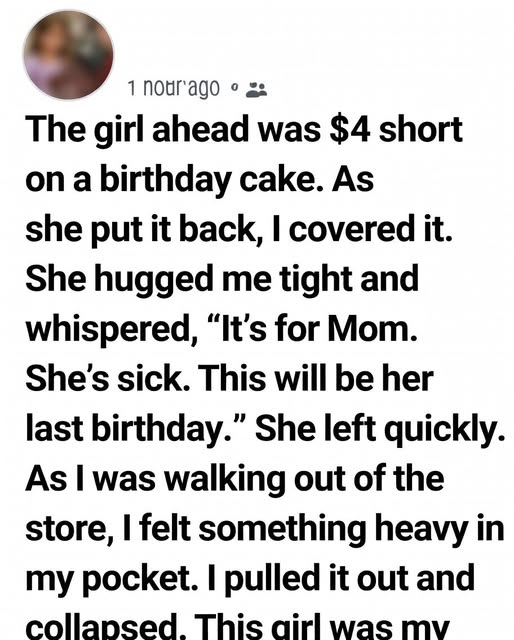
She couldn’t have been more than eight or nine years old. Small, quiet, standing near the bakery section with a box in her hands. It was a simple cake, nothing elaborate—white frosting, a bit uneven around the edges, the kind you’d pick up for a small celebration. She held it carefully, almost protectively, like it mattered more than it should.
At first, I didn’t think much of it. Kids come into stores all the time with parents nearby, or waiting just out of sight. But something about the way she stood there felt different. There was no one next to her. No adult guiding her, no distraction, no noise. Just her, the cake, and a kind of quiet tension that didn’t belong on a child’s face.
I found myself watching, not out of curiosity, but because something felt off.
She walked slowly toward the checkout counter, placed the cake down, and waited. When it was her turn, she reached into her pocket and pulled out what looked like a small handful of coins and folded bills. The cashier counted it. There was a pause. Then a quiet explanation.
It wasn’t enough.
The moment stretched longer than it should have. Not dramatic, not loud—just uncomfortable in a way that made you want to look away. The cashier wasn’t unkind, just matter-of-fact. The total was clear. The money didn’t match.
The girl didn’t argue. That’s what stood out most. No pleading, no attempt to negotiate. She just nodded slightly, as if she had expected this outcome all along. She looked at the cake one last time, then gently slid it aside and said a soft “thank you.”
It wasn’t resignation in the usual sense. It was acceptance—too calm, too practiced for someone her age.
She turned away.
And that should have been the end of it.
Most people would have continued with their day. It wasn’t their problem. It wasn’t urgent. Just another small, forgettable moment in a busy place.
But something about it stayed.
Sometimes, you don’t think things through. You don’t weigh the pros and cons or consider whether it’s your place to step in. You just act because doing nothing feels worse.
Before I fully processed it, I stepped forward.
I told the cashier I’d cover the rest.
It wasn’t a grand gesture. It wasn’t even a significant amount of money. Just a simple decision, made quickly, without overthinking.
But the reaction was immediate.
The girl froze.
She turned slowly, as if she wasn’t sure she had heard correctly. Her eyes met mine, searching for confirmation. When it settled in—when she realized the cake was actually hers—something shifted in her expression.
It wasn’t excitement, not in the way you’d expect from a child getting something unexpected.
It was relief.
Deep, overwhelming relief that seemed far too heavy for someone her age to carry in the first place.
Before I could say anything else, she stepped forward and hugged me. No hesitation, no awkwardness—just instinct. It caught me off guard, but there was nothing uncomfortable about it. It was genuine in a way that doesn’t happen often.
“It’s for my mom,” she said quietly.
That was it.
No elaboration, no attempt to make the story bigger than it was. Just a simple explanation that somehow said everything.
“She’s not feeling well.”
There was no doubt in her voice. No performance, no exaggeration. Just honesty.
I nodded, not really trusting myself to say anything that wouldn’t feel unnecessary. Some moments don’t need words. This was one of them.
She picked up the cake again, holding it with the same care as before—but now, it felt different. Like it had regained its purpose.
Then she walked away.
No lingering, no dramatics. Just a quiet exit, back into whatever world she had come from.
I finished my shopping, but the rhythm of the day had shifted. Everything felt slightly off, like I had stepped into something unexpected and hadn’t quite stepped back out yet.
It wasn’t until I got outside that I noticed it.
A small piece of paper in my pocket.
At first, I didn’t recognize it. I was sure it hadn’t been there earlier. I pulled it out, unfolded it, and saw the handwriting immediately.
Careful. Intentional.
“Thank you for helping me. I didn’t know what to do.”
Underneath the message was a drawing.
A cake.
Simple, slightly uneven, with one small candle on top.
It wasn’t artistic in the traditional sense. It didn’t need to be. Every line felt deliberate, like it had been drawn with purpose rather than skill.
And that’s when it hit me.
She had written it before.
Before she knew anyone would help. Before she reached the counter. Before she found out the money wouldn’t be enough.
She had come prepared to say thank you—just in case.
That detail stayed with me more than anything else.
It said something about her situation, about the way she saw the world. That help wasn’t guaranteed. That kindness wasn’t something you could count on. But still, she had left space for it, just in case it appeared.
That kind of awareness doesn’t come from nowhere.
I stood there longer than I expected, holding that piece of paper, trying to make sense of why something so small felt so significant.
We tend to think that making a difference requires something bigger. Something planned, intentional, maybe even complicated. We imagine impact as something measurable, something that leaves a visible mark.
But most of the time, it doesn’t look like that.
Most of the time, it’s a moment.
A decision made quickly, without analysis. A choice to notice instead of ignore. To step in instead of step around.
There was nothing extraordinary about what I did. Anyone could have done it.
But that’s exactly the point.
We often overcomplicate the idea of kindness. We wait for the right situation, the right scale, the right reason. And in doing so, we miss the moments that actually matter.
Because they don’t announce themselves.
They just appear, quietly, in the middle of ordinary days.
That note now sits somewhere I see every day.
Not as a reminder of what I did.
But as a reminder of what’s possible when you don’t look away.
It doesn’t take much to change the direction of a moment. Sometimes, it’s just a few steps forward. A simple decision. A willingness to respond without needing a reason beyond the fact that you can.
Kindness doesn’t need to be loud to be real.
It doesn’t need recognition, or validation, or a story attached to it.
It just needs to show up when it matters.
And sometimes, when it does, it leaves behind something far more lasting than you ever expected.