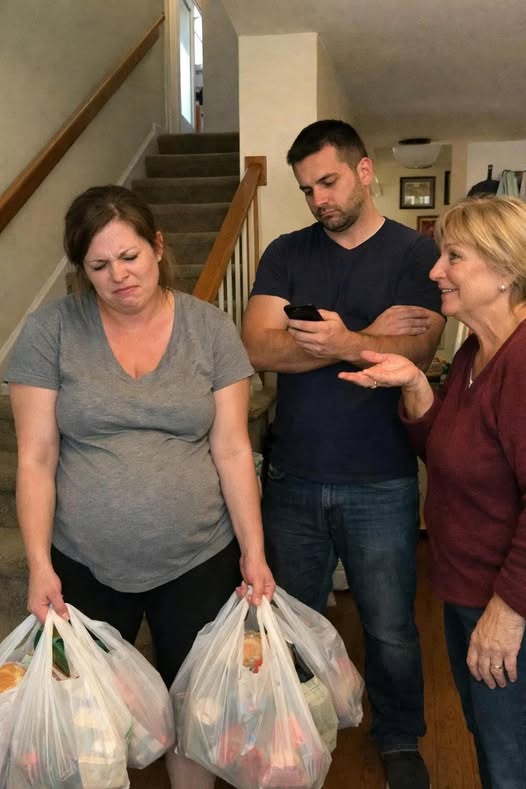
I was eight months pregnant the day I realized how invisible I had become inside my own marriage.
It wasn’t some dramatic moment, no screaming match or shattered plates, just a quiet afternoon that left a louder echo than any argument ever could. I had just come back from the grocery store, my arms burning, my lower back tight, the baby shifting heavily inside me like she was trying to find room in a world that already felt crowded. The bags weren’t filled with anything indulgent or unnecessary, just rice, milk, vegetables, prenatal vitamins, chicken breast, the kind of ordinary things that make up a life you’re trying to keep together.
I stood at the bottom of the stairs and looked at my husband, Mark, who was standing near the door with his keys still in his hand, scrolling on his phone like the world wasn’t waiting on him.
“Can you help me carry these up?” I asked, keeping my voice light even though my ankles were already throbbing. “I’m really tired.”
He hesitated. Actually hesitated. Like I’d asked him to do something unreasonable, something that required negotiation or debate.
Before he could answer, his mother, Evelyn, called out sharply from the kitchen.
“The world doesn’t spin around your belly,” she said, not even bothering to look at me. “Pregnancy isn’t a sickness.”

The words landed harder than the weight in my arms.
Mark didn’t defend me. He didn’t meet my eyes. He just nodded once, slow and obedient, as if she’d stated a fact that couldn’t be argued with.
Something inside me folded in on itself.
I didn’t say anything. I bent down, lifted the bags myself, and started dragging them up the stairs one by one. Each step felt heavier than the last, not just physically, but emotionally, like I was carrying something far bigger than groceries. I focused on my breathing, on not crying, because I had learned over the past year that tears only invited commentary. Tears were weakness. Tears were “hormones.” Tears were something Evelyn liked to diagnose but never comfort.
That night, I barely slept. The baby kicked relentlessly, restless, as if she could feel my tension, and I lay awake staring at the ceiling, wondering how I had ended up feeling so profoundly alone in a house full of people. Mark slept beside me, breathing evenly, unaware or unwilling to notice the distance growing between us like a crack spreading quietly through glass.
Just after sunrise the next morning, there was a knock on the door.
Not a polite tap. Not the casual knock of a neighbor borrowing sugar. This was loud, urgent, almost aggressive, like whoever stood on the porch wasn’t asking for permission to be heard.
Mark groaned, pulled on a shirt, and shuffled toward the door. I followed more slowly, one hand instinctively resting on my belly, my heart already beating faster. Something about that knock felt heavy with meaning.
The color drained from Mark’s face the moment he opened the door.
Standing on the porch were his father, Robert, and his two brothers, Andrew and Simon.
We didn’t see them often. In fact, we rarely saw them at all. There had been years of distance, old arguments no one talked about anymore, holidays spent separately, conversations reduced to polite nods and stiff small talk. Seeing them all together, unannounced, this early in the morning, made my stomach drop.
Robert didn’t waste time.
He stepped forward, gently but firmly moving Mark aside as if he weighed nothing, and looked directly at me.
“I came to apologize,” he said, his voice calm but unwavering. “For raising a lazy, ignorant man who doesn’t appreciate his wife or his unborn child.”
The silence that followed was suffocating.
Evelyn froze in the kitchen doorway. Mark stood there, stunned, mouth slightly open, saying nothing. Andrew and Simon remained quiet behind their father, faces serious, almost grim.
Robert didn’t look at his wife. He didn’t look at his son. His eyes stayed on me.
“I heard what happened yesterday,” he continued. “About the groceries. About how you were spoken to. About how you were treated.”
My throat tightened, and I had to swallow hard to keep my composure.
“I raised my sons to be strong,” he said. “But strength isn’t volume, and it isn’t control. Strength is responsibility. Strength is care. Strength is showing up when someone else is struggling.”
He paused, took a breath, and something in his expression softened.
“And today,” he said, “I came to make something clear.”
Mark shifted uncomfortably beside him.
“I was planning to go to my lawyer’s office later today,” Robert continued. “I had planned to review my will. For years, the plan was simple. Everything would go to my sons.”
Mark’s head snapped up.
“But plans change,” Robert said evenly, “when people show you who they really are.”
He gestured briefly toward Andrew and Simon.
“These two have shown consistency. Respect. Accountability,” he said. “And then there’s you,” he added, turning back to me.
I felt my eyes sting.
“Even exhausted, even unsupported, even carrying a child inside you,” Robert said, “you carried more weight yesterday than my son did standing there with empty hands.”
Mark looked like he’d been struck.
“You did what needed to be done without complaining,” Robert went on. “That tells me everything I need to know.”
He straightened, his voice firm.
“So here’s how it will be. The strongest members of my family will inherit what I leave behind. My two sons—and you.”
Evelyn finally found her voice, sputtering something about disrespect, about misunderstanding, about family matters being private. Mark opened his mouth, then closed it again, like he couldn’t find words that fit the moment.
Robert raised a hand, silencing them both.
“This isn’t about punishment,” he said. “It’s about values. And today, I saw them clearly.”
Then he did something I never expected.
He stepped closer and placed a gentle hand on my shoulder.
“Thank you,” he said quietly. “For protecting my grandchild. Even when no one protected you.”
They didn’t stay long after that. There was no shouting, no further explanation, no dramatic exit. Just truth, delivered cleanly and without cruelty.
When the door closed behind them, the house felt smaller. Quieter. Like something fundamental had shifted.
Evelyn retreated to the kitchen without a word. Mark stood frozen in the living room, staring at the floor.
For a long time, neither of us spoke.
When he finally did, his voice was low, uncertain, stripped of its usual confidence.
“I didn’t realize,” he said. “I didn’t think it was that bad.”
I looked at him, really looked at him, and for the first time I didn’t rush to reassure him.
“It was,” I said simply.
Something cracked in his expression then. Not shattered. But cracked enough to let something else in.
Over the weeks that followed, things began to change, slowly and awkwardly at first. Mark started doing things without being asked. Carrying bags. Cooking dinner. Sitting beside me instead of disappearing into his phone. He apologized more than once, not in grand gestures, but in quiet moments when it mattered.
Evelyn remained distant, but quieter. Smaller somehow.
Robert visited often. He checked on me. Asked how the baby was doing. Brought groceries without comment. Fixed things around the house without making it feel like charity.
When our daughter was born, healthy and loud and perfect, Robert held her with tears in his eyes.
“She’s strong,” he said. “Just like her mother.”
That night, as I lay in bed holding my newborn, Mark beside me, I finally felt something I hadn’t felt in months.
Peace.
Not because everything was perfect.
But because I was no longer invisible.
Because someone had seen my strength, named it, and refused to ignore it.
And that changed everything.