When my only child died, I believed I had buried every future version of family with him.
Five years later, a little boy walked into my kindergarten classroom carrying a familiar crescent-shaped birthmark beneath his right eye — and a smile that cracked open everything I thought had scarred shut.
Hope is a dangerous thing when it shows up wearing your dead son’s face.
Five years ago, I buried my son.
Most people know me as Ms. Carter, the dependable kindergarten teacher with extra tissues and gentle patience. They don’t see the empty chair at my kitchen table or the silence that follows me home.
My world stopped the night I lost Ethan.
He was nineteen when the phone rang. I can still see his half-finished mug of cocoa on the counter.
“Mrs. Carter? Is this Ethan’s mother?”
“Yes… who is this?”
“This is Officer Daniels. I’m so sorry. There’s been an accident. Your son—”
The words that followed rearranged my life. A drunk driver. A collision. He didn’t suffer.
The week after blurred into casseroles and soft voices.
“You’re not alone, Linda,” my neighbor Carol whispered, pressing a dish into my hands.
At the cemetery, Pastor Hill offered his arm. I refused it, though my knees trembled.
“I’m still here, Ethan,” I whispered at the fresh mound of earth. “Mom’s still here.”
Five years passed. I stayed in the same house. I poured everything into my students.
“Ms. Carter, look at my picture!” a boy named Jacob once shouted.
“It’s wonderful! Is that a puppy or a dinosaur?”
“Both!” he grinned.
Routine became survival.
Then came a Monday morning like any other.
I parked in my usual spot and whispered, “Let me make today count.” The school buzzed with its usual chaos. I handed out tissues, began the morning song.
At 8:05, Principal Alvarez appeared in my doorway with a small boy clutching a blue backpack.
“Ms. Carter, this is Mason. He just transferred.”
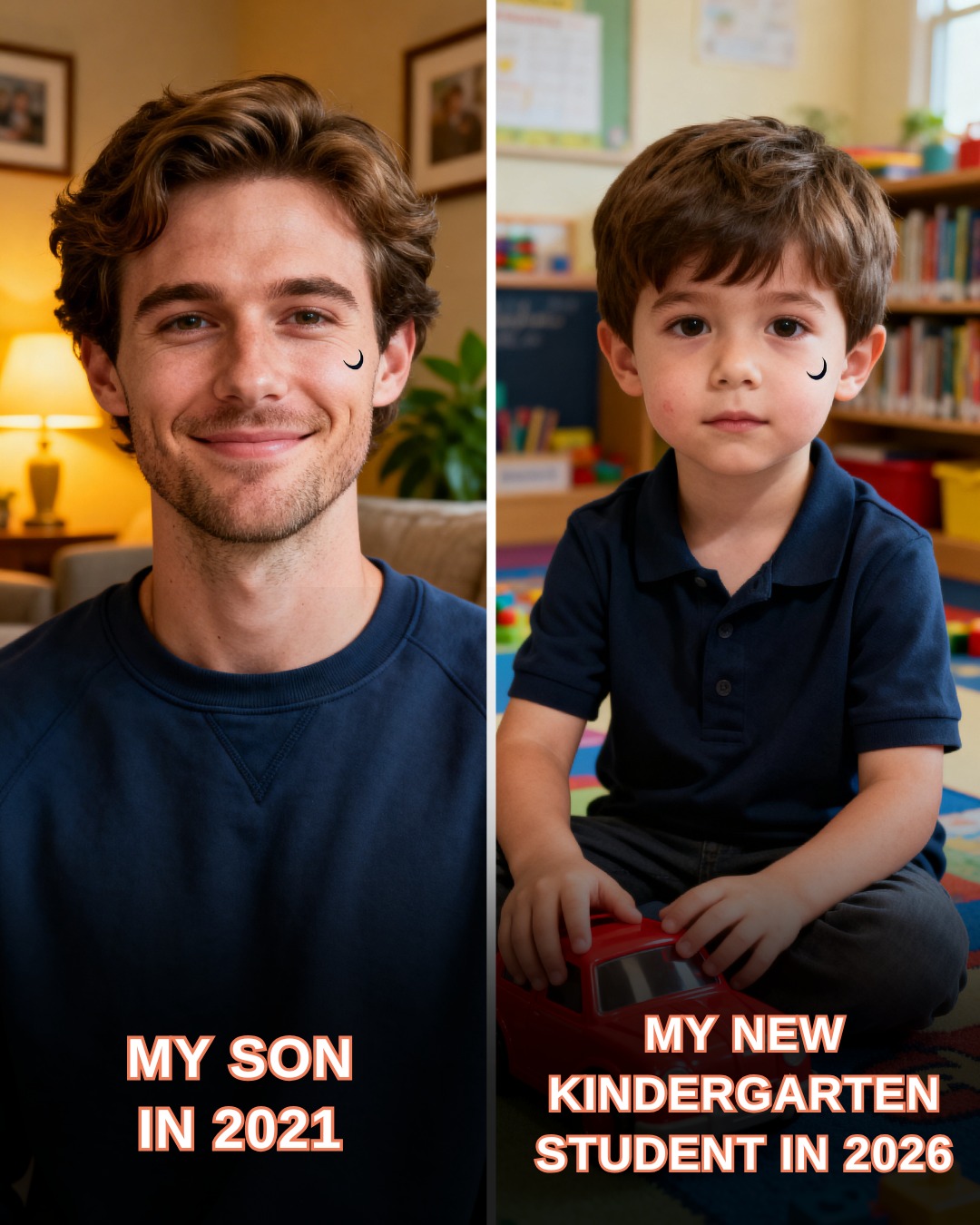
He stood beside her, brown hair falling into wide, watchful eyes.
“Hi, Mason,” I said gently. “We’re happy you’re here.”
He tilted his head slightly before offering a shy, crooked smile.
That’s when I saw it.
A crescent-shaped birthmark just beneath his right eye.
My breath caught. Ethan had the same mark. Same place.
Glue sticks slipped from my hand and clattered to the floor.
“Uh-oh, Ms. Carter!” little Sophie chirped.
“No harm done,” I forced a smile.
I kept moving. Read The Very Hungry Caterpillar. Sang the cleanup song. But my gaze kept drifting back to Mason — the way he squinted thoughtfully, the way he offered his snack to a classmate without being asked.
During circle time, I knelt beside him.
“Who picks you up after school, Mason?”
“My mom and dad,” he said brightly. “They’re both coming!”
That afternoon, I found reasons to linger.
When the classroom door opened, Mason jumped up.
“Mom!” he called, racing into a woman’s arms.
My heart stuttered.
It was Claire.
Older now, hair pulled back neatly, but unmistakable. She had dated Ethan during his final year of high school.
Our eyes locked.
“Hi,” I managed. “I’m Ms. Carter.”
“I know who you are,” she said quietly. “You’re Ethan’s mom.”
Other parents glanced over, sensing tension.
Principal Alvarez stepped closer. “Everything alright?”
“Just allergies,” I said quickly.
Claire swallowed. “Can we talk somewhere private?”
In the principal’s office, the air thickened with memory.
I didn’t ease into it.
“I need to know the truth. Is Mason… Ethan’s son?”
Claire closed her eyes briefly. “Yes.”
The word shook me.
“He has Ethan’s face,” I whispered.
“I should’ve told you,” she said, voice unsteady. “I was twenty and terrified. You were drowning in grief. I didn’t know how to walk into that with something else.”
“I lost him too,” I said.
“I know. But I was alone. Pregnant. Scared you’d take him from me. Or think I was trying to hold onto you through him.”
“This is my son’s child.”
“And he’s my child,” she replied firmly. “I carried him. I raised him.”
“I’m not trying to take him,” I said quickly. “I just… want to know him. Even just pancakes or the park—”
“No,” she said sharply.
Heat rushed to my face. “You’re right. Too fast. I’m sorry.”
The door opened. A tall man stepped inside.
“This is Mason’s dad, Ryan,” Claire said.
He looked between us. “What’s going on?”
I stepped forward. “I’m Linda Carter. Ethan’s mother.”
He frowned slightly.
“Ethan was Mason’s biological father,” Claire said.
Ryan went very still.
“You told me Mason’s father was gone,” he said carefully.
“He is. He died before he knew.”
Ryan absorbed that quietly. Then he looked at me.
“So you’re his grandmother.”
“Yes. I just found out today.”
He exhaled slowly. “This isn’t about DNA. I’m his dad in every way that matters.”
“And I respect that,” I replied.
“We’ll handle this carefully,” he said. “Slowly. With boundaries. Counselor involved. Mason sets the pace. No surprises.”
“I don’t want a tug-of-war,” I said softly. “I just want to be part of his life.”
Principal Alvarez nodded. “We can help coordinate support.”
Ryan looked at Claire, then at me. “We’ll talk.”
The following Saturday, I walked into a small diner downtown. They were already seated — Claire, Ryan, and Mason halfway through pancakes.
“Ms. Carter!” Mason beamed, syrup on his chin. “You came!”
He scooted over, patting the seat beside him.
Claire smiled nervously. “We thought you might want to join us.”
“I do love pancakes,” I said, sliding in.
Ryan passed me a menu politely.
Mason leaned close. “If you ask, they put chocolate chips inside.”
“Is that so?” I smiled.
“Mom says I’d live on pancakes and coloring books.”
“And chocolate milk,” Claire added.
“My son loved chocolate milk,” I said quietly. “Even at eighteen.”
Ryan studied me, then nodded slightly.
Mason pulled out a crayon and began drawing on a napkin.
“Can you draw, Ms. Carter?”
“I can try.”
We sketched a lopsided dog and a bright sun. Claire’s shoulders slowly relaxed. She slid the sugar toward me.
“You take two, right?”
I smiled faintly. “Still do.”
Mason looked up, eyes shining. “Are you coming next Saturday too?”
I glanced at Claire. She gave a small, brave nod.
“I’d like that very much,” I said.
As Mason leaned against my arm, humming softly, something inside me shifted. The ache was still there — it might always be. But it no longer felt like the end of my story.
Grief had not disappeared.
It had grown roots.
And somehow, through pancakes and crayons and careful boundaries, it had begun to bloom.
Now I carry a living piece of my son’s smile into every Saturday morning.
And this time, hope doesn’t feel quite so frightening.