Single dad saw a little girl searching trash on Christmas eve_and the truth left him stunned
 Part 1
Nathan Hayes expected Christmas Eve to be quiet.
At 11:47 p.m., he stepped out of his apartment building, keys in hand, bracing himself against the bitter December wind. Another night shift at the security company. Another stretch of silence. Since moving into the smaller apartment 3 years earlier, he had grown accustomed to nights that passed without meaning.
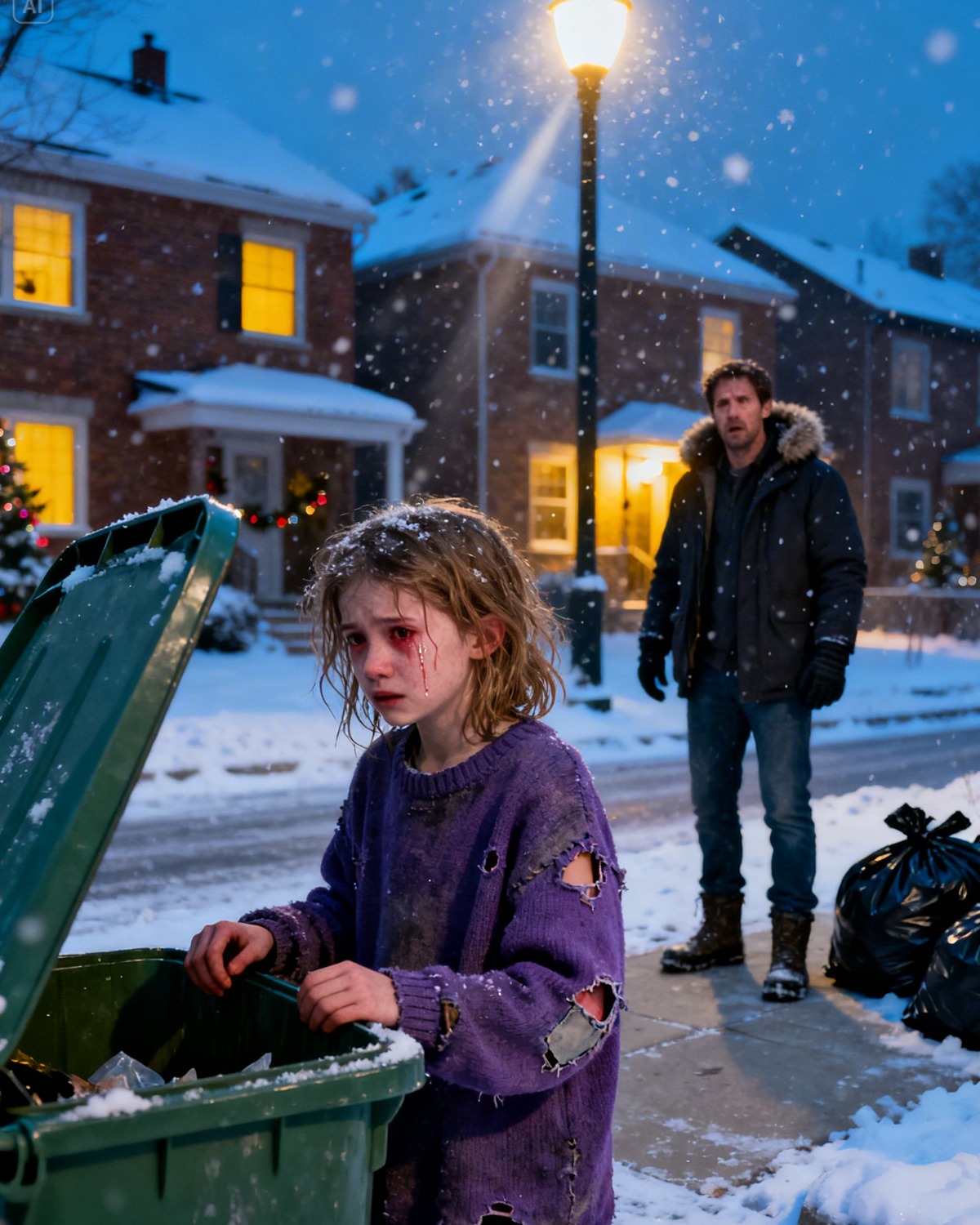
He was halfway to his car when movement near the dumpster caught his attention.
At first, he assumed it was a stray animal. Then his eyes adjusted to the darkness.
It was a child.
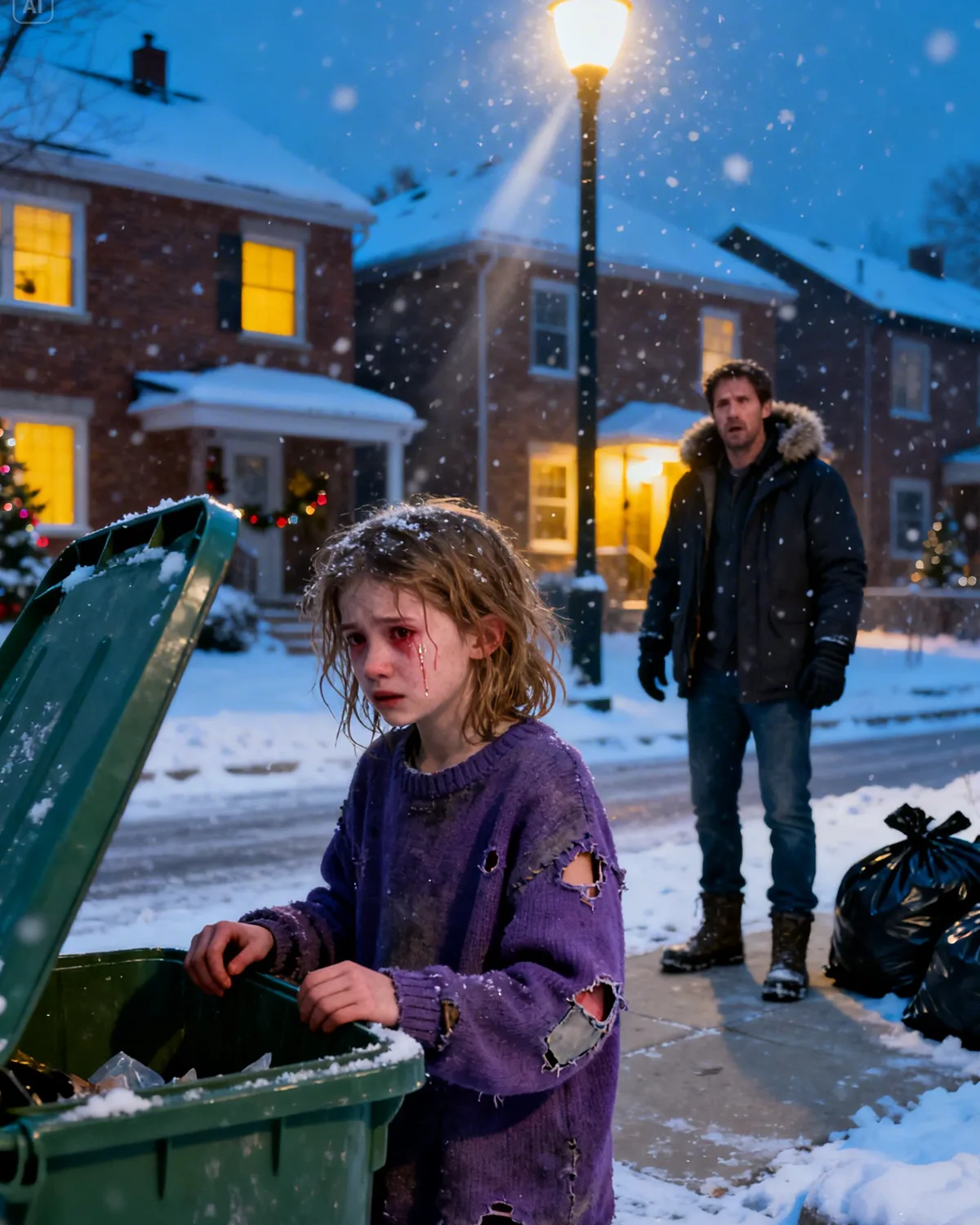
A little girl, no more than 7 years old, stood on tiptoe beside the garbage bin, methodically sorting through discarded containers and crumpled wrappers. Her thin fingers were red and trembling in the cold. She worked with quiet efficiency, as if this was not new to her.
Nathan’s feet moved before his thoughts caught up.
“Hey there,” he called softly.
The girl jerked her head up, wide brown eyes flashing with fear. She clutched a partially eaten sandwich to her chest, ready to bolt.
“It’s okay,” Nathan said, raising one hand slowly. “I’m not going to hurt you.”
She remained frozen, studying him with a guarded expression that did not belong on a child’s face. She wore a tattered purple jacket that hung loose on her small frame. Dark hair fell in tangled strands around pale, hollow cheeks.
“What’s your name?” he asked gently.
After a long pause, she whispered, “Melody.”
“Melody,” he repeated, kneeling to her level. “That’s a beautiful name. I’m Nathan.”
Her grip tightened around the sandwich.
“Are you looking for something specific?” he asked.
“Food,” she said, barely audible above the wind.
The word landed heavily.
“Where are your parents?” Nathan asked.
Her bottom lip trembled. She stared at the ground.
“I don’t have any.”
Something twisted inside him—something he had buried for 3 years.
Three years earlier, Nathan had been preparing to become a father. His wife, Sarah, had filled their small apartment with warmth. They had painted the nursery a soft yellow, choosing not to learn the baby’s gender. Every night she would guide his hand to her growing belly, and they would talk about names. About the future.
On a rainy Thursday morning in March, Sarah went into labor. Nathan drove to the hospital with shaking hands and a heart full of anticipation. An hour later, a doctor stood before him with eyes that would not meet his.
Complications. Unexpected. Rare.
In the span of a single day, he lost Sarah and their unborn son, David.
The man who left the hospital was not the same one who had entered it. In the years that followed, Nathan shrank his world. Smaller apartment. A job that required minimal conversation. Walls high enough to keep everything out.
Until now.
“What do you mean you don’t have any?” he asked Melody, his voice softer than it had been in years.
“I was living with my grandma Ruth,” she said. “After my mama left when I was a baby.”
She swallowed.
“Grandma Ruth got sick 3 weeks ago. She had this cough that wouldn’t go away. We didn’t have money for the doctor. She just kept taking medicine from the store.” Melody wiped her nose with her sleeve. “One morning I tried to wake her up. She wouldn’t open her eyes.”
Nathan felt the memory rise unbidden—shaking Sarah’s shoulder, whispering her name, waiting for her to respond.
“The people in uniforms came,” Melody continued. “They said I had to go live with new families. But none of them wanted me to stay. They kept moving me around. And the last people didn’t care about me. So I walked here. I thought maybe if I came back to our old neighborhood, Grandma Ruth might come home, too.”
“How long have you been out here?” Nathan asked.
“2 days. I’ve been sleeping in the basement next door. There’s a broken window.”
A 7-year-old child alone for 2 days in December.
Nathan checked the time. 12:03 a.m. Christmas Day.
“Melody,” he said carefully, “you don’t have to do this alone anymore.”
She looked at him with cautious disbelief.
“I know you don’t trust grown-ups,” he continued. “But I promise you—I’m not going anywhere.”
There was something in his voice that made her shoulders ease, just slightly.
“How about we start by getting you somewhere warm?” he asked.
After a long hesitation, she nodded.
Nathan’s apartment was modest and bare. No photographs. No decorations. Nothing to suggest the life he had once imagined. But when Melody stepped inside and felt the central heating, her eyes widened as if she had entered something extraordinary.
He ran a hot bath. He found smaller clothes for her—an oversized T-shirt, sweatpants with a drawstring, clean socks. While she soaked, he heated leftover soup and made grilled cheese sandwiches.
When Melody emerged, cheeks pink from the bath and hair clean, she looked younger. Fragile, but human again.
She ate carefully, stretching each bite.
“There’s more,” Nathan said gently. “You can have as much as you want.”
“Really?”
“Really.”
That night, as Melody slept restlessly on his couch, Nathan made calls. He contacted the Department of Children and Family Services. He requested information about emergency guardianship. He called his supervisor for time off. Then he dialed Mitchell, an old friend and lawyer.
“It’s Christmas morning,” Mitchell said groggily.
“Mitch, I need your help,” Nathan replied.
For the first time in 3 years, he meant it.
Part 2
Mitchell listened as Nathan explained everything.
“This is going to be complicated,” Mitchell warned. “Background checks. Home studies. Evaluations.”
“I don’t care,” Nathan said. “I’m not walking away.”
When he ended the call, he found Melody standing in the doorway.
“You’re still here,” she whispered.
“Of course I’m still here.”
“But in the morning—”
“In the morning we figure this out. You’re not going back to sleeping in basements. Not while I’m here.”
She threw her arms around his neck.
Something that had been frozen inside him for 3 years began to thaw.
The following weeks moved in a blur of paperwork and hearings. Nathan attended parenting classes. Submitted to psychological evaluations. Completed background checks. Met with social workers and counselors.
Melody remained with him under emergency placement.
Healing came unevenly.
Some nights she woke screaming from nightmares, reliving the morning she had tried to wake Ruth. Nathan would sit beside her until the shaking stopped.
Other times she hoarded food in her room, terrified it would disappear. Nathan gently explained, again and again, that there would always be more.
There were moments when she shut down completely, withdrawing as if preparing to be abandoned.
Nathan stayed.
He learned to braid hair—badly at first. He learned to help with homework. He learned to listen when a 7-year-old struggled to explain feelings too big for her vocabulary.
And he learned joy again.
The first time Melody laughed at one of his attempts at humor, the sound startled him. He had forgotten what laughter felt like inside his own home.
When she brought home an A+ in math, pride filled him in a way that grief never had.
The first time she called him “Dad,” tentative and soft, he excused himself to the bathroom and cried.
During a therapy session 6 months later, Nathan spoke openly.
“I thought my chance at being a father died with Sarah and David,” he told Dr. Richards. “But maybe I needed to understand loss the way Melody does. Maybe that’s why I can help her.”
“And how has caring for Melody affected you?” the counselor asked.
“She saved me,” Nathan said simply. “I thought I was rescuing her. But she gave me a reason to live again.”
Part 3
The courthouse hallway felt longer than usual.
Melody sat beside him, wearing a new purple dress that fit properly. Her hand found his.
“Are you nervous?” she asked.
“A little,” he admitted. “You?”
“Excited nervous,” she said thoughtfully. “Like opening a present you really want.”
When their case was called, they entered the courtroom together. Mitchell stood nearby, along with the assigned social worker and the guardian ad litem representing Melody’s interests.
Judge Patricia Hernandez reviewed the file.
“Mr. Hayes,” she began, “when you first requested emergency guardianship, you were a single man who had known this child less than 24 hours. I had concerns.”
She paused.
“The reports from Dr. Richards, from Melody’s teachers, and from the social workers monitoring your home all describe the same thing—a man who has dedicated himself completely to this child’s well-being.”
She turned to Melody.
“Is there anything you would like to say?”
Melody stood.
“Your Honor, Nathan saved my life. Not just that first night. Every day. He helps me with homework. He braids my hair, even when it’s crooked. He stays when I have bad dreams. He keeps his promises. I know he’s my real dad because he chooses me every day.”
The courtroom fell quiet.
Judge Hernandez smiled.
“By the power vested in me by the state, I grant the petition for adoption. Nathan Hayes, you are now the legal father of Melody Hayes.”
The gavel struck.
Nathan exhaled as if he had been holding his breath for 3 years.
“We did it,” Melody whispered.
“We did it,” he replied, lifting her into his arms.
That evening they celebrated with takeout Chinese food, a new tradition. Melody handed him a drawing she had made in art therapy: two figures holding hands in front of a house. Above them were the words My Family.
Nathan hung it on the refrigerator.
“I used to think family was only the people you were born with,” he told her. “But you taught me something different.”
Melody climbed into his lap.
“Thank you for not walking away that night,” she said.
He kissed the top of her head.
“Thank you for letting me stay.”
Later, as he tucked her into bed, Nathan stood for a moment in the doorway. The child who had been searching through garbage on Christmas Eve now slept peacefully in a room filled with warmth and certainty.
He had stepped outside that night expecting another lonely shift.
Instead, he had found his daughter.
Two broken lives had crossed in the cold.
By choosing to stay, they built something neither had thought possible.
A family formed not by blood, but by decision.
And in choosing each other, they had given one another exactly what they both needed most—a place to belong.