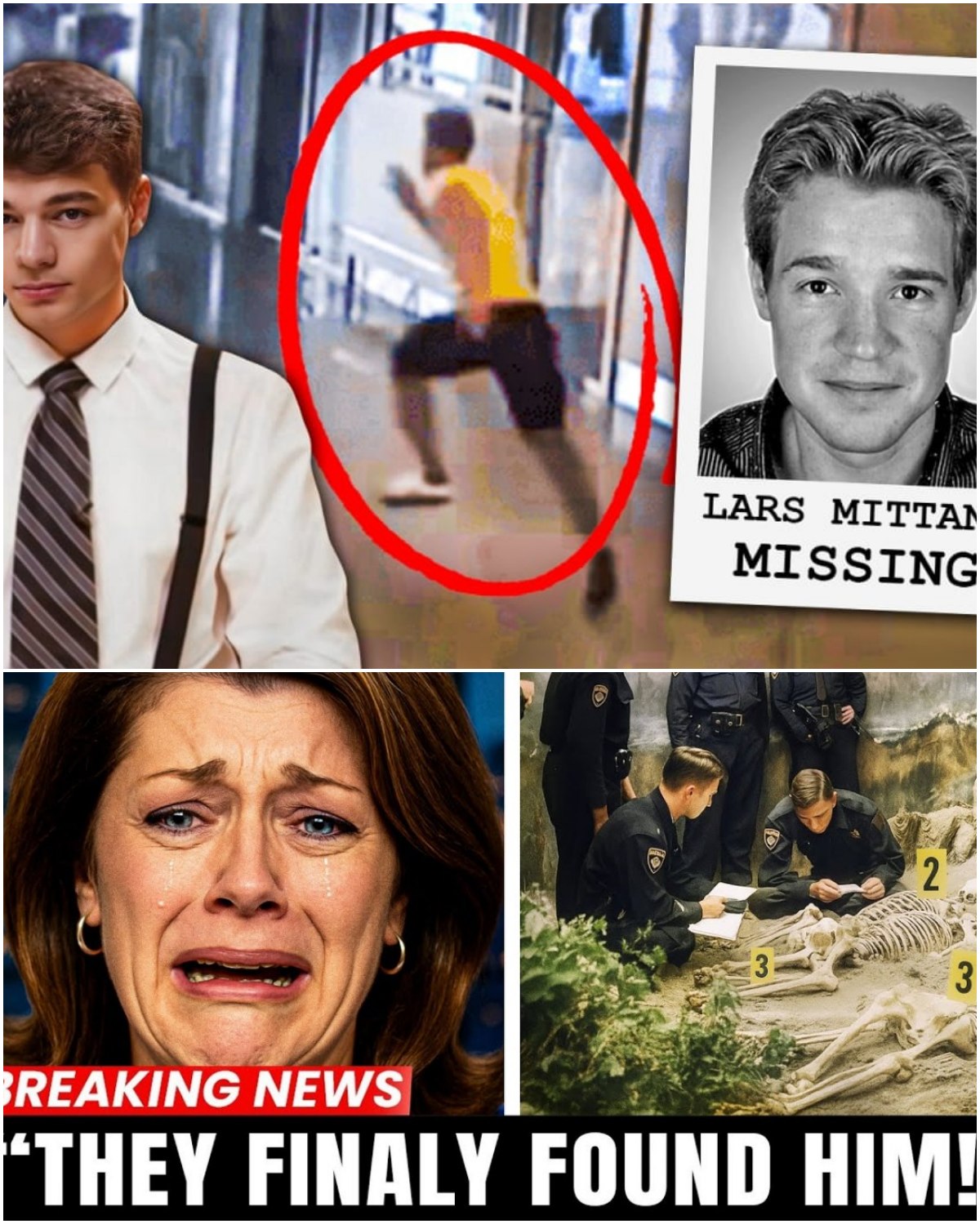
The first sound was breathing—ragged, mechanical, as if it belonged to a machine that had forgotten how lungs were supposed to work.
Lars Mittank woke on a concrete floor slick with condensation. Fluorescent light hummed above him, not flickering, not dimming—just a constant, surgical white that pressed against his skull. For a long moment, he didn’t know where he was, or when. His body knew pain before his mind caught up: a splitting ache behind his right eye, a stiffness in his neck, a tremor in his hands that would not stop.
He tried to sit up. The world tilted, then snapped back into place with a nausea so sharp he tasted metal.
Memory came in fragments. Bulgaria. The seaside resort. A fight. Blood on knuckles that weren’t his. A hospital room that smelled like antiseptic and old fear. And then—
The airport.
Lars squeezed his eyes shut, but the images kept coming.
In the summer of 2014, Lars Mittank had been twenty-eight years old and already tired in a way he couldn’t explain. He worked in a factory back in Germany, the kind of job that left grease under your nails and a dull ringing in your ears. When his friends suggested a cheap holiday on the Black Sea coast, he said yes too quickly, as if distance itself might fix something broken inside him.
Varna had smelled like salt and cigarettes. The nights were loud and careless, full of beer and arguments about nothing. On the fourth night, outside a bar pulsing with bass, a stranger’s shoulder clipped Lars’s own. Words were exchanged. Then fists. Then pain.
Someone hit him from the side. Someone else kicked him when he was already down.
He woke the next morning with his head wrapped in gauze and a doctor speaking Bulgarian too fast to follow. A concussion, they said. A ruptured eardrum. Nothing life-threatening, but flying might be a bad idea—for now.
His friends went home without him.
Lars told himself it was fine. He would rest. He would catch a later flight. He called his mother to reassure her, downplaying the injury, laughing too loudly. She heard something else in his voice, something brittle, but she let him go.
Over the next two days, sleep refused to come properly. When it did, it brought dreams of corridors that never ended and voices whispering just out of reach. He felt watched, though no one was there. The walls of his cheap hotel room seemed to press inward, breathing with him.
At night, he heard footsteps outside his door.
By the third day, fear had become a physical thing lodged in his chest. He went back to the hospital, insisting something was wrong. They gave him antibiotics, told him anxiety was normal after head trauma. He nodded, pretended to understand.
That was when the man in the hallway looked at him too long.
Not staring. Measuring.
Lars left the hospital shaking.
At the airport the next morning, dragging his bag behind him, the air-conditioning felt like needles against his skin. Every sound was too loud. Every face looked sharp, aggressive. He tried to check in, but the woman behind the counter told him he needed clearance from a doctor to fly.
He felt the room closing in.
That was when he called his mother again.
“Someone’s trying to kill me,” he whispered, his voice breaking. “I can’t explain. Please. You have to believe me.”
She told him to find a doctor at the airport clinic. She told him to stay where people could see him. He said okay, but even as he agreed, something inside him was already screaming run.
The surveillance cameras caught what happened next.
Lars stood up from the waiting area, eyes wild, movements jerky. He left his bag behind. He broke into a run, sprinting past security, past startled passengers, out through a side exit into the blinding sunlight.
And then he was gone.
For years, that was all the world had.
A video. A phone call. A disappearance that refused to make sense.
Online, Lars became a ghost that people argued over. Some said psychosis. Others said concussion-induced paranoia. Others went further—whispering about intelligence agencies, secret experiments, organ trafficking rings. Every theory found an audience.
Search teams combed the forests outside Varna. Divers searched the sea. Dogs lost his scent at the edge of a field.
Nothing.
Lars Mittank vanished on July 8, 2014, and time hardened around that fact like concrete.
His mother kept his room exactly as it was. His jacket still hung by the door. Every unknown phone number made her heart jump. Every year that passed without answers felt heavier than the last.
By 2025, most people had stopped looking.
Then a maintenance worker in northern Greece found a man living inside a decommissioned Cold War listening station, a concrete bunker half-swallowed by weeds and rust. The man was thin, bearded, sunburned, his clothes layered and mismatched. He spoke German with a broken rhythm, as if the language itself hurt him.
When asked his name, he hesitated.
“I think,” he said slowly, “I used to be Lars.”
The news hit the internet like an electric shock.
Lars Mittank was alive.
Photographs leaked within hours. His face was unmistakable, older now, carved by weather and time, but the same eyes stared out from beneath the grime. The same nose, slightly crooked from the fight. The same scar near his temple.
His mother collapsed when she saw him on television. Then she laughed. Then she cried until her chest hurt.
But from the beginning, something was wrong.
Lars refused to answer questions about the years he’d been missing. He agreed to return to Germany, but only under certain conditions: no cameras, no crowds, no hospitals unless absolutely necessary. He startled at sudden noises. He slept in short bursts, always facing the door.
Doctors found no obvious signs of brain damage beyond the old injury. Psychiatrists tried to coax memories out of him, but he shut down when pressed, retreating behind a polite, distant smile.
“I was somewhere safe,” he would say. “Then it wasn’t safe anymore.”
That was all.
The public wanted explanations. Closure. A neat ending to a story that had haunted them for over a decade.
They did not get one.
It was three weeks after his return that Lars began to write again.
Not emails. Not messages.
Maps.
He filled notebooks with careful, obsessive lines—coastlines, roads, clusters of buildings drawn from impossible angles. Coordinates scribbled in the margins. Symbols that repeated, over and over, like a private alphabet.
His mother found the first notebook under his bed and felt a familiar chill crawl up her spine.
When she asked him about it, Lars looked genuinely surprised.
“I didn’t realize I was doing that,” he said.
A former geography professor—now a consultant for missing persons cases—was brought in quietly. She studied the maps for hours without speaking.
Finally, she looked up.
“These aren’t imaginary,” she said. “They’re real places. Restricted ones.”
Military zones. Abandoned research facilities. Listening posts officially shut down decades earlier.
Places no tourist should ever have seen.
The truth began to leak sideways, through people who were not supposed to talk.
During the Cold War, Eastern Europe had been riddled with signal intelligence stations—facilities designed to listen, to record, to intercept. Some were abandoned. Some were repurposed. A few, according to rumors that never quite died, were never fully shut down at all.
Lars had run from the airport into the surrounding countryside, driven by terror so complete it erased reason. He had hidden in fields, slept in ditches, followed roads at night. Hunger had forced him closer to civilization, not farther away.
Eventually, he had stumbled upon a place that should not have existed.
A bunker that still had power.
At first, the men there had seemed helpful. Scientists, they said. Researchers. They gave him food. Treated his injuries. Asked gentle questions about what he’d heard, what he’d seen, who he’d spoken to.
Lars, exhausted and confused, answered.
He did not understand what he had wandered into until it was far too late.
They never locked the doors.
They didn’t have to.
The experiments were not what people online later imagined—no needles, no surgical tables, no screaming subjects strapped down. The cruelty was quieter than that.
They tested thresholds.
Isolation. Sound. Frequency. They played tones just below conscious perception, vibrations that made the bones in his skull hum. They asked him to describe what he felt. They adjusted variables. They watched.
At first, Lars thought the voices were hallucinations—whispers that slid into his thoughts uninvited. Warnings. Fragments of language that didn’t feel like his own. Over time, he realized they always came after the tones.
The facility wasn’t just listening to signals.
It was learning how to speak back.
Years blurred together. He was allowed outside sometimes, always escorted, always watched. They told him the world thought he was dead. They told him no one was looking for him anymore.
When he resisted, they reminded him how easily an accident could happen.
So he learned to cooperate.
And to wait.
The escape had not been heroic.
One night, alarms screamed through the bunker—real ones this time. Systems failing. Power surging unpredictably. The men who watched him panicked, shouting into radios that returned only static.
Lars felt it before he understood it: the low-frequency hum rising, spiraling out of control. The voices in his head became a roar, overlapping, incoherent, desperate.
Something they had built had begun to listen to itself.
In the chaos, no one noticed when he ran.
He didn’t stop running for days.
By the time he collapsed in Greece, years had passed, and the world had moved on without him.
When parts of this story finally surfaced—through whistleblowers, through documents that were never meant to see daylight—the reaction was not relief.
It was fear.
Officials denied everything, of course. They called the claims exaggerations, misinterpretations, conspiracy thinking resurrected by a traumatized man. But the maps Lars had drawn matched satellite images too precisely to dismiss.
The bunker in Greece was sealed within a week of his discovery.
Journalists tried to reach Lars. He declined all interviews.
One night, months later, his mother woke to find his bed empty.
No signs of struggle. No note.
Just a single notebook left open on the desk.
On the last page, he had written one sentence, over and over, until the paper tore.
It’s still listening.
They never found him a second time.
Some say he went back to destroy what he’d helped create. Others believe he was taken before he could try. A few insist he never left the house at all—that whatever walked out that door wasn’t entirely human anymore.
The truth, once again, refuses to settle.
But engineers working on new communication arrays in Europe report anomalies even now—feedback loops, phantom signals, bursts of data with no identifiable source. Patterns that look, disturbingly, like language.
Sometimes, late at night, Lars’s mother swears she hears a faint hum through the walls of her house. Not loud enough to frighten her anymore.
Just enough to remind her that some doors, once opened, never truly close.
And that the mystery of Lars Mittank was never about a man who ran from an airport—
—but about what followed him when he did.