A Retired Detective at a Gala Spotted a Wax Figure That Matched His 21-Year Unsolved Case
Charleston, South Carolina. October 15th, 2015. Vincent Hayes attended a medical charity gala in Charleston. He wasn’t supposed to be there. His daughter dragged him, said he needed to get out more. Around the ballroom were 12 wax figures. Historical medical teaching models over a hundred years old, or so everyone believed.
Vincent walked past 11 of them without a second glance. But the 12th one, Cleopatra, stopped him cold. Because Vincent recognized her face. He’d been staring at that face for 21 years. Ever since 16-year-old Aaliyah Porter disappeared and was never found. Until now.
Vincent Hayes stood in front of his bathroom mirror, struggling with his tie. 51 years old, retired from Charleston Police Department exactly 2 weeksago after 30 years of service. But retirement meant nothing when one case still haunted him every single day.
Aaliyah Porter, 16 years old, disappeared August 12th, 1994, 21 years ago. Vincent was 28 then. Young detective, first major case. He’d promised Aaliyah’s mother, Gloria, that he’d find her daughter. He never did. No witnesses, no leads, no body. Just a girl whovanished walking home from summer classes at her college.
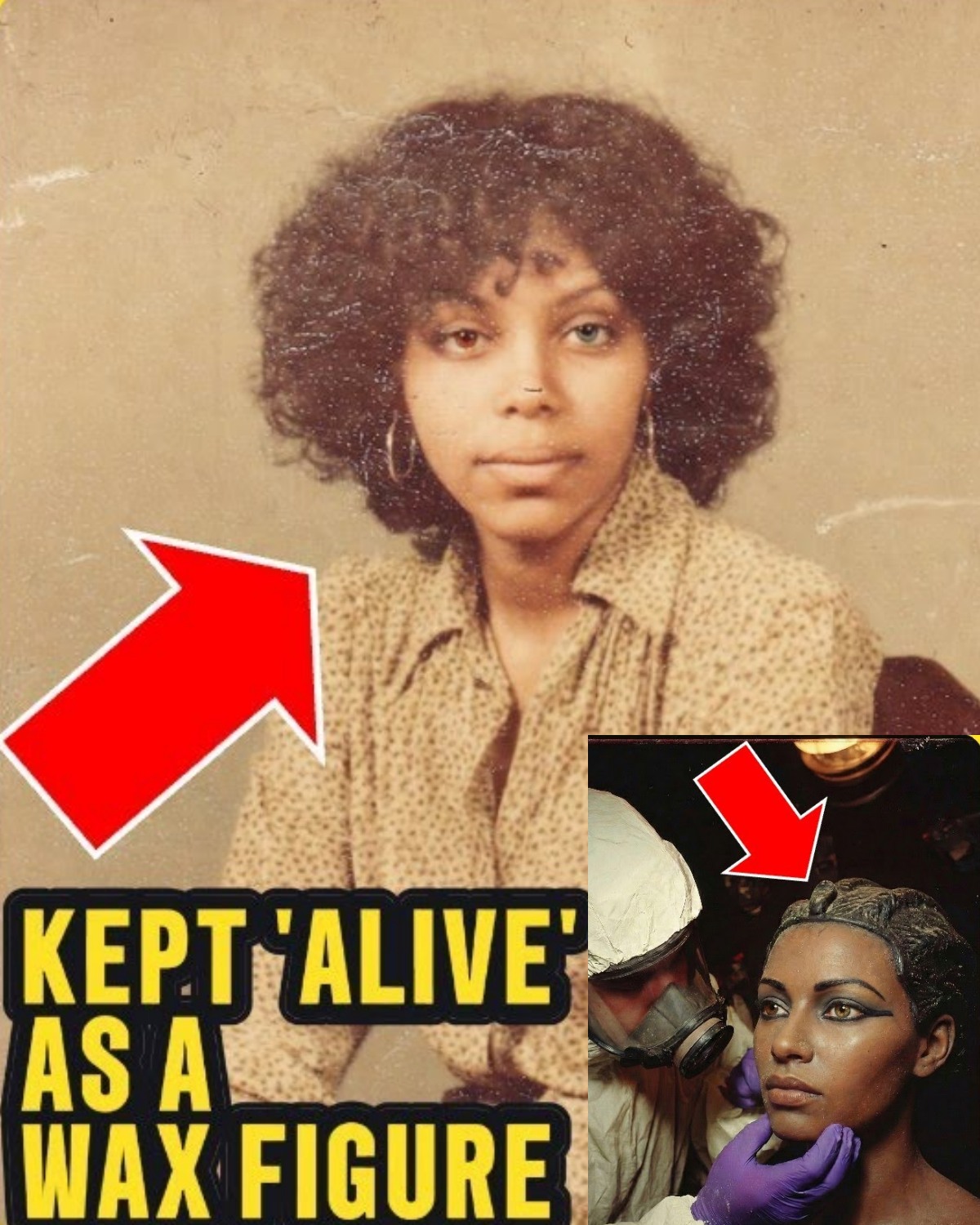
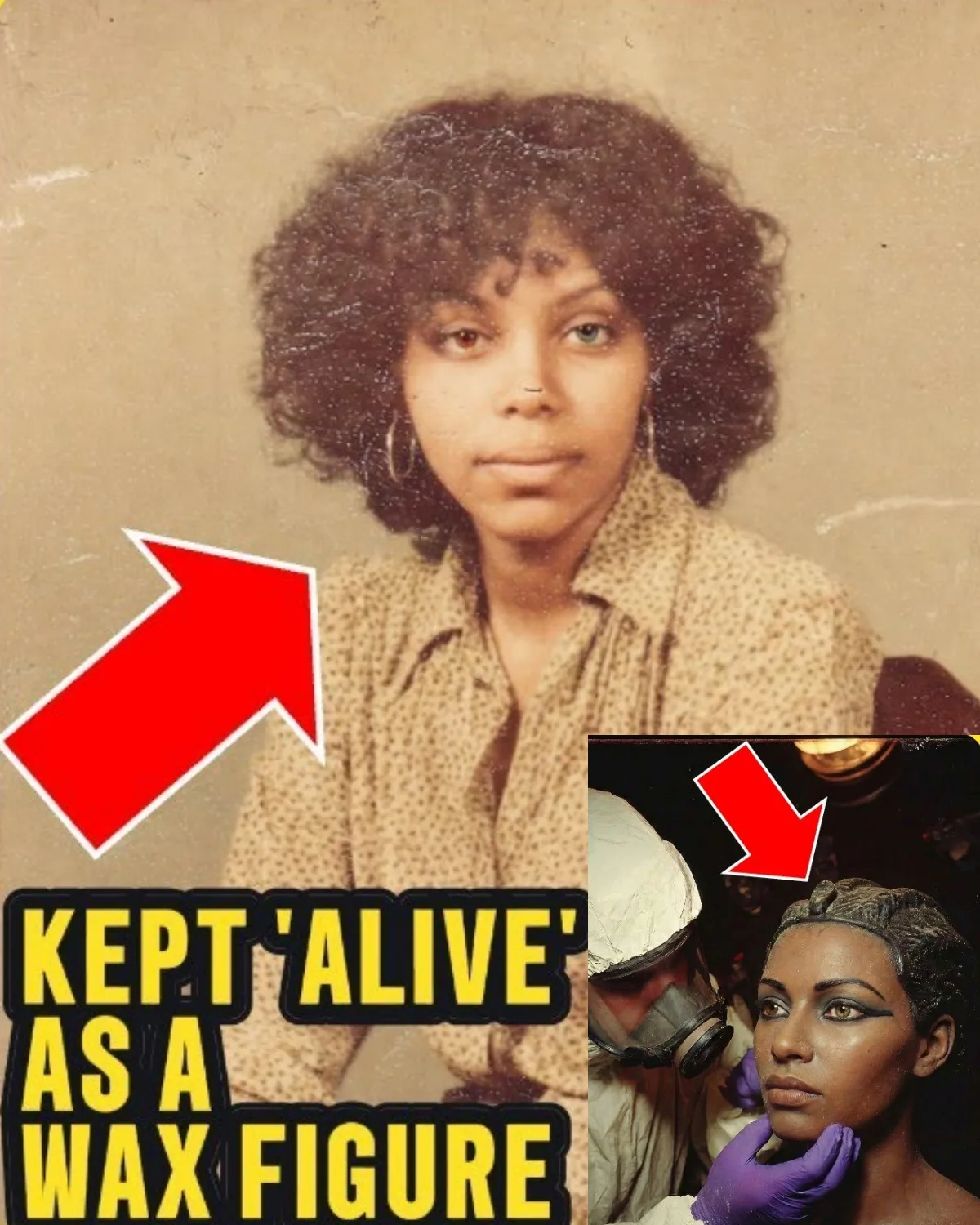
The case went cold after 6 months, officially closed. But Vincent kept the file, kept Aaliyah’s photo on his desk for three decades, kept her medical records memorized, kept searching even when everyone else stopped. Especially the distinctive detail that made Aaliyah unforgettable. Heterochromia. One brown eye, one hazel eye. Rare genetic condition present in less than 1% of the population.
Vincent had stared at photos of those eyes for 21 years. And tonight he was being dragged to a charity gala instead of working the case.
“Dad, are you ready?” His daughter Simone called from downstairs. “We’re going to be late.” Vincent gave up on the tie, left it slightly crooked, grabbed his jacket. Simone waited by the door. 32 years old, worked in hospital administration. She’d been worried about Vincent since he retired. Kept saying he needed to get out more and stop obsessing over old cases.
Tonight’s solution: dragging him to a $500 per plate medical charity gala.
“I still don’t understand why I need to be there,” Vincent said.
“Because you’ve been retired for 2 weeks and you’ve barely left the house. You sit in your office staring at cold case files. It’s not healthy, Dad.”
“I’m fine.”
“You’re not fine. Mom died 3 years ago. You retired two weeks ago. You have no hobbies, no friends outside the department. You need to do something besides relive old cases.”
Vincent wanted to argue, but Simone had her mother’s eyes. He could never win arguments with those eyes. “One night,” he agreed. “But I’m leaving by 9.”
“Deal.”
Charleston Convention Center. Grand Ballroom. 7:00 p.m. The ballroom was enormous. Crystal chandeliers, round tables with white tablecloths, hundreds of people in expensive clothes. Everyone here for one reason: honoring Dr. Harrison Caldwell. A banner stretched across the stage. “40 Years of Healing. Dr. Harrison Caldwell Tribute Gala.” Vincent felt completely out of place in his uncomfortable suit.
“Who’s Dr. Caldwell?” He asked as they checked in at the entrance.
“Pediatrician at Somerville Children’s Hospital,” Simone explained. “Practiced there for 40 years. Mostly serves rural communities, low-income families. Tonight’s raising money for hospital expansion. My hospital is partnering with them, so I got free tickets.”
Around the perimeter of the ballroom stood 12 glass display cases. Inside each case, a life-sized wax figure. Incredibly detailed historical figures in period costumes. A placard near the entrance read: “Dr. Caldwell’s Historical Medical Education Collection. 19th Century Wax Teaching Figures on Loan for Tonight’s Event.”
Vincent walked closer to examine them. Victorian era doctors, Civil War nurses, historical medical pioneers. Each figure posed differently, each wearing elaborate period costumes. The craftsmanship was remarkable. The wax skin looked almost real. Individual hairs painted onto eyebrows, texture on the lips. Even the fingernails had tiny details.
And in the back corner, near the stage, Cleopatra. The figure wore an Egyptian costume: gold headdress, elaborate jewelry, posed with one arm raised as if addressing subjects. Vincent was about to turn away when something caught his eye. The face. Something familiar about the bone structure. The way the light caught the features. He stepped closer to the display case.
The eyes. Glass eyes. Obviously glass, but the colors. One brown, one hazel. Vincent’s heart stopped.
Heterochromia. No. Coincidence. Lots of people had different colored eyes. This was just a historical wax figure from the 1800s. But Vincent couldn’t look away. He pulled out his phone, opened his photos, scrolled to a folder he’d kept for 21 years. Aaliyah Porter’s case file. He’d photographed every document, every piece of evidence.
There. Aaliyah’s school picture from 1994. 16 years old, smiling at the camera, one brown eye on the right, one hazel eye on the left. Vincent held the phone up, compared the photo to the wax figure’s face. The eye color placement was identical. Brown right, hazel left. The facial structure, the bone structure, the spacing between the eyes, the shape of the jaw. His hands started shaking. This couldn’t be possible. This was supposed to be a historical teaching figure from the 1800s. There was no way.
But those eyes, that face. Vincent had stared at Aaliyah Porter’s photo for 21 years. He knew every detail, every feature. He’d memorized that face trying to find her. And now he was looking at it, preserved in wax, on display at a charity gala.
“Sir, can I help you?” Vincent turned. A young man in a staff uniform. Name tag read: Event Security.
“I was just looking at the figure,” Vincent said, his voice not quite steady.
“Please don’t get too close to the displays. They’re very fragile. Dr. Caldwell’s collection is over a hundred years old.”
“Where did he get this one? Cleopatra.”
The staff member shrugged. “I just work security, sir. You’d have to ask Dr. Caldwell. He’s being honored tonight. He’s up on stage.”
Vincent looked toward the stage. An older white man stood there accepting congratulations. 75 years old, white hair, distinguished looking. People lined up to shake his hand.
“Dad.” Simone appeared beside him. “What are you doing? Dinner’s starting. We need to sit down.”
Vincent couldn’t take his eyes off the Cleopatra figure. “Simone, look at this figure’s eyes.”
“What about them?”
“Heterochromia. One brown, one hazel. Same as Aaliyah Porter.”
Simone looked at the figure, then at her father. “Dad, lots of people have different colored eyes.”
“Not in that exact pattern. Not with that facial structure.” Vincent pulled up Aaliyah’s photo on his phone, showed Simone. “Look, the placement is identical. The bone structure matches.”
Simone studied both images. Her expression shifted from skepticism to uncertainty. “It’s similar,” she admitted slowly. “But Dad, this is supposed to be an antique medical teaching figure. It can’t be.”
“I know what I’m looking at.” Vincent’s voice was firm. “I’ve stared at Aaliyah Porter’s face for 21 years. That’s her.”
Simone looked at the figure again, at her father. “What are you going to do?”
“I’m going to ask Dr. Caldwell where he got it.”
“Dad, you can’t just accuse a respected doctor of… of what? Having a missing person in his wax collection at his own charity gala in front of hundreds of people?”
“I’m not accusing. I’m asking.” Vincent started walking toward the stage.
Simone grabbed his arm. “Dad, please think about this. If you’re wrong, you’ll embarrass yourself. Embarrass me. This is my hospital’s partner event.”
“I’m not wrong.” Vincent pulled free, walked through the crowd. People were sitting down for dinner. The program was starting. Dr. Harrison Caldwell stood at the microphone, beginning his speech.
“Thank you all for coming tonight,” Caldwell said. His voice was warm, practiced. “40 years ago, I started practicing medicine in Somerville, a small rural community, underserved. I wanted to help children who didn’t have access to quality healthcare.” Applause.
Caldwell smiled. Continued talking about his decades of service, his dedication to low-income families, his passion for medical education. Vincent reached the edge of the stage. Waited for Caldwell to finish. The speech went on. Stories about grateful patients, statistics about children treated, plans for hospital expansion.
Finally, Caldwell concluded. “And tonight, I’m honored to share my personal collection with you. These historical wax figures represent the evolution of medical education. Before modern technology, doctors learned from specimens like these. I’ve collected them for 50 years. They remind me why I became a doctor. To understand the human body, to heal, to serve.” More applause. Caldwell stepped away from the microphone. People rushed forward to congratulate him.
Vincent pushed through the crowd. “Dr. Caldwell,” he called out.
Caldwell turned, smiled politely. “Yes?”
“I need to ask you about your collection. Specifically, the Cleopatra figure.”
“Isn’t it remarkable? One of my favorites. The detail is extraordinary.”
“Where did you get it?”
Caldwell’s smile faltered slightly. “I purchased it years ago. An estate sale in Columbia. Part of a medical school’s old teaching collection.”
“Which medical school?”
“I don’t recall exactly. It was decades ago.”
“Do you have documentation? Records of purchase?”
Caldwell’s expression cooled. “Why are you asking?”
“I’m a retired detective. That figure resembles someone from an old missing person case. I need to know its provenance.”
The crowd around them had gone quiet. People were listening now.
“Sir, these are historical artifacts,” Caldwell said. His voice was sharper. “Over a hundred years old. They can’t possibly have anything to do with modern missing person cases.”
“The figure has heterochromia. One brown eye, one hazel. Same distinctive pattern as a girl who went missing 21 years ago.”
“Heterochromia is not uncommon.”
“In that exact eye configuration? With that facial structure? The probability is extremely low.”
Caldwell’s face hardened. “I don’t appreciate these accusations, especially not at an event honoring my life’s work.”
“I’m not accusing. I’m asking for information.” And [clears throat] “I’ve given you my answer. I purchased that figure legally decades ago. Now, if you’ll excuse me—”
“If that figure is who I think it is… Her mother has been searching for her for 21 years. She deserves to know.”
“Security.” Caldwell’s voice was cold. He gestured to the uniformed staff. “This gentleman is disrupting the event. Please escort him out.”
Two security guards approached. Large men, professional. “Sir, you need to leave,” one said.
“I’m not disrupting anything. I’m asking legitimate questions.”
“Now, sir.” They grabbed Vincent’s arms. Firm grip, not gentle.
“Dad!” Simone rushed forward. Her face was red, mortified.
“Miss, your father needs to leave,” the guard said.
“I’m so sorry,” Simone said to Caldwell, to everyone watching. “He just retired. He’s been under a lot of stress. I apologize for this disruption.”
The guards pulled Vincent toward the exit, through the silent crowd, past the staring faces, past the wax figures, past Cleopatra. Vincent looked at the figure one more time. At those eyes. Aaliyah Porter’s eyes. He was sure of it.
They escorted him outside into the cool October night. The ballroom doors closed behind them with a heavy thud. Simone came out a moment later, furious.
“What were you thinking?” she demanded. “You just accused a respected doctor of… of having a dead body in his collection at his own charity gala in front of the entire medical community.”
“That figure is Aaliyah Porter.”
“You don’t know that. You saw similar eyes and convinced yourself.”
“Simone, I’ve worked missing persons for 30 years. I know Aaliyah’s face, her bone structure, her distinctive features. That’s her.”
“It’s a wax figure from the 1800s, Dad.”
“Then why wouldn’t Caldwell tell me where he got it? Why did he have me thrown out instead of just showing me documentation?”
Simone opened her mouth, closed it. She didn’t have an answer.
“I know how this looks,” Vincent said quietly. “I know you’re embarrassed. But I’m not wrong about this.”
“How can you be sure?”
“Because I’ve stared at her photo for 21 years. Because I promised her mother I’d find her, and I just did.”
Simone looked back at the convention center, at the darkened windows. “What are you going to do?”
“Prove it.”
Vincent didn’t sleep that night. He sat at his kitchen table with Aaliyah’s case file spread out. Every document, every photo, every piece of evidence he’d collected over 21 years. Missing person report from August 12, 1994. Aaliyah Porter, 16 years old, black female, 5’6″, disappeared walking home from summer classes at her college. Physical description: dark curly hair, brown skin, athletic build. Distinctive feature: heterochromia iridium, one brown iris, one hazel iris. Genetic condition, present from birth. Pattern: brown right eye, hazel left eye.
Vincent had the photo of the Cleopatra figure on his phone. He’d managed to take it before security grabbed him. He zoomed in on the face, the eyes. Brown right, hazel left. Exactly like Aaliyah. The facial structure matched, too. The cheekbones, the jawline, the nose shape. But how could he prove it? He needed more evidence, more than just visual similarity.
At 6:00 in the morning, his phone rang. Simone.
“Dad, I couldn’t sleep either. I’m sorry about last night.”
“Stop apologizing.”
“I’ve been thinking. If you really believe that figure is Aaliyah, we need to test it properly. I have access to facial recognition software at work, medical grade. We use it for patient identification.”
Vincent sat up. “You’d help me?”
“I’m still not convinced you’re right. But if there’s even a chance that figure is a missing person, we need to know. The gala ended this morning. They’re packing up Caldwell’s collection right now. If we’re going to photograph that figure, we need to go now.”
They arrived at the convention center at 7:00 a.m. The loading dock was open. Workers dismantling displays, caterers cleaning up. The ballroom mostly empty. The wax figures were being carefully wrapped and crated.
“Can we help you?” A worker in coveralls approached them.
“I’m from MUSC,” Simone said smoothly, showing her hospital ID. “We’re writing about last night’s event for our newsletter. Can I get some photos of Dr. Caldwell’s collection before you pack it?”
The worker shrugged. “Be quick. We’re loading the truck in 20 minutes.”
Simone pulled Vincent toward the Cleopatra figure. It was still in its display case, not yet wrapped. “Take photos,” she whispered. “Multiple angles. Clear shots of the face.”
Vincent photographed the figure from every direction. Close-ups of the eyes, the facial structure, the bone placement, the ear shape, every identifying feature.
“Got it,” he said.
They left before anyone asked questions.
At Simone’s office downtown, she uploaded the photos to her computer, pulled up professional facial recognition software. “This is age progression technology,” she explained. “Used to update photos of missing children. Takes an old photo and projects what they’d look like years later.”
She uploaded Aaliyah’s 1994 school photo, 16 years old. “The software will age her face 21 years. Show what she’d look like at 37.” The program ran calculations, generated an aged image. Then Simone uploaded the Cleopatra figure photo. “Now we compare the aged Aaliyah projection to the figure. The software analyzes bone structure, facial proportions, distinctive features. If there’s a match, it’ll flag it.”
They waited. The program processing, comparing thousands of data points. Results appeared on screen.
Facial structure match: 96%. Probability of random match: less than one in 100,000. Distinctive features matched: heterochromia pattern exact. Bone structure: high confidence. Facial proportions: high confidence.
Simone stared at the screen. “Dad,” she whispered. “You were right. That’s her. That’s Aaliyah Porter.”
Vincent felt something break inside him. 21 years. 21 years of searching, of wondering, of carrying guilt. And Aaliyah had been there all along, preserved, displayed, while her mother searched desperately.
“We need to take this to the police,” Simone said. “Now.”
Charleston Police Department, cold case unit. Vincent found Detective Lisa Park at her desk. They’d been partners for 15 years before Vincent retired.
“Lisa, I need you to look at something.” He explained everything. The gala, the figure, the eyes, the facial recognition analysis. Lisa listened, her expression shifting from skeptical to concerned.
“You’re telling me Dr. Caldwell has a wax figure that’s actually Aaliyah Porter?”
“The facial recognition software says 96% match. The heterochromia pattern is exact. The probability of this being coincidence is less than 1 in 100,000.”
“Vincent, Dr. Caldwell is… he’s respected, connected. He knows the mayor, the police chief, the hospital board.”
“I know. But the evidence doesn’t lie.”
Lisa looked at the photos, at the analysis. “Even if this software is accurate, it doesn’t prove anything criminal. Maybe Caldwell purchased a figure that happened to resemble Aaliyah. Maybe someone made a figure using her as a model before she disappeared.”
“She disappeared 21 years ago. That figure supposedly dates to the 1800s. Those timelines don’t match.”
“I’m just saying accusing Caldwell of anything requires ironclad evidence. We’d need to prove that figure actually contains human remains. We’d need DNA testing.”
“So get a warrant.”
“Based on facial recognition software? No judge will authorize that. We’d be asking to destroy a potentially valuable historical artifact based on visual similarity.”
Vincent felt the familiar frustration. The system protecting powerful people. “So what do I do?”
“Find more evidence. Find a connection between Caldwell and Aaliyah. Find out where he really got that figure. Then maybe we can move forward.”
Lisa paused. “But Vincent, be careful. If you’re right about this, whoever created that figure doesn’t want it discovered. Start asking questions, you might attract attention you don’t want.”
Vincent spent the next three days researching Dr. Harrison Caldwell. Medical degree from University of South Carolina, 1967. Pediatrics residency at MUSC. Private practice in Somerville from 1972 to present. 43 years serving rural communities. Hundreds of grateful patients. Awards. Recognition. Spotless reputation.
But Vincent found something interesting buried in old records. Caldwell’s medical school roommate: Robert Kensington. Vincent researched Kensington. CEO of Kensington Biotech, pharmaceutical company headquartered in Columbia. Specialized in drug development and clinical trials. Caldwell and Kensington had stayed close for 50 years. Kensington served on Somerville Children’s Hospital board. They’d co-authored medical papers together in the 70s. Their families took vacations together. Very close friends.
Vincent dug deeper into Kensington Biotech. Found archived newspaper articles from 1994. “Local Pharmaceutical Company Seeks Volunteers for Clinical Study.” The article described Kensington Biotech recruiting college students for drug trials, testing an experimental anti-depressant medication. Volunteers would receive $5,000 for participation. Study location: Kensington Biotech Research Facility in Columbia. The recruitment dates: July through August 1994.
Aaliyah disappeared August 12, 1994.
Vincent’s pulse quickened. He kept searching. Found another article, smaller, buried in the archives. “College Students Volunteer for Depression Medication Trial.” The article included a photo. A recruitment fair at Morehouse College. Students signing up. And in the background, barely visible, a young woman with dark curly hair. Vincent enlarged the photo, enhanced it. Aaliyah Porter. She was there. At the recruitment fair. Right before she disappeared.
Vincent grabbed his phone, called Aaliyah’s former roommate, a woman named Shiree Williams. She’d been interviewed in the original 1994 investigation, but didn’t know anything useful. Maybe she did now.
“Miss Williams, this is Vincent Hayes, Charleston PD. I interviewed you back in ’94 about Aaliyah Porter.”
“I remember.” Her voice was cautious. “Did you find her?”
“I’m trying to. I need to ask you something. Did Aaliyah ever mention volunteering for a drug study? A clinical trial?”
Silence. Then, “Oh my god. The pharmaceutical study. I completely forgot about that.”
Vincent’s grip tightened on the phone. “Tell me everything.”
“There was a company recruiting on campus that summer. Kensington Biotech. They were offering $5,000 to student volunteers. Depression medication trial. Aaliyah needed money for next semester’s tuition. Her financial aid hadn’t come through yet. She signed up.”
“When?”
“Early August. She went to the facility for the first phase. Initial screening and baseline tests. She was supposed to come back a week later to start the actual trial. But she disappeared before the second appointment.”
“Did she mention anyone from the company? Any names?”
“No. Just that the money would save her. $5,000 was huge for us back then.”
“Did you tell the police this in ’94?”
“No one asked about drug trials. They asked about boyfriends, friends, classes, normal stuff. I didn’t think the trial mattered. She disappeared before she even started taking the medication.”
Vincent thanked her, hung up. Aaliyah went to Kensington Biotech facility in early August 1994. Disappeared August 12th. Never came back for her second appointment. And now she was a wax figure in Dr. Caldwell’s collection. Caldwell and Kensington were best friends. The connection was there. Vincent could feel it. Something happened at that facility. Something that killed Aaliyah. And Caldwell helped Kensington cover it up.
Vincent received a phone call that night. Unknown number. He almost didn’t answer.
“Hello?”
Heavy breathing. Then a voice, distorted, electronic, like speaking through a voice modulator. “Stop investigating Dr. Caldwell.”
Vincent sat up. “Who is this?”
“You’re retired. This doesn’t concern you anymore. Walk away.”
“If Caldwell did nothing wrong, why are you threatening me?”
“This is your only warning. Stop digging or there will be consequences.” The line went dead.
Vincent stared at his phone. Someone was watching him. Someone knew he was investigating. Someone with resources, with connections, with the ability to make threats.
The next afternoon, Vincent came home from the grocery store to find his front door slightly ajar. He’d locked it. He was certain. He pushed the door open carefully, scanned the interior. Nothing looked disturbed. But Vincent had lived alone for 3 years. He knew his house. He knew when things were wrong. The living room was too neat. Someone had searched it professionally. Put everything back almost perfectly, but not quite. His desk drawers were closed, but Vincent always left the top drawer slightly open. Now it was flush. His computer was off. He’d left it in sleep mode. Papers on his kitchen table were stacked. He never stacked them. He spread them out to work.
Someone had been here. Searched the house. Gone through his files. And on the kitchen table, placed prominently on top of the Aaliyah Porter case file, a note. Typed. No signature. “Drop it or your daughter pays.”
Vincent grabbed his phone, called Simone. “Where are you right now?”
“At work. Dad, what’s wrong?”
“Someone broke into my house. Left a threat. They mentioned you specifically. I need you to leave work immediately. Don’t go home. Meet me at—” He thought quickly. “The Starbucks on King Street. The one with the side entrance. 30 minutes.”
“Dad, you’re scaring me.”
“30 minutes. Don’t tell anyone where you’re going. Just leave.”
Vincent grabbed his keys, his wallet, Aaliyah’s case file, headed for the door. Someone didn’t want him investigating Caldwell. Someone powerful enough to hire people to break into his house, to threaten his daughter. But Vincent had spent 30 years working cases. He knew threats meant he was close to something important. Close to the truth.
Vincent met Simone at the Starbucks, took her to a hotel, paid cash for a room, no credit cards that could be traced. “Stay here. Don’t call anyone. Don’t tell anyone where you are. I’ll fix this.”
“Fix what? Dad, what’s happening?”
“Someone doesn’t want me looking into Caldwell. Someone powerful enough to hire people to break into my house. I’m going to end this, but I need you safe first.”
“We should go to the police.”
“The police can’t help. Not yet. Not until I have proof.” Vincent hugged his daughter. “I’ll call you when it’s safe. I promise.”
He left Simone at the hotel, drove to Somerville, to the Children’s Hospital where Caldwell practiced. He was done playing by rules.
Somerville Children’s Hospital was small, single building, served rural communities, low-income families. Vincent walked in like he belonged. Straight to the administration desk. “I need to see Dr. Caldwell. It’s urgent.”
“Do you have an appointment?”
“Tell him Vincent Hayes is here. Tell him if he doesn’t see me, I’m going straight to the media with what I know about Aaliyah Porter and Kensington Biotech.”
The receptionist’s expression changed. She picked up the phone, made a call. A moment later. “Dr. Caldwell will see you. Third floor, office 302.”
Vincent took the elevator up. His phone was in his pocket. Recording app activated.
Dr. Caldwell’s office was small, cluttered with medical journals, photos of smiling children. 40 years of treating patients. Caldwell sat behind his desk, looking older than he had at the gala. Tired.
“Mr. Hayes. What do you want?”
“The truth about Aaliyah Porter. About that wax figure.”
“I’ve already told you—”
“I know about Kensington Biotech. I know Aaliyah volunteered for a drug trial at your friend’s facility in August ’94. I know she disappeared right after. I know you and Robert Kensington have been best friends for 50 years. I know something happened at that facility and you helped him cover it up.”
Caldwell’s jaw tightened. “You don’t know anything.”
“Then tell me I’m wrong. Tell me that figure isn’t Aaliyah Porter. Explain to me why you won’t show me documentation of where you got it. Explain why someone broke into my house last night and threatened my daughter.”
“I didn’t order anyone to threaten you.”
“But you know who did. Was it Kensington? Is he the one trying to keep this quiet?”
Caldwell stood. “Get out of my office.”
“I have Aaliyah’s medical records. I have genetic documentation of her heterochromia. I have facial recognition analysis showing a 96% match. I have witnesses who say she went to Kensington’s facility and never came back. I have enough to make the police investigate. The only question is whether you help me willingly or whether I force your hand.”
“You’re making serious accusations without evidence.”
“Then give me evidence. Let the police DNA test that figure. If it’s really just a historical artifact, the test will prove it. You’ll be vindicated. I’ll be wrong. Everyone moves on.”
“The figure is fragile. Over a hundred years old. Testing would destroy it.”
“It’s not a hundred years old.” Vincent stepped closer. “It’s 21 years old. You made it. You preserved Aaliyah’s body after she died in that trial. You turned her into a wax figure so Robert Kensington could hide what his company did.”
“That’s insane.”
“Is it? Because I think you’ve been doing this for years. I think Aaliyah wasn’t the only one. I think whenever someone died in Kensington’s trials, you’d preserve the body, hide the evidence, add another figure to your collection. How many, Dr. Caldwell? How many people died in Robert Kensington’s illegal experiments?”
Caldwell’s face had gone pale. “Get out,” he said quietly.
“Tell me the truth. You’ve spent 40 years helping children. You don’t have to protect Kensington anymore. Help me bring him to justice. Help these families get closure.”
“I said, get out.” Caldwell pressed a button on his desk. “Security to office 302.”
Two hospital security guards arrived within minutes. “Escort this man off hospital property,” Caldwell ordered. “If he comes back, call the police.”
The guards grabbed Vincent. Started pulling him toward the door.
“You can’t hide this forever,” Vincent called out. “The truth is coming. You can help me or you can go down with Kensington. Your choice.”
They dragged him out, down the elevator, through the lobby, out to the parking lot. “Don’t come back,” one guard warned.
Vincent got in his car, drove away. But his phone had recorded the entire conversation. Every word, every evasion, every threat. Not a confession, but something.
Vincent went straight to Charleston PD, found Lisa Park, played her the recording.
“He didn’t deny it,” Vincent pointed out. “When I accused him of preserving bodies, he didn’t deny it. He just told me to leave.”
“That’s not an admission,” Lisa said carefully.
“It’s suspicious as hell. Combined with everything else. The facial recognition match, the Kensington connection, Aaliyah attending that clinical trial right before she disappeared. You have enough for a warrant.”
Lisa was quiet for a long moment. “Let me talk to the captain.”
An hour later, Vincent sat in Captain Morrison’s office. Morrison listened to everything, reviewed the evidence.
“This is thin,” Morrison said. “We’re talking about accusing a respected doctor and a pharmaceutical CEO of covering up deaths and preserving bodies. That’s… that’s insane.”
“The evidence supports it,” Vincent insisted.
“The evidence is circumstantial. Facial recognition software and coincidental timing and a threatening phone call and a break-in. Someone doesn’t want this investigated.” Morrison rubbed his face. “Even if you’re right, we can’t get a warrant to DNA test that figure without something stronger. We need direct evidence.”
“So what do I do? Wait for them to threaten my daughter again? Wait for more evidence to conveniently disappear?”
Morrison was quiet. Then, “You’re a civilian now, Vincent. You can do things we can’t. If you find something concrete, something that directly ties Caldwell to that figure, bring it to us. We’ll move forward.”
Vincent understood. Morrison was giving him permission to investigate unofficially.
“Be careful,” Morrison added. “If you’re right about this, these people have killed before.”
Vincent spent the next week digging deeper. He researched Kensington Biotech’s clinical trial history, found patterns, gaps. In 1997, 3 years after Aaliyah, the company reported another volunteer “withdrawal” from a trial. Student named Marcus Chen. “Left the study for personal reasons.” No follow-up. In 2001, another volunteer “withdrawal.” Sarah Williams. “Moved out of state.” No follow-up. In 2005, 2008, 2011, 2014. Every few years, a volunteer would “disappear” from Kensington Biotech trials. Always listed as withdrawal, always with vague explanations.
Vincent cross-referenced the names with missing person databases. Marcus Chen, reported missing by family in 1997, never found. Sarah Williams, reported missing by roommate in 2001, never found. All of them. Every single volunteer who “withdrew” from Kensington’s trials. All had missing person reports filed. All were never found. 12 names total. 12 missing people. All connected to Kensington Biotech.
Vincent felt sick. Dr. Caldwell had 12 wax figures in his collection. 12 figures. 12 missing people. All volunteers in Robert Kensington’s trials. This wasn’t just about Aaliyah. This was systematic. Years of illegal trials, years of deaths, years of cover-ups.
Vincent took everything to Lisa Park. “12 missing people,” he said. “All connected to Kensington Biotech, all disappeared after volunteering for trials. And Caldwell has exactly 12 wax figures in his collection.”
Lisa stared at the evidence. “This is enough. I’m taking this to the DA.”
The district attorney reviewed the case for 3 days, then issued warrants: for Dr. Harrison Caldwell’s arrest, for a search of his home, for DNA testing of all 12 wax figures.
Police arrested Caldwell at the hospital, took him into custody without incident. Searched his home in Somerville. Found a laboratory in the basement. Sophisticated preservation equipment, chemicals, tools. Detailed notes. 12 binders. 12 names. 12 dates. 12 procedures. All documented. Everything Caldwell had done. Every body he’d preserved. Every cover-up.
Including detailed notes on Aaliyah Porter. “Subject: Aaliyah Porter, age 16. Died August 12th, 1994 at Kensington Biotech Research Facility. Cause: Adverse reaction to experimental compound KB-747. Massive brain hemorrhage. Subject deceased before emergency services could be contacted. Body retrieved by H. Caldwell at 2200 hours. Preservation process began August 13th, completed August 20th. Subject preserved as Egyptian figure ‘Cleopatra’ and added to personal collection.”
The notes were clinical, detached, like Aaliyah was a specimen, not a person. The same for all 12 victims.
Police immediately sought arrest warrants for Robert Kensington. But Kensington was gone. Private jet to Dubai departed 6 hours before Caldwell’s arrest. Someone had warned him. $40 million transferred to offshore accounts, property sold, assets liquidated. Robert Kensington had fled the country. And Dubai had no extradition treaty with the United States. He was untouchable.
The DNA testing took 2 weeks. Samples from all 12 wax figures compared against missing person databases. Family DNA. Results confirmed what Vincent already knew. All 12 figures were the missing volunteers. All killed in Kensington’s illegal trials. All preserved by Caldwell to hide the evidence. Including Aaliyah Porter. DNA matched to Gloria Porter. 99.97%. Mother and daughter.
Vincent called Gloria. Drove to her house in West Ashley. Sat in her living room surrounded by 21 years of searching.
“Mrs. Porter, we found her. Aaliyah. The wax figure is her. DNA confirmed it.”
Gloria collapsed. Vincent caught her, held her while she sobbed. “What happened to my baby?” she finally asked.
Vincent told her everything. The drug trial. The adverse reaction. Kensington’s cover-up. Caldwell’s preservation. “She died 21 years ago,” Vincent said quietly. “August 12th, 1994. The day she disappeared. She went to that facility. The medication killed her. They hid her body. I’m so sorry.”
“Where is she now?”
“In police custody. Evidence. But once the trial is over… you can bring her home.”
Gloria stared at photos of Aaliyah on the walls. Her baby who’d been dead for 21 years while Gloria searched desperately. “What about the men who did this?”
“Caldwell is in custody. He’ll stand trial. But Kensington fled to Dubai. He’s gone. We can’t reach him.”
“So he gets away with it.”
“I’m sorry.”
Gloria was quiet for a long time. Then, “At least I know. At least I can bring her home. That’s something.”
Dr. Harrison Caldwell’s trial was in March 2016. He pleaded guilty to everything. 12 counts of obstruction of justice, 12 counts of abuse of a corpse, 12 counts of accessory after the fact. Not murder. He didn’t kill anyone. But he helped hide 12 deaths. Helped a pharmaceutical company escape accountability for illegal trials that killed volunteers.
The judge sentenced him to 30 years in federal prison. Caldwell was 76 years old. He’d die behind bars.
Vincent attended every day of the trial. Sat with Gloria Porter and the other 11 families. Watched Caldwell shuffle into court in prison orange. Watched justice, partial justice, but justice. When the judge read the sentence, Gloria reached for Vincent’s hand, squeezed. “Thank you,” she whispered. “For not giving up.”
Outside the courthouse, reporters swarmed. “Detective Hayes, you solved a 21-year-old cold case. How does it feel?”
Vincent looked at the cameras. “Robert Kensington killed 12 people in illegal drug trials. He’s living free in Dubai right now. Living on $40 million he stole. That’s not justice. That’s failure.”
“But you found Aaliyah Porter.”
“21 years too late. While her mother searched desperately. While Kensington profited from illegal experiments. The system failed these families. Don’t pretend otherwise.” Vincent walked away. Didn’t answer any more questions.
Aaliyah Porter’s funeral was in April 2016, 21 years after she disappeared. Gloria finally got to bury her daughter. The service was at Mount Zion Baptist Church, the same church where Gloria had prayed every Sunday for 21 years, begging God to bring Aaliyah home. The casket was closed. The funeral home had done their best to restore what Caldwell’s preservation had damaged, but some things couldn’t be fixed.
Gloria stood at the pulpit. Read a letter she’d written. “Dear Aaliyah, I’m sorry it took so long to find you. I’m sorry I couldn’t protect you from what those men did. I’m sorry they took you from me. But you’re home now, baby. Finally home. And I promise you, your story will be told. Your name will be remembered. The world will know what happened to you. Rest now, sweet girl. Rest.” She couldn’t finish. Broke down crying.
Vincent walked to the pulpit, helped Gloria back to her seat, stood in front of the congregation.
“I was 28 years old when Aaliyah disappeared,” he said. “Young detective, first big case. I promised Gloria I’d find her daughter. It took me 21 years, but I kept that promise.”
He looked at the casket. “Aaliyah volunteered for a medical trial because she needed tuition money, wanted to stay in school, wanted to build a future. Instead, she was killed by an experimental drug. And the men responsible tried to hide her forever, turn her into an object, erase her humanity. But Aaliyah wasn’t an object. She was a person, a daughter, a student, a young woman with dreams and plans and a future that was stolen. Her story matters. Her life matters. And we will not let the people who did this to her be forgotten either.”
Vincent sat down. The service continued. Songs, prayers, testimonials from people who remembered Aaliyah. At the cemetery, they buried her next to her father. He died in 2003, never knowing what happened to his daughter. The headstone read: “Aaliyah Marie Porter. June 5th, 1978 – August 12th, 1994. Beloved daughter. Lost for 21 years. Found by a detective who never gave up. Rest in peace, beautiful girl.”
Vincent stood at the grave after everyone left. Gloria beside him.
“What happens now?” she asked.
“Caldwell is in prison. The other 11 families are burying their loved ones. Robert Kensington is still in Dubai. I’ve tried everything. Extradition requests, international warrants, diplomatic channels. Nothing works. He’s protected.”
“So he wins.”
“In this life. Yes, he wins.”
Gloria was quiet then. “But Aaliyah is home. I can visit her, talk to her, bring flowers. That’s something. After 21 years of not knowing, having somewhere to go. That’s something.”
“It should be more.”
“It should be. But sometimes we don’t get what should be. We get what is. And what is is that my baby is finally at rest.”
They stood at the grave together. Vincent placed flowers, yellow roses, Gloria’s favorite.
“I’ll come back next week,” Vincent said.
“So will I. Every Sunday. Like I always did. But now I’m not praying for her to come home. I’m just telling her I love her.”
Present day. October 2020. 5 years after Aaliyah’s funeral. Vincent Hayes is 56 years old. Still lives in Mount Pleasant. Still keeps Aaliyah Porter’s case file in his office. The case is closed, solved, but the file remains. Because Robert Kensington is still free.
Vincent visits Aaliyah’s grave on the 15th of every month, the day he discovered her at the gala. Brings flowers. Updates her on the world she missed.
Gloria Porter is 61 now. Retired from nursing. Visits every Sunday without fail. Brings yellow roses. Talks to her daughter about her grandchildren, [clears throat] about life.
Dr. Harrison Caldwell died in prison in March 2018. Heart attack. Age 79. Served 2 years of his 30-year sentence. His obituary mentioned his 40 years of medical service. Didn’t mention the 12 people he helped murder.
Robert Kensington still lives in Dubai. Last known address: luxury penthouse in downtown Dubai. Net worth approximately $60 million. He plays golf, sails, dines at expensive restaurants, posts photos on social media of his perfect life.
Vincent has tried everything to bring him back. Hired international lawyers, contacted Interpol repeatedly, filed extradition requests through multiple channels. UAE authorities refused to cooperate. Kensington has connections, has paid the right people, has diplomatic protection. He’s untouchable. Vincent knows Kensington will never face justice.
The 11 other families buried their loved ones, got closure, but no justice. Marcus Chen, Sarah Williams, 10 others. All volunteers who trusted a pharmaceutical company, all killed by experimental drugs, all hidden for years. Their families finally know, finally have graves to visit, finally have answers. But the man responsible lives in luxury while they mourn. The system failed.
Today is October 15th, 2020. 5 years since Vincent discovered Aaliyah at the gala. He stands at her grave, places yellow roses next to the ones Gloria left Sunday.
“Hey, Aaliyah,” he says quietly. “5 years. Hard to believe it’s been that long.” The grave doesn’t answer. Never does.
“Gloria is doing well. Retired last year. Spends time with your nephews, her grandchildren from your cousin. They look like you. Same smile.”
Vincent pauses. Looks at the dates on the headstone. 16 years old. Gone so young.
“Kensington is still in Dubai. I tried again last month. Filed another extradition request. Got denied again. I’ve accepted that he’s never coming back. The UAE won’t touch him. He’s bought his protection.”
The October wind rustles through the cemetery trees.
“But I want you to know your case changed things. After your story went public, families demanded accountability. Congress held hearings. Passed new legislation. Clinical trials have stricter oversight now. Independent monitoring. Mandatory reporting. Volunteer safety protections. It’s called the Aaliyah Porter Clinical Trial Safety Act.”
Vincent’s voice catches slightly. “It won’t bring you back. Won’t bring back the other 11. But maybe it’ll save someone else. Maybe your death meant something.”
He stands there in silence, remembering the 16-year-old girl in the case file, the one he’d searched for for 21 years.
“I kept my promise to your mother. Took me way too long. But I found you. I brought you home. I’m sorry I couldn’t get Kensington. I’m sorry he gets to live free while you’re here. That’s not fair. That’s not justice.”
Vincent touches the headstone. Cold marble under his fingers. “But I did what I could. And I’ll keep trying. As long as I’m alive, I’ll keep pushing for extradition. Keep demanding justice. Keep making sure people remember your name and what was done to you.”
He turns to leave. Stops. “I’ll see you next month. Same time, same flowers.”
Vincent walks away through the cemetery, past rows of graves, past other families visiting their dead. Gets in his car, drives home. In his office, Aaliyah’s case file sits on the shelf, marked closed, solved. But next to it, a red folder, thick with documents. Everything Vincent has on Robert Kensington. Every address, every business connection, every piece of information. Updated constantly. Because the case isn’t really closed. Not while Kensington lives free.
Vincent opens the red folder, reads through documents he’s read a hundred times, looking for something new, some angle he hasn’t tried, some way to bring Kensington home. He’s 56 years old, retired 5 years, but he hasn’t stopped working. Won’t stop until Robert Kensington faces justice. Even if it takes another 21 years, even if Vincent dies trying. Because Aaliyah Porter deserves justice. Because all 12 victims deserve justice. Because sometimes the system fails. Sometimes the bad guys win. Sometimes justice is delayed indefinitely. But that doesn’t mean you stop fighting.
Vincent closes the folder. Adds today’s date to his log of extradition attempts. Tomorrow he’ll try again. And the day after that. And every day after until Robert Kensington answers for what he did, or until Vincent can’t fight anymore.
The story doesn’t end with justice. Doesn’t end with closure. Doesn’t end with satisfying resolution. It ends with an old detective sitting in his office, staring at a red folder, planning his next move. Still fighting, still searching, still refusing to accept defeat. Because that’s what you do when the system fails. You keep fighting anyway.
The end