The Wedding Was About to End With a Kiss — “Stop,” My Mother-in-Law Said, and When She Ripped Off My Wig in Front of Everyone, No One in the Church Spoke Again
I stopped recognizing myself somewhere around the fourth month of radiation, when the woman in the mirror looked like a distant relative who had borrowed my eyes but forgotten my face, when my scalp was smooth and unfamiliar under my fingertips and my eyebrows had faded into faint shadows that made every expression feel unfinished, rehearsed, borrowed. I learned to smile again the way someone relearns a language after a stroke, carefully and with effort, making sure the corners of my mouth lifted at the right angle so people wouldn’t flinch or look away too quickly.
But Thomas Reed never looked at me like I was disappearing.
He looked at me the same way he always had, like I was still anchored to the world, like nothing essential had shifted, even when everything else clearly had. On the night my oncologist finally leaned back in her chair, folded her hands, and said, with cautious optimism, “Your scans look good. We’ll keep monitoring, but this is the outcome we hoped for,” Thomas showed up at my apartment with lukewarm Thai food and a nervous energy that buzzed around him like static.
“You’re quiet,” I said, pushing noodles around my plate, my appetite still unreliable.
“I’m trying not to say something stupid,” he replied, smiling, though his knee bounced against the coffee table.
“That’s never stopped you before.”
He laughed, then reached into his jacket pocket, and I felt the air change before I even saw the box. It was small, velvet, deep blue, the kind of object that weighs nothing but somehow makes your chest feel heavy.
I shook my head before he could even open it. “Thomas, I don’t—look at me. I’m not exactly in my comeback era.”
He didn’t tease me, didn’t rush, didn’t fill the silence with reassurances. He took my hands instead, warm and steady, and kissed my knuckles the way he always did when he wanted me to listen.
“I didn’t fall in love with your hair,” he said quietly. “I fell in love with the way you argue about books you’ve already read three times, and the way you cry at commercials you pretend you hate, and the way you kept showing up to treatment even when you were terrified.”
When he knelt in front of me, right there between the couch and the coffee table with a loose floorboard that always squeaked, his voice wavered just enough to make it real.
“Marry me,” he whispered. “Not because things are easy. Because you’re alive, and I want every version of this life with you.”
I said yes too fast, too loudly, then broke down in a way that surprised both of us, laughing and crying at the same time while he held me like I wasn’t fragile, like I wasn’t something that might shatter if touched too firmly.
We decided on a small wedding in his hometown, a quiet coastal place in Massachusetts where everyone seemed to know everyone else’s business and pretended not to. His mother, Lorraine Reed, was polite in the way that felt practiced and brittle, her smiles sharp at the edges, her concern delivered like inspection.
“You’re sure you’re feeling strong enough for a wedding?” she asked during our first dinner together, her eyes flicking briefly to my head before returning to my face.
“I am,” I said, evenly.
“And you’re certain this isn’t all happening too fast?” she added, folding her napkin just so.
Thomas squeezed my hand under the table and answered for me. “We’re sure.”
On the morning of the ceremony, I stood in the bridal suite with my hands trembling as I pinned my wig into place, chestnut waves curled perfectly, so convincing it almost felt cruel. My maid of honor, Riley, leaned against the counter watching me through the mirror.
“You don’t owe anyone the whole story,” she said. “Not today. Not ever.”
“I just want one day,” I admitted softly, “where I’m seen as a bride, not a medical chart.”
The ceremony itself was beautiful, sunlight pouring through tall windows, the kind of warmth that feels intentional. Thomas’s face when he saw me walking down the aisle grounded me more than any medication ever had. I made it through the vows, my voice only breaking once, and when the officiant smiled and said, “You may kiss the bride,” Thomas leaned in—
“Stop.”
The word cut through the room like glass.
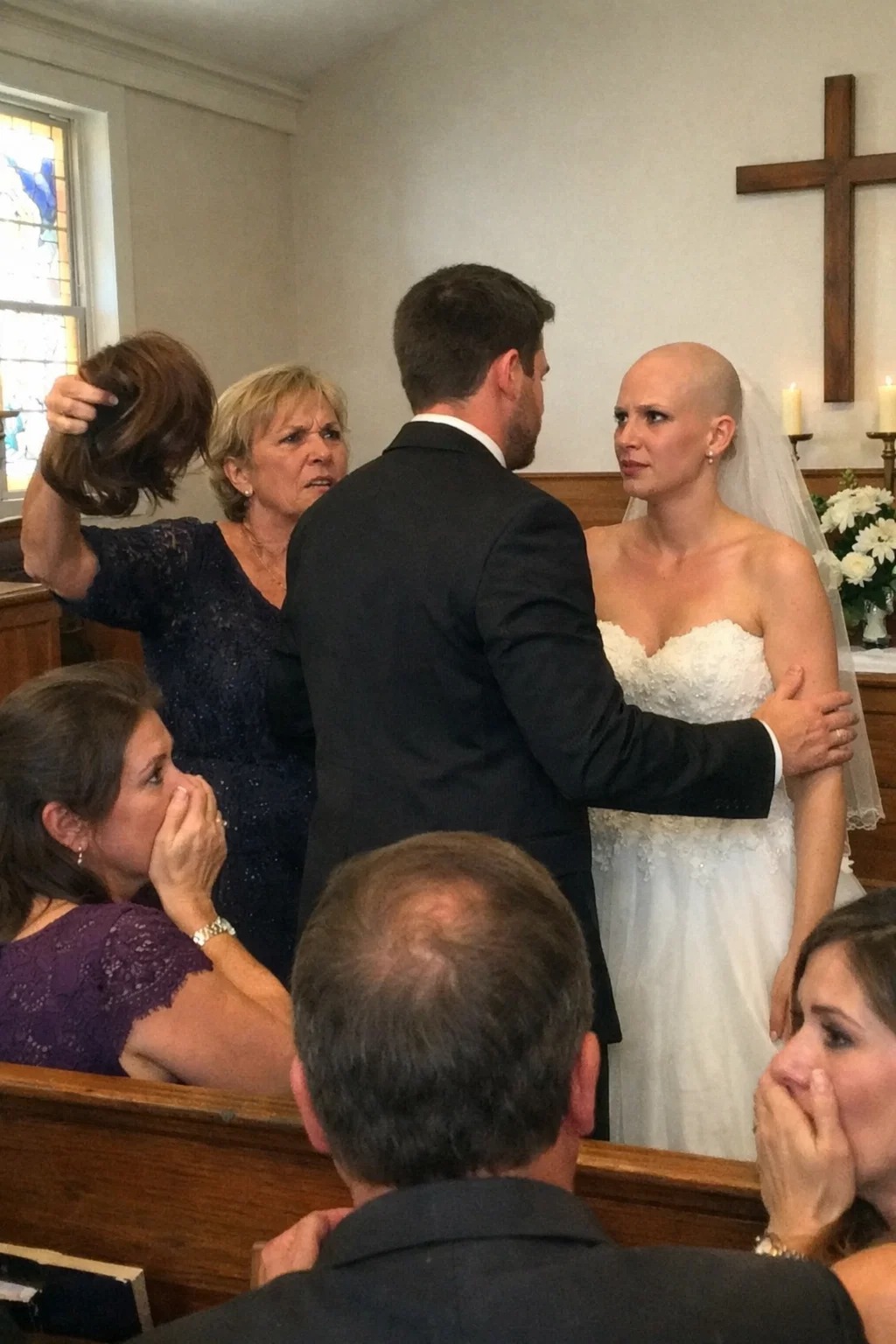
Lorraine stood abruptly, her chair scraping loudly against the floor, her heels clicking with purpose as she moved forward, her face tight with something that looked like triumph. Before I could even process what was happening, she reached out, grabbed the edge of my hair near my temple, and yanked.
The wig came off in one violent motion.
The sound the room made was collective, sharp, involuntary. My scalp was bare under the lights, exposed in a way that stole the air from my lungs, my heart plummeting as old shame surged up like a reflex.
“You lied,” Lorraine snapped, holding the wig up as if it were proof. “You deceived my son.”
Before I could speak, Thomas stepped between us, his voice calm but carrying an edge I had never heard before.
“Mom,” he said, clearly, “I asked her to be my wife after I watched her fight to stay alive.”
Lorraine scoffed. “You deserve honesty. You deserve better than this performance.”
Thomas turned to face the guests, his shoulders squared, his expression steady.
“She never hid anything from me,” he said. “I went to every appointment. I shaved my head the day she started treatment. I was there when she couldn’t stand without help and when she laughed at herself for dropping spoons she didn’t even want.”
A murmur rippled through the room.
“And since we’re talking about honesty,” he continued, lifting his hand to his own hair, “let’s be clear.”
He reached up, tugged firmly, and removed the hairpiece he had worn for months, letting it fall to the floor between him and his mother, revealing a smooth scalp that mirrored my own.
The silence that followed was complete.
“I’ve been wearing that,” Thomas said evenly, “to see if you cared about truth or just appearances. And now I know.”
Lorraine’s face drained of color. “That’s not—”
“You’re not welcome here anymore,” Thomas said, not raising his voice. “Not today. Not in our lives unless you learn what respect looks like.”
She left without another word.
The rest of the ceremony happened without wigs, without pretense, without fear. We kissed to applause that felt earned, not polite. At the reception, people hugged me without hesitation, spoke to me without pity, laughed with us instead of around us.
Months later, Lorraine tried to apologize. We listened. We set boundaries. Whether she would ever truly change remained to be seen, but cruelty no longer had a seat at our table.
Thomas and I danced that night, two bare heads reflecting the light, surrounded by people who stayed when things got uncomfortable.
And for the first time since everything began, I recognized myself again—not because I looked the same, but because I was finally seen, fully, and loved anyway.