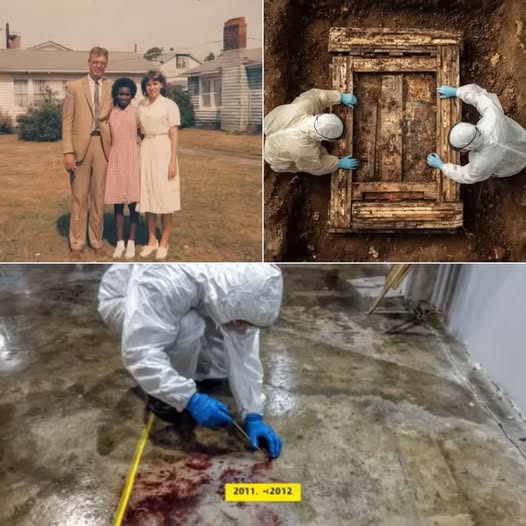
The first thing they broke was the silence.
For three days the house on the edge of the Michigan fields had rattled with the punishing thud of a jackhammer, its mechanical roar echoing up through the floorboards, shaking dust from the ceiling and glasses in the kitchen cabinets. The sound seemed alien in that old farmhouse, like something modern and impatient trying to force its way into a place that had been built for stillness.
On the third day, the noise stopped.

Marcus Bledsoe was in the small makeshift office he and his wife had set up in one of the upstairs bedrooms, trying to focus on spreadsheets while his children argued over crayons in the next room. When the sudden quiet fell, it pressed in on his ears so sharply that he sat up straight and checked his phone, convinced for a moment that there must have been a power outage.
But the lights were still on. The Wi-Fi hadn’t blinked. The only thing missing was the jackhammer.
He waited for it to start again.
Five seconds. Ten.
Nothing.
Under the quiet he could hear the faint murmur of voices from below—muffled, low, not the easy banter he’d grown used to over the last few days. This was different. One of the workers said something sharp, too quick and clipped to be a joke. Another voice answered, quieter.
The hairs rose on Marcus’s arms.
He stood up, told the kids he’d be right back, and took the stairs down two at a time. The smell of concrete dust met him at the main floor—chalky, dry, the new scent of construction aggressively overwriting the musty oldness the house had worn when they first bought it.
The basement door was open. The voices drifted up, clearer now.
“…telling you, that’s not normal—”
“Hold up, just—just look at it, man.”
Marcus gripped the railing and descended into the cool half-darkness. The single bulb at the bottom of the stairs cast a small circle of light over the men gathered in the middle of the room. The old basement, with its rough stone walls and low ceiling, had always unsettled him in a way he couldn’t quite articulate. He’d chalked it up to age and imagination.
Now the three construction workers stood in a tight huddle, their boots powdered gray, tools lowered, all of them staring down at the ground as if they’d uncovered something alive.
“What’s going on?” Marcus asked. His voice came out lighter than he intended, trying for casual and landing closer to tentative.
The foreman, Gary, looked up. He was a big man, sunburned neck, permanent squint, the kind of guy who could swing a sledgehammer all day and complain about being out of shape. But his face looked oddly pale under the dust.
“We hit something,” Gary said. “Over here.”
Marcus stepped closer. Half of the basement floor was already broken up—chunks of old concrete stacked in neat piles, an open rectangle where the jackhammer had chewed down to the packed earth below. But just off to the side of that rectangle, hugging the base of the stairs, was an untouched island of concrete.
He’d noticed it before, back when he and Aisha first inspected the house: the slab near the steps didn’t quite match the rest. Slightly different shade, a hairline lip where it met the original floor. He’d assumed it was just a patch, maybe to repair some old plumbing work.
Now the exposed edge where Gary had chipped away at it showed something else.
“The rest of the floor’s got rebar,” Gary said, tapping his boot against the broken section, where rusty steel rods stuck out from jagged concrete. “This part? Nothing. Slab’s thinner too. And it… uh…” He hesitated, nose wrinkling. “Smells bad.”
Marcus hadn’t noticed it at first, over the sharp tang of dust. But as he crouched nearer to the untouched slab his stomach lurched.
It was faint, buried under concrete and soil and time, but it was there: a sour, sweet rot that didn’t belong in the cool dry air of the cellar. Instantly his brain shoved the scent into some deep primitive category—danger, sickness, stay away—and his body responded with a tightness in his throat.
“Probably an old drain or something,” he said, because saying anything felt better than saying nothing. “A septic issue?”
Gary didn’t answer. He just picked up a crowbar and slid it under the cracked lip of the slab, glancing at Marcus as though asking permission.
“Go ahead,” Marcus managed.
The foreman leaned his weight onto the bar. The concrete gave with a grinding crunch, a piece the size of a dinner plate breaking free. A wave of air pushed up through the new gap, warmer than the surrounding chill, saturated with the smell Marcus’s brain was already trying to refuse.
Kevin, the youngest of the crew, swore under his breath and covered his mouth with the crook of his arm.
“Jesus,” he choked. “That’s… that’s not septic.”
Another chunk of concrete came up, and another. The makeshift lid was thin, poured quickly, sloppily, as if whoever did it had been in a hurry. Each piece they pried loose made the smell stronger, turning the basement air thick and sticky in Marcus’s lungs. His eyes watered.
“Boss,” Kevin muttered, backing away. “I’m telling you, this is messed up. This is… I think this is… you know.”
He didn’t say the word. They didn’t need him to.
Gary swallowed, breath visible in the damp air, and kept working, prying up one last slab. It flipped over with a dull thud and rolled aside, exposing a shallow depression dug into the earth, no more than maybe three feet deep, four long, a crude, narrow trench.
Something pale lay in the dirt at the bottom, half-wrapped in what might once have been fabric.
Kevin’s shovel scraped against it as he tried to clear some of the soil away. The resistance was wrong. Not rock. Not wood. Something with just enough give to make the sound unbearable.
They all heard the clink of metal against… whatever it was.
“Stop,” Gary said sharply. “Just—just stop for a second.”
The three men stared down.
There was cloth, yes—torn, discolored, clinging to itself in damp clumps. Something white and curved beneath it that Marcus’s brain refused, for one brief moment, to identify. And there, among the dirt and scraps, was something horribly ordinary: a cheap plastic bracelet, pink once, now dulled and cracked but unmistakably a child’s.
Marcus’s vision narrowed. The basement, the people in it, the cold stone walls all seemed to recede, leaving only that little loop of plastic in the center of his perception.
That doesn’t make sense, some part of him thought. That doesn’t belong underground.
Someone shifted. The smell rolled over them again, and his stomach clenched.
Gary cleared his throat. “We gotta call this in,” he said, voice rough. “This is… we’re not digging any more of this. This is for the police.”
Marcus nodded, but it was automatic, his mind already sprinting ahead to a place his body hadn’t caught up with. Police. His children upstairs. His wife in the kitchen. The house they’d poured their savings into. The house he’d promised them was a new beginning.
“I’ll… I’ll call,” he said, backing away from the hole, one hand reaching blindly for the railing. “I’ll go call.”
As he turned, something caught the light at the edge of the grave—just a glint through dust and dirt. One of the men, not even sure why he did it, reached down and plucked it free.
It was a small plastic sandwich bag, fogged with age but still sealed. Inside, folded into quarters, was a scrap of lined notebook paper. The ink on it had bled and faded, but the pressure of the writing had bitten deep grooves into the fibers.
Gary held it up, squinting, lips moving as he sounded out the words still visible.
“I just want to go back,” he read, his voice sounding wrong in his own ears. “Please let me out.”
No one spoke after that.
Marcus staggered up the stairs and into the clean sunlight like a drowning man breaking the surface. The air outside was bright and sharp with cut grass and the distant smell of manure from neighboring farms—normal, benign smells that felt suddenly obscene against what lay below.
“Aisha!” he called, his own voice strange now, thinner than it ought to be.
She appeared in the doorway, wiping her hands on a dish towel, a question already forming on her face. It died the moment she saw him. Whatever expression he wore must have said enough.
“What happened?” she asked.
“Call 911.” His throat constricted; he forced the words through anyway. “Just… call 911. Right now.”
“Marcus, what—”
“Please,” he said. “Just trust me. Call.”
He didn’t go back into the basement.
He didn’t need to.
The dead were already awake.
Thirty-one years earlier, in another basement two states away, a little girl had learned how to disappear without moving an inch.
Her name was Tyra Ellis, and before anyone poured concrete over her, the world had spent years trying to forget she existed.
Tyra’s earliest memories were not of a single place, but of a pattern. The pattern went like this: a room that belonged to someone else—always someone else—filled with unfamiliar furniture and unfamiliar smells. A kind voice at first, a new set of rules, new faces to learn. A few weeks or months of tentative routine. Then an argument she didn’t understand, a visit from a caseworker, a trash bag for her clothes, and a car ride to the next temporary life.
She learned quickly that adults liked it when she was quiet. They called her “well-behaved” when she didn’t cry during goodbyes, called her “so easy” when she did what they asked without asking questions back. She discovered that if she pressed herself into silence, if she took up less space on the couch, if she made her footsteps soft and never raised her voice, life went a little smoother. Not good, not kind, but smoother.
Quiet was a shield. It kept her from being the loudest one when someone lost their temper. It kept her from being blamed for other kids’ chaos. It didn’t make her safe—nothing ever did—but it made her less visible when danger moved through a room looking for someone to land on.
At nine years old, she had lived in five different foster homes and one group home. She could pack her belongings in under fifteen minutes. She never fully unpacked.
The group home in Ohio, where she ended up after her last placement fell apart, was an old brick building with squeaky floors and overworked staff. The kids there ranged from toddlers with sticky hands to sullen teenagers who smoked in the back lot and watched everyone with wary, animal eyes.
Tyra slept in a narrow bed in a room she shared with two other girls. Her side of the room was neat, her few possessions stacked in careful piles: three shirts, two pairs of jeans, a small stuffed rabbit with one ear torn, a paperback book missing its cover. The book had come from a church donations box, and she’d picked it because the first line talked about a girl running away into a forest. She read it late at night with a flashlight she wasn’t supposed to have, tracing each word with her finger, the story opening a window in her mind.
“Ellis?”
The caseworker’s voice broke in on a Tuesday morning halfway through breakfast. Tyra looked up from her cereal. The woman standing in the doorway was one of the newer ones, with tired eyes and a kind of rushed cheerfulness that never quite hid how exhausted she always seemed. Her name was Miss Powell.
“Tyra, honey, can you come with me?” she asked. “Got some people want to meet you.”
Some people.
She knew what that meant.
Around the table, a few of the other kids slowed their chewing. This was a familiar scene. Sometimes it went well and a kid left with a new family and didn’t come back. Sometimes it didn’t, and the kid came back a week later with fewer belongings and a new wary layer in their eyes.
Tyra set down her spoon, wiped her hands on her jeans, and followed Miss Powell to the small visitors’ room.
Two adults were waiting there, perched on chairs that looked too small for their dignity. They were both white, middle-aged, dressed in Sunday clothes even though it was a weekday morning. The man was tall and thin, his shirt tucked in sharply, his hair combed back so neatly it looked like it might hurt. The woman was shorter, her hair sprayed into unwilling obedience, a stiff cloud around a face with a mouth that smiled and eyes that did not.
“Tyra, this is Mr. and Mrs. Whitmore,” Miss Powell said, her voice dipping into that careful brightness she used for delicate moments. “They’ve come all the way from Michigan to meet you.”
Michigan sounded far away. Tyra had only a vague picture of it—a colder place, a shape on a map sometimes colored in differently during school lessons. She folded her hands in front of her, feeling the familiar weight of other people’s scrutiny settle over her shoulders.
“Hello,” she said, so softly she barely heard herself.
The man rose to his feet and offered his hand. “Hello, Tyra,” he said. His voice was gentle, almost too gentle, like the way people talked to skittish animals. “You can call me Richard.”
She took his hand because that was what you were supposed to do. His palm was dry, his grip firm enough to make the bones in her fingers press together.
“And I’m Diane,” the woman said, standing too. Her eyes ran over Tyra like a measuring tape. Tyra felt herself being weighed and found wanting but couldn’t say why. “We’ve been praying for you, sweetheart.”
Tyra nodded without knowing how to respond to that.
They talked for an hour. Or rather, the adults talked. Miss Powell asked questions about the Whitmores’ home, their town, their church. The Whitmores answered with an ease that suggested they were used to telling their story: their small evangelical congregation, their house on five acres of land, their calling to take in a child in need. They spoke about God’s grace and second chances, about offering love and discipline to a girl from a “difficult background.”
Tyra listened, hands clasped in her lap, eyes flickering between the adults’ faces. No one asked her what she wanted. They asked if she liked school (she nodded), if she went to church (sometimes), if she was willing to follow house rules (another nod).
Diane’s smile grew brittle at the corners whenever the word discipline came up, but her voice stayed warm. “Children thrive with structure,” she said. “We believe in firm but loving guidance. Spare the rod and spoil the child, that’s what Scripture teaches.”
Miss Powell smiled a little too widely back. “Of course,” she said.
There was paperwork after that, more meetings, a whirlwind of signatures and official voices. Tyra was told several times that this was a blessing, that she was “so lucky” to be adopted, that not every kid got this chance.
She didn’t feel lucky. She felt like she was being picked up and moved again, her life folded like laundry and placed in someone else’s drawer.
On the day she left, she put the stuffed rabbit and the coverless book in her bag first. Everything else felt interchangeable.
The Whitmore house sat alone on flat land under a vast sky.
They reached it after hours of driving through fields that looked like they went on forever, the roads narrowing and emptying the farther they got from the highway. Tyra pressed her forehead against the cool glass of the car window, watching trees and telegraph poles slide by. Every now and then, a farmhouse would appear in the distance, then vanish behind them like a thought.
When they finally turned onto a long gravel driveway, stones crunching under the tires, Tyra saw the house—a two-story farmhouse with peeling white paint and a sagging porch. The yard around it was mostly scrub grass, the land beyond stretching into carefully plowed lines.
“It needs a little love,” Richard said, following her gaze. “But she’s sturdy. Lord’s blessed us with this place.”
To Tyra, it looked like every other rural house she’d ever glimpsed from the window of a car, except there were no other houses close by. No streetlamps. No sidewalks. Just open land on all sides, a horizon that felt too far away to touch.
The Whitmores moved with practiced efficiency. Bags were carried in. Coats were hung. Tyra was shown her room—a small space at the top of the stairs with a single bed, a dresser, a narrow window that looked out over the fields. There were no posters, no toys, no evidence that a child had ever slept there before.
“We’ll get you some proper curtains soon,” Diane said briskly, pulling open the dresser drawers. “For now, you can put your things in here. We like to keep everything tidy.”
Tyra placed her few folded clothes carefully inside. The stuffed rabbit she put on the pillow, arranged just so. She tucked the book between mattress and wall, where it couldn’t be easily noticed.
The house smelled of lemon polish and something sharper she couldn’t name at first. It reminded her a little of hospital corridors, that faint antiseptic cleanliness that made her skin itch.
Everywhere she looked there were Bible verses framed and hung like family portraits. Above the doorway: “As for me and my house, we will serve the Lord.” In the hallway: “Train up a child in the way he should go.” On the living room wall, in looping cursive script: “Spare the rod, spoil the child.”
There were almost no photographs. One wedding picture of Richard and Diane, younger versions of themselves standing stiffly in front of a church. A group shot of their congregation, rows of smiling faces in Sunday best. No snapshots on the fridge. No school pictures of children.
This is a house that doesn’t remember, Tyra thought, though she had no words for it. A house with no past.
Dinner that first night was a silent choreography. Diane set plates on the table—overcooked green beans, grayish meatloaf, instant mashed potatoes. Richard bowed his head and prayed, his words long and heavy, thanking God for the food, for the house, for the “blessing of a new daughter.”
Tyra kept her head bowed too, hands folded tight in her lap. When he said amen, she echoed it softly.
“Tell us about school,” Richard said as they ate. “What’s your favorite subject?”
Tyra swallowed a mouthful of potatoes, thinking. “Reading,” she said finally. “I like stories.”
Diane’s fork paused halfway to her mouth. “Some stories are good,” she said. “Biblical stories, stories that uplift the spirit. But a lot of what they put in those books nowadays is full of filth and worldly ideas. You understand we won’t tolerate that in this house.”
Tyra lowered her eyes. “Yes, ma’am.”
After that, they didn’t ask many questions. They spoke about the church instead—about Wednesday night Bible study, Sunday services, the women’s choir Diane sang in. They spoke of neighbors Tyra hadn’t met yet, of crops and weather patterns and the price of feed. She listened, invisible at the edge of their sentences, pushing food around her plate and trying to match the rhythm of their life.
She did everything she’d been taught to do. She said please and thank you. She did the dishes without being asked. She kept her room immaculate, bed made so tightly the blankets barely creased. She moved softly through the house, a shadow careful not to brush against anyone too hard.
In those first months, her quietness was accepted as virtue.
“She’s a good girl,” she overheard Diane say on the phone once, in the next room. “Damaged, of course. You can tell. But obedient. The Lord’s working on her.”
The phrase “damaged” stuck to her like a new layer of skin. She didn’t know how to argue with it. It didn’t feel wrong, exactly. Just heavy.
The church was small and bright and mercilessly earnest.
On Wednesdays and Sundays, the Whitmores drove down a narrow road lined with cornfields to a squat building with a white steeple and a gravel parking lot. Inside, the walls were bare except for a large wooden cross at the front and posters encouraging Scripture memorization. The congregation—maybe fifty people in all—greeted Richard and Diane warmly, their smiles widening with curiosity when they saw Tyra.
“Oh, is this the girl?” an older woman cooed, taking Tyra’s chin gently between her fingers and turning her face toward the light. “Sweetheart, what’s your name?”
“Tyra,” she said, wishing the woman wouldn’t touch her.
“Well, aren’t you a blessing,” the woman said. “The Whitmores are just saints, taking you in. You be sure to listen to them now, you hear?”
Tyra nodded. She heard some version of that sentence a dozen times that first Sunday. The Whitmores were saints. The Whitmores were generous. The Whitmores were doing God’s work.
No one asked where Tyra had come from. If they wondered about her life before, they didn’t ask out loud. She was an accessory to the couple’s virtue, a living illustration in their ongoing sermon about faith and charity.
The services themselves were a blur of hymns and sermons, of raised hands and amens. Tyra sat between Richard and Diane on the hard wooden pew, her back straight, her eyes on the pastor when she remembered to look up. The words about sin and salvation washed over her, some heavy and frightening, others oddly soothing in their certainty.
God knows you, the pastor said once, his voice ringing. God sees you when no one else does.
The thought lodged somewhere inside her. She wasn’t sure if it was comforting or terrifying.
School was another world entirely.
Tyra’s first day there, she watched the other seventh-graders cluster in small groups at the edges of the playground, sorting themselves with the casual cruelty of adolescents. This was a small rural school in a largely white town. Tyra stood out immediately, not just because of the color of her skin, but because of everything about her—the thrift-store clothes chosen by Diane, the way she clutched her notebook like a shield, the way she seemed to fold inward when too many eyes landed on her.
Some kids were openly curious. “Where you from?” a boy asked, walking backward in front of her as she made her way to the classroom. “You from Detroit? My cousin says Detroit’s got gangs everywhere.”
“I’m from Ohio,” Tyra said.
“Ohio?” The boy looked vaguely disappointed. “Oh.”
Others simply stared and then turned away, filing her under some category that meant “not our concern.”
There were kindnesses, small and real. A girl named Megan offered to show Tyra where the cafeteria was. A teacher with soft gray hair and tired eyes placed a hand lightly on Tyra’s shoulder once before class and said, “If you need help with anything, you can come to me, okay?”—and looked like she meant it.
Still, Tyra moved through the school day like a ghost, careful not to brush too close to anyone, careful not to attract attention. The habit of invisibility was hard to break, and safer not to try.
At home, homework was monitored, television restricted to religious programming, music limited to hymns and bland Christian pop.
The first time Tyra came home late from the library, she met another side of Diane.
She’d lost track of time. The school library was small, but to her it still felt like a treasure trove. That afternoon she’d found a fantasy novel tucked between pamphlets about history and farming—a story about a girl who discovered she had magic and used it to escape a life she hated. Tyra had sunk into a battered armchair and read until the clock on the wall jerked her back to reality.
By the time she ran the last few yards up the Whitmores’ driveway, the sky was already dimming. Her breath puffed in front of her. Her fingers were numb by the time she fumbled with the front door handle.
Diane was waiting in the hallway.
“Where have you been?” Her voice was quiet, dangerous.
“The library.” Tyra’s chest heaved. “I— I lost track of time, I’m sorry, I—”
Diane’s hand flashed out and snatched the book from under her arm. She glanced down at the cover—a cloaked figure, a castle, a dragon curling across the sky—and her mouth thinned.
“Witchcraft,” she said. “Sorcery. Lies. Do you know what the Bible says about witches, Tyra?”
Tyra shook her head, heart thudding.
“It says, ‘Suffer not a witch to live,’” Diane hissed. “It says such things are an abomination in the eyes of the Lord. And you bring this filth into my home?”
“I didn’t know,” Tyra whispered. Tears burned at the back of her eyes, but she held them back. You cried later, if you could. Not here. Not where they could see.
“Don’t you lie to me,” Diane snapped. “You knew enough to hide that book under your arm. You think I’m stupid?”
She called Richard, voice clipped. “We need to have a talk with our daughter,” she said.
The talk turned into shouting, and then into something else.
Tyra’s punishment that night was the basement.
Until then, she’d barely been down there. She knew it existed—a dim, cement-floored cellar beneath the house where Richard stored tools and holiday decorations. Now she learned what it felt like when the door closed behind her with a heavy click and the lock slid into place.
The stairs creaked under her feet as she descended, the darkness thick. There was a single naked bulb hanging in the center of the roof, casting a weak yellow spill onto the floor. The walls were stone, damp in places, the air cool and metallic.
“Three hours,” Diane said from the top of the stairs. Her silhouette was a dark cutout against the light behind her. “You can think about your sins. Maybe the Lord will speak to your heart in the quiet.”
Then she flicked the switch.
The bulb went out.
The basement swallowed Tyra whole. The darkness was so complete she couldn’t see her own hands. She stood frozen for a moment, pulse pounding in her ears, every childhood fear of the dark roaring back in full force.
You’re not a little kid, she told herself, arms wrapping around her own waist. You’re not a baby. You’re fourteen.
She wasn’t. Not yet. She was barely ten.
But alone in that basement, numbers didn’t feel like they mattered much.
She sank to the floor, pulling her knees against her chest, and counted breaths. Time dissolved. The darkness pressed against her eyes like hands.
When the light finally snapped back on, it was so sudden she flinched, raising a hand to shield her face. The door creaked open, and Diane’s figure appeared again.
“Have you learned your lesson?” Diane asked.
“Yes, ma’am,” Tyra whispered.
The punishments escalated slowly. A missed chore became an hour in the basement. A tone Diane deemed “disrespectful” earned her a night on the cold floor, a thin blanket barely cutting the chill. When she once talked too long on the phone with Megan about a school project, Diane yanked the phone from the wall, called Megan’s parents, and informed them that their daughter would not be speaking to Tyra again because “bad company corrupts good character.”
“You think I don’t see you?” Diane said that night, standing over Tyra as she scrubbed the bathroom tiles on her knees. “You think I don’t see the rebellion in your eyes? Don’t forget where you came from, little girl. Trash. Broken homes. Sin. We brought you out of that. We are the only reason you’re not on the streets.”
Tyra kept her eyes on the floor and scrubbed harder.
As the years ticked by, she grew into adolescence like a plant growing in bad soil—crooked, hungry, reaching desperately for any patch of light.
At school, fragments of the person she might have been flickered. She laughed sometimes at Megan’s jokes. She discovered that music from the radio in the art room made her feel like her chest might burst open with feeling. She wrote stories in the margins of her notebooks—tiny adventures squeezed between math problems and vocabulary words, so small they looked like scribbles.
At home, that spark earned her only suspicion.
When Diane found a folded piece of notebook paper in Tyra’s pocket with a few lines of a story—A girl opens a door and finds a world where nobody yells, where nobody hits—she tore it up in front of her.
“Foolishness,” she said. “Fantasies. The world is what the Lord says it is, not what some silly child dreams.”
By early 1989, when Tyra was fourteen, she had stopped going to school regularly. Officially, she was “sick.” Unofficially, the basement had become less a punishment and more a regular feature of her life.
Neighbors rarely saw her. When someone did catch a glimpse—from a car on the road, from a pew at church—they noted how quiet she was, how polite, how she seemed to hover always at the edge of things.
“She’s shy,” Diane would say with a tinkling laugh, her eyes tightening for just a fraction of a second. “And troubled, of course. You know how these foster kids can be. But we’re praying through it.”
People nodded sympathetically. They knew the story, more or less. A damaged child saved by godly people was an easy script to applaud. It required nothing from them but admiration.
And so when Tyra vanished, they accepted another easy script.
“She ran away,” Diane told them one Sunday after church, her voice catching just enough to sound tender. “Packed a bag and left in the night. After all we did… we tried, we prayed… some children, you just can’t save them from themselves.”
No one asked to see the note Tyra left. There wasn’t one. No one asked when exactly she’d last been seen. No one drove out to the farmhouse in the dark and rang the bell to make sure she wasn’t just locked in a bedroom or sitting on the steps, stubborn and scared.
They took the story they were offered and folded it neatly into the file in their minds labeled “Sad, but some kids are like that,” and they moved on.
Somewhere underground, a girl who had never gone anywhere lay still in the dark.
In the offices of Ohio’s overwhelmed child welfare system, Tyra’s file told a different story. It was written in bureaucratic shorthand, but the translation was simple.
A life.
A life reduced to forms and signatures.
There were intake reports, foster home evaluations, notes from social workers who had changed jobs or burned out or moved away. There was the adoption decree from 1984, a neat official document declaring that one Richard and one Diane Whitmore were now her legal parents.
And then there was the final entry: “Client reported as voluntary runaway by adoptive parents. Case closed.”
After that, the file was moved to a cabinet, then eventually to a box, then eventually to a basement archive where the labels yellowed and the dust settled thick.
For two years, nothing disturbed that dust.
Then a caseworker named Sarah Jenkins pulled the box from the shelf.
Sarah was in her early thirties then, still young enough to believe that diligence could compensate for a broken system. Her desk was a clutter of sticky notes and coffee mugs and files in precarious stacks. She stayed late more evenings than she went home on time. There were days she felt she was trying to bail out a sinking ship with a teaspoon, but she kept bailing anyway.
That summer, she’d been assigned the adoption application of another couple: a childless pair with a rural home, a church connection, a glowing reference from their pastor. The Whites. They wanted to adopt a nine-year-old boy.
As she flipped through their paperwork, checking boxes, something snagged in her memory. A phrase, a date. She frowned and pulled another stack of files closer.
Under “previous placements” on the form, the Whites had written: none.
Sarah stared at the line.
But she remembered something, dimly. A training session, an office conversation. There had been talk of a couple in rural Michigan, devout, eager to adopt, taking in a black girl from Ohio. The case had been presented as a success story, evidence that the system sometimes did what it was supposed to do.
She dug.
The names were similar, but not identical. Whitmore, not White. Different spelling. Different address. Different town. Still, the echo nagged at her.
She checked the central registry. Up came the 1984 adoption: Tyra Ellis to Richard and Diane Whitmore.
Then she checked the database for missing children. Up came the notation from 1989: Ellis, Tyra. Status: voluntary runaway. No further action required.
Sarah felt a small knot form in her stomach.
She called Ohio’s contact number for the Whitmores.
Diane answered on the second ring, her voice crisp.
Sarah introduced herself, explained why she was calling, asked about the discrepancy. “Our records show you previously adopted a girl named Tyra,” she said. “She’s not listed on your new application. Can you clarify?”
There was a brief silence on the line. When Diane spoke again, her tone had shifted—invisible, but audible to someone listening carefully. “Tyra is no longer with us,” she said.
The words dropped into Sarah’s ear like ice.
“I see,” Sarah said, pen hovering over the file. “Our records say she ran away. Has there been any update since then? Any contact?”
“No,” Diane replied. “She chose to leave a godly home for a life of sin. We pray for her soul, but her choices are her own. As far as we’re concerned, that chapter is closed. The Lord has given us a new opportunity to save a child, and that is where our focus lies.”
The matter-of-fact cruelty under the pious language set every alarm bell in Sarah’s head ringing.
She hung up and typed a formal note. She requested that the adoption be reviewed further. She described Diane’s affect, her wording, her discomfort with the idea that a missing child could simply be considered a closed chapter.
Her supervisor, a man called Henderson with sagging shoulders and permanent worry lines, read the note. He sighed.
“Look,” he said, standing in her doorway. “We’ve got fifty-plus active cases on our plates. The girl’s file is closed. The parents reported her as a runaway years ago. There’s no indication of foul play.”
“But there’s no police report,” Sarah said. “No investigation. That’s… that’s not right. A fourteen-year-old disappears and we just take the parents’ word for it? There should at least be follow-up.”
He rubbed his eyes. “And who’s going to do that follow-up? You? On your lunch break? We don’t have the manpower to chase down every kid who doesn’t want to be found. If the cops are needed, they get called. They weren’t called. It was a different time; you know that. We can’t reach back into the past every time a file makes us uneasy.”
Her unease hardened. “So we just ignore it?”
“We prioritize,” Henderson said, not unkindly. “We triage. There are kids in active danger right now, today, that need your attention. Don’t go digging into ghosts. It’ll burn you out faster than this job already will.”
He signed the clearance for the Whites’ adoption.
Sarah watched as the papers moved on to the next stage, the machine grinding forward. She thought about calling the police in Michigan herself. She thought about writing a second, more forceful memo.
In the end, she did none of those things.
She went back to her other cases because they were urgent and there were too many of them and because the system implicitly constantly screamed go go go, do this now, don’t look back.
But she remembered.
When, thirty years later, an unfamiliar phone number lit up her living room and a detective introduced himself and said the name “Tyra Ellis,” the knot in her stomach, which she thought she had long ago swallowed, returned in an instant.
“I knew it,” she whispered into the phone, voice cracking with age and guilt. “I knew something was wrong.”
The discovery in the Bledsoes’ basement traveled faster than any concrete could contain.
By the time Detective Sergeant Mark Evans arrived at the farmhouse, the local sheriff’s deputies had already cordoned off the property. Patrol cars sat along the gravel drive, lights flashing in the bright afternoon, their presence jarring against the tranquil backdrop of fields. The air around the house hummed with quiet urgency: the low murmur of officers conferring, the crackle of radios, the occasional sharp word as someone adjusted tape or directed a vehicle.
Evans had been a cop for over two decades. He’d seen scenes like this before—houses turned crime scenes, ordinary spaces suddenly revealed as stages for terrible acts. But as he walked down the basement stairs and the smell hit him full force, something deep inside him clenched in a way that felt new.
He’d been prepared for a body.
He hadn’t been prepared for how small it would be.
The forensic team worked methodically in Tyvek suits, gloved hands moving with careful precision. The shallow grave gaped open under the glare of portable lamps. Bits of dirt and fabric and bone lay exposed, each one photographed and logged before being removed. The cheap plastic bracelet had been tagged and bagged already, placed delicately into evidence like a piece of jewelry dug up from an archaeological site.
Evans crouched at the edge of the cavity, one hand over his mouth, the other resting on his knee. He’d learned long ago to keep emotion off his face at scenes like this. It helped the younger officers, helped the families later, helped the work.
But standing in that basement, he felt something cold settle in his chest that went beyond professional anger. Whoever had done this hadn’t just killed. They’d hidden. They’d buried and concreted over, trusting the world to forget.
For three decades, the world had obliged.
He straightened, his knees cracking, and turned to the Bledsoes, who stood near the stairs, pale and shaken. Aisha clutched the railing so tightly her knuckles were white. Marcus kept looking from Evans to the hole, as if he still couldn’t quite accept what he’d found beneath his own feet.
“Mr. and Mrs. Bledsoe,” Evans said, keeping his tone calm. “I know this is overwhelming. Thank you for calling this in as soon as you did. I just need to ask you a few questions about the previous owners of the property.”
They told him what they knew, which wasn’t much. The Whitmores had seemed like any elderly couple selling a house they could no longer maintain. They’d talked vaguely about retiring to somewhere warmer. There had been no mention of any remodeling done to the basement, no stories about pipes replaced or slabs poured.
“Did they say anything about a daughter?” Evans asked.
Aisha frowned, thinking. “I… think Diane mentioned once that they hadn’t had children.” She looked uncertain. “Or maybe she said they didn’t have any living with them. I’m not sure. It was a passing comment. We were more focused on the inspections, the loan approval…”
Evans nodded. It was the same everywhere: people thinking about mortgages and paint colors, not about the history soaked into the beams.
He thanked them, assured them they’d be relocated temporarily, and went back to the business of the dead.
The body went to the medical examiner. The robe, the bracelet, the journal page all went to the lab. The house went on lockdown. Computer searches were run on the property, digging through records dating back decades.
The first big answer came from the autopsy.
The remains were female. Decades old. The bones suggested an adolescent, around fourteen or fifteen at the time of death. There were old, healed fractures in the ribs and forearm, consistent with repeated blunt force trauma.
Around the neck bones, faint marks suggested strangulation or sustained pressure.
The ME wrote “homicide” and underlined it.
The second answer came from DNA.
A tooth yielded a partial profile. When that profile was run through the national database, which now held entries from countless missing persons cases, it pinged almost at once.
Name: Ellis, Tyra.
Last known location: Ohio.
Reported missing: 1989.
Status: voluntary runaway.
Evans stared at the screen for a long moment, the glow reflecting in his tired eyes. He printed the file and read it again on paper, as if the words would make more sense there.
A runaway.
He’d worked enough missing kids cases to know the hierarchy of concern. Runaways were always at the bottom. They were the kids everyone quietly believed had chosen the life they got. Less urgency. Less press. Less outrage.
Yet here she was, a “runaway” who’d never left the property.
He felt that cold thing inside him harden into purpose.
“We owe you more than this,” he murmured, not sure if he was talking to the file or the girl.
The investigation into the Whitmores’ past was like peeling back old wallpaper in an abandoned house: with each layer stripped away, more mold crawled into view.
Records showed that Richard and Diane had taken in several foster children before Tyra, between 1978 and 1983. All had been removed from their home after relatively short stays. The official reasons varied—“behavioral issues,” “difficulty adjusting,” “mutual mismatch.” Nowhere was there any suggestion that the problem might have been the home itself.
One boy, aged twelve, had gone to a different placement after the Whitmores. Within months, he’d been marked as a runaway from that new home.
He’d never been found.
In an old school’s storage closet, the investigators found yearbooks from the late eighties. Tyra appeared in two of them, small and serious and unsmiling, sitting in the second row of group photos. Her name was printed incorrectly in one—“Tara”—a tiny bureaucratic misstep on top of so many larger ones.
They tracked down teachers and neighbors.
The former school counselor, Carol, met them in the living room of a modest house, her hands shaking slightly as she poured tea. She was in her seventies now, her hair silver, but her memory of Tyra was sharp.
“She came to me a few times,” Carol said, fingers tightening around the cup. “You get a sense, after a while, of which kids are just being dramatic and which ones… aren’t. Tyra was so quiet. The kind of quiet you don’t ignore.”
She described the day Tyra had told her about the basement.
“She didn’t start with that,” Carol said. “She started with grades. With feeling tired. With having trouble concentrating. Then it came out that she wasn’t sleeping well. That she was scared of the dark. I asked if something had happened.”
Carol closed her eyes briefly, reliving it. “She said, very matter-of-factly, that her parents sometimes locked her in the basement when she was ‘bad.’ She said it like she was describing the weather. But her hands…” She lifted her own, illustrating the tremor she’d seen in the girl’s.
“I asked how often ‘sometimes’ was,” Carol continued. “She said, ‘Oh, not every day. Just when I make them mad.’ And she laughed. The kind of laugh you hear from kids when something is very wrong and they don’t have words for why.”
Carol had followed protocol. She’d filed a report with social services. She’d called the Whitmore house.
“Mrs. Whitmore was… charming,” she said bitterly. “She sounded so concerned. She said Tyra had a ‘vivid imagination,’ that she told lies for attention, that her background made her prone to exaggeration. She reminded me that they were good Christian people, that they’d taken this child in when no one else wanted her. She made me feel—” Carol’s voice wobbled, anger and shame twisting together. “She made me feel like I was accusing a charity worker of theft.”
Social services had done a welfare check. Diane and Richard had shown them a clean house, a tidy bedroom, a well-stocked pantry. Tyra, coached or afraid or both, had said she was fine.
The case had been closed.
“I believed the wrong person,” Carol said now, tears slipping down her face. “I believed the grown-up with the pretty words instead of the scared kid. I’ve thought about her so many times over the years. And I always told myself, maybe she got out. Maybe she did run away like they said.” Her shoulders shook. “I wanted to believe that.”
The neighbor down the road, an old man with a weathered face, remembered a night of screaming.
“I was walking my dog,” he said, scratching absentmindedly behind the dog’s ears as he talked. “Heard this yelling from the Whitmores’ place. A girl’s voice. High-pitched. Sounded like she was in pain.”
He’d asked Richard about it the following Sunday, in the church yard.
“He smiled that little smile of his,” the neighbor recalled, lips curling as if the memory itself tasted sour. “Said his wife was ‘praying over’ their daughter. Deliverance, he called it. Casting out demons of disobedience.”
The neighbor had felt uneasy, but he was a religious man himself. “Didn’t feel like my place to question another man’s household,” he admitted. “Wish to God I had.”
Evans and his team listened to each of these accounts, adding them to the growing wall of evidence. Every story painted the same picture: a couple who weaponized piety, who used the language of faith as a smokescreen for cruelty, and a system and community willing to accept the smokescreen because it was easier than looking closely.
The final, most damning pieces of evidence came not from human memory, but from objects left behind.
In the garage of the farmhouse, wedged into the rafters, they found an old cardboard box coated in dust. Inside, neatly stacked, were cassette tapes.
Each tape had a label in neat, spidery handwriting: “Discipline Session – 3/12/88.” “Discipline Session – 5/03/89.” Over and over, dates spanning months.
When Evans played the first one back at the station, a hush fell over the room.
The tape hissed. Then came a girl’s voice, small and tremulous.
“Please,” she sobbed. “Please, I’ll be good, I promise, I’m sorry, I’m sorry—”
A woman’s voice replied, calm and iron-hard. Diane.
“The Lord cannot abide rebellion, Tyra. You know that. You brought this on yourself.”
There were sounds after that. A crack that could only be a belt or a switch. A choked cry. A prayer in tongues, Diane’s voice rising and falling in a feverish rhythm, mingling with the child’s sobs in a way that made Evans’s skin crawl.
No one in the room spoke until the tape clicked off.
When it did, one of the younger detectives stood abruptly and walked out, the door swinging behind him.
Evans let him go. He sat in his chair for a long moment, hands clenched on the table, the echo of Tyra’s voice ringing in his ears.
He had kids of his own. He knew the small sounds children made when they were tired or hurt or scared. The sounds on the tape were something else, something deeper and more desperate, a fear that had passed through panic and into helplessness.
He pressed his palms over his eyes.
“We’re not just dealing with a murder,” he said quietly. “We’re dealing with torture.”
Finding the Whitmores themselves was surprisingly easy.
People who flee justice often think distance is enough. They rarely overhaul their entire lives. They still cash pensions, still see doctors, still maintain social ties. They leave paper trails.
By 2020, Richard and Diane had long since left the Michigan farmhouse. Property records showed they’d sold it in 2002. Florida utility records, Medicare billing, and church directories all placed them in a quiet retirement community near the Gulf.
Evans flew down with two local deputies and a folder thick with evidence.
Serenity Palms was the kind of place developers designed to look like a brochure: manicured lawns, pastel stucco homes, golf carts humming along private paths. The sun beat down on neat hedges and plastic flamingos. It was a setting that seemed aggressively at odds with the horrors Evans carried in his manila folder.
They found Richard outside his small villa, watering roses.
He was eighty-one now, his once-straight back stooped, his hair thin and white. His face was a map of wrinkles. To anyone watching from a distance, he would have looked like any other old man tending his garden.
“Mr. Whitmore?” Evans called.
Richard turned slowly. His pale blue eyes flicked over the uniforms, the badges, the serious expressions. For a split second, something unreadable passed over his face, then smoothed away.
“Yes?” he asked.
“We’re with the Michigan State Police,” Evans said. “We need to speak with you about your adopted daughter. Tyra.”
The name seemed to land oddly in the air between them, like a foreign object dropped into a conversation about weather.
Richard’s eyebrows rose faintly. “That was a long time ago,” he said. “She ran away.”
Evans held his gaze. “No,” he replied evenly. “She didn’t.”
He watched closely for the flinch, the denial, the outburst. What he saw instead was… irritation.
“Mr. Whitmore,” Evans continued, “we found human remains under the concrete in your former basement. DNA confirms they belonged to Tyra. We also found tapes in your handwriting and your wife’s, documenting what you called ‘discipline sessions.’ We have enough evidence to arrest you for murder.”
Richard turned off the hose with a slow, deliberate motion. He carefully coiled it on the hook, aligning it as neatly as if he had all the time in the world. When he finally looked back at Evans, his expression was almost bored.
“My wife handled discipline,” he said. “She’s dead. You should talk to her.”
“Diane died in 2015,” Evans replied. “We can’t talk to her. We can talk to you. You poured the concrete, Mr. Whitmore. We have receipts.”
For a moment, something flickered behind the old man’s eyes—not guilt, exactly, but calculation. The look of someone rearranging pieces on an inner chessboard.
He didn’t fight when they cuffed him. He didn’t protest. As they led him away from the roses, he kept his head up, his steps steady, as if concerned more with maintaining dignity than with his sudden plunge into exposure.
In the interrogation room, his story came out in fragments.
Yes, there had been discipline. Children needed to learn obedience. The Bible said so.
Yes, they’d locked her in the basement. That was their right as parents.
Yes, one night things had “gone too far.”
“I didn’t realize she’d stopped breathing,” he said, the words flat. “She just got quiet. Diane said her spirit had been broken as the Lord required.”
He described how they’d kept Tyra’s body in the house for three days, wrapped in the church robe she’d been wearing. He said they’d prayed over her, asking God what to do.
Somehow, in that twisted calculus, the answer had been concrete.
“I bought the mix at the hardware store,” he said. “Poured it myself. I’ve always been handy.”
He said these things calmly, without heat, as if describing how he’d fixed a broken fence or repaired a leaky pipe.
What chilled Evans the most was not the content of the confession, but the lack of any visible emotion attached to it. No remorse. No horror. Not even pride. Just a flat, resigned acceptance that this, too, was part of the story of his life.
The tapes did what his words did not. Jurors later would hear Tyra’s small voice. They would hear the belt, the prayers, the rhythmic cruelty. They would hear Richard’s own voice sometimes in the background, low and approving.
It would be enough.
News of the case broke slowly at first—a local story about a body found in a basement, an elderly man arrested in connection. But the pieces were too explosive to stay contained.
A young woman working at a regional paper digested the details and realized the larger implications: a black girl adopted by a white evangelical couple, disappearing in the eighties, written off as a runaway, found decades later under their house. A system that had turned away at every crucial moment.
She wrote the article that way—not as a simple crime story, but as a failure story. As a story with many hands on the shovel.
National outlets picked it up. The phrasing varied, but the essence was the same.
She was nine when she was adopted.
She was fourteen when she died.
She was thirty-one years buried.
By then, Tyra’s biological aunt, Brenda Jackson, had lived with a different kind of ghost for three decades.
Brenda had been just nineteen when child services took Tyra and placed her in foster care. She’d fought to keep her niece, filling out every form, sitting through every evaluation, but her youth, her single status, her small apartment, her low income—all of it had been deemed insufficient. When the state decided Tyra would be “better off” with a married couple in Michigan, Brenda’s protests were filed away with the rest of the paperwork.
She never fully believed the runaway story.
“They told me she’d run away,” she said on camera, tears streaking her face. “But that wasn’t my baby. She was quiet, but she wasn’t reckless. She didn’t even like crossing busy streets. How’s she gonna just disappear and never call nobody, never write, never nothing? I knew something was wrong. But who was I? Just her aunt. Not a lawyer, not a judge. Just someone who loved her.”
The day a reporter showed up at her apartment door and said Tyra’s name, Brenda’s legs went out from under her. She slid down the wall in her narrow hallway, clutching the photograph she’d kept of Tyra at nine—beaded braids, shy smile, eyes that always seemed older than her years.
“I kept that picture on my dresser for thirty years,” she said later, sitting on her faded couch with cameras rolling. “Talked to it sometimes like a fool. Asked her where she’d gone. Asked her why she never came back.” She swallowed hard. “Turns out she never went nowhere. Turns out she was right where they put her.”
Her grief wasn’t quiet. It surged and broke in front of the nation, her voice raw as she condemned not just the Whitmores, but the system that had handed her niece over and then walked away.
“They didn’t adopt her to love her,” Brenda said. “They adopted her as a project, as a paycheck, as something to beat and break and feel holy about. And the system let them. Signed the papers, cashed the checks, closed the file. How many more kids got buried like that? How many more they called runaways when they was really victims?”
Her words resonated beyond her living room. For every Tyra whose remains were found, there were countless other children whose files bore that same label—runaway—whose stories ended not with discovery and outrage, but with silence.
Advocates seized on the case as a grim emblem. They cited statistics about black and brown children in foster care, about disproportionate placements with white families in rural areas, about the lack of oversight, the minimized reports of abuse, the racial biases threaded through it all.
It wasn’t that Tyra’s story was unique.
It was that it had finally been exhumed.
When the case went to trial, Richard arrived in a wheelchair, a blanket over his knees. His defense team leaned heavily on his age, on his claimed confusion, on the idea that his late wife had been the driving force.
The prosecution leaned on the facts.
They showed the jurors photographs of the basement, of the shallow grave, of the bracelet on its little bed of dirt. They played the tapes, carefully edited to spare the courtroom the worst but still enough to sear the heart. They read snippets of the lost journal page, those fragile words preserved in plastic for three decades: I just want to go back. Please let me out.
They brought in social workers and neighbors and church members. One by one, people described their uneasy memories, their ignored instincts, their small complicities.
It became clear that, while Richard and Diane had wielded the belt and the lock and the concrete, they had not been the only ones holding a corner of the shroud.
In the end, the jury took less than a day.
They found him guilty of first-degree murder.
His age spared him the death penalty, but the judge’s words at sentencing carried a different kind of finality.
“You spent a lifetime wrapping your cruelty in the language of faith,” the judge said. “You used religion as a weapon against a child who depended on you for care. You hid your crime and relied on the indifference of systems and communities to keep it buried. For thirty-one years, you succeeded.” He paused. “You will spend the rest of your life in prison. May the memory of what you did follow you every day you have left.”
Richard said nothing. He stared straight ahead, hands folded in his lap, the same calm expression on his face he’d worn while watering his roses.
He died less than two years later, frail body finally giving out in the prison infirmary. If he ever felt or expressed remorse, no record of it survived.
Tyra, meanwhile, had people speaking for her now who hadn’t been able to before.
Advocates pushed for reforms. Old cases were re-examined. States revisited policies on how missing foster children were classified and followed up. None of it could bring Tyra back or retroactively save her, but it chipped away, in small insufficient increments, at the structures that had made her erasure possible.
Back in Michigan, life at the farmhouse resumed, slowly.
The Bledsoes didn’t move.
At first, they considered it. The shock of finding a body under their basement, of becoming unwilling stewards of a crime scene, of seeing their home flood with investigators and reporters—it was almost too much.
Their children had nightmares. Aisha couldn’t go into the basement without feeling panic claw at her chest. Marcus felt waves of guilt at the thought that they had lived above Tyra’s grave for months without knowing.
But when the noise died down and the officers left and the tape came down, they walked through the house room by room, touching the walls, listening to the echo of their own footsteps. It was still their home. Their children’s drawings were still on the fridge, their laughter still in the corners of the living room.
“We can leave,” Marcus said quietly one night, sitting at the kitchen table. “Find another place. Start over. If that’s what you want.”
Aisha looked at him, then at the ceiling, as if seeing through it to the sky, to the fields beyond, to the years built into the beams.
“She already had everything taken from her,” she said. “Her life. Her future. Her voice. If we leave because of what he did, it’s like we’re letting him take this place too.”
“So we stay,” Marcus said.
“So we stay,” she agreed. “But we don’t pretend it didn’t happen.”
They finished renovating the basement, but they left one corner untouched.
The section of floor where the grave had been remained uncarpeted. They fenced it off with a simple white railing. Inside that small boundary, they created a memorial.
Brenda sent them a photograph of Tyra at nine—one hand on her hip, chin tilted slightly, a hint of defiance in her eyes that the world had failed to nurture. They had it framed and placed on a small wooden table. Beside it, they laid a plain white dress, carefully folded, a soft echo of the church robe that had been used to shroud the girl in death.
The pink plastic bracelet, cracked but cleaned, sat on a square of velvet like a fragile crown.
Sometimes the Bledsoes would bring flowers and lay them there. Sometimes, on quiet evenings, when the kids were asleep and the house was still, Aisha would sit on the basement steps and talk to Tyra.
She didn’t know who she was talking to exactly—a soul, a memory, an idea. It didn’t matter.
“I’m sorry,” she would say. “I’m sorry no one came for you when you needed them. I’m sorry they called you a runaway when you were trapped. You deserved so much more.”
Upstairs, her children played and argued and slammed doors and skipped homework and rolled their eyes at chores. They were disciplined, yes, but with boundaries and explanations, with exasperation and love, not with locks and fists. They were not perfect. No family was.
But the house was different now.
People still spoke of the Whitmore place in town, dropping their voices on the name out of habit. But over time, the association shifted slightly. It became “the old Whitmore place where they found that girl… you know, the one where the new family put up the memorial.”
School groups came sometimes, with permission, to talk about Tyra’s story. Social workers came to remind themselves why their work mattered even when it felt hopeless. Pastors came, some humbled, some defensive, to reckon with how easily faith could be twisted into justification for harm.
Tyra’s grave under concrete had been a secret. Tyra’s corner in the basement was not.
Her file in Ohio had once been stamped CLOSED and forgotten. Now, instead, people opened old files and asked hard questions.
It was too little, too late, for her.
But every time someone looked at her picture, read her name, said it out loud, it pushed back against the erasure that had begun long before the concrete was poured.
She had been a girl who liked stories and quiet and maybe, in another life, would have written books of her own. She had been stubborn and scared and hopeful and tired. She had been more than the sum of her tragedies.
For thirty-one years, the only record of her final words had been a scrap of paper in a plastic bag under a basement floor.
I just want to go back.
Please let me out.
No one had heard that plea in time.
But now, the world at least had listened to what remained of her story.
A spirit had been taken.
A life had been buried.
And after three decades of silence, a little girl who never ran away had, finally, been found.