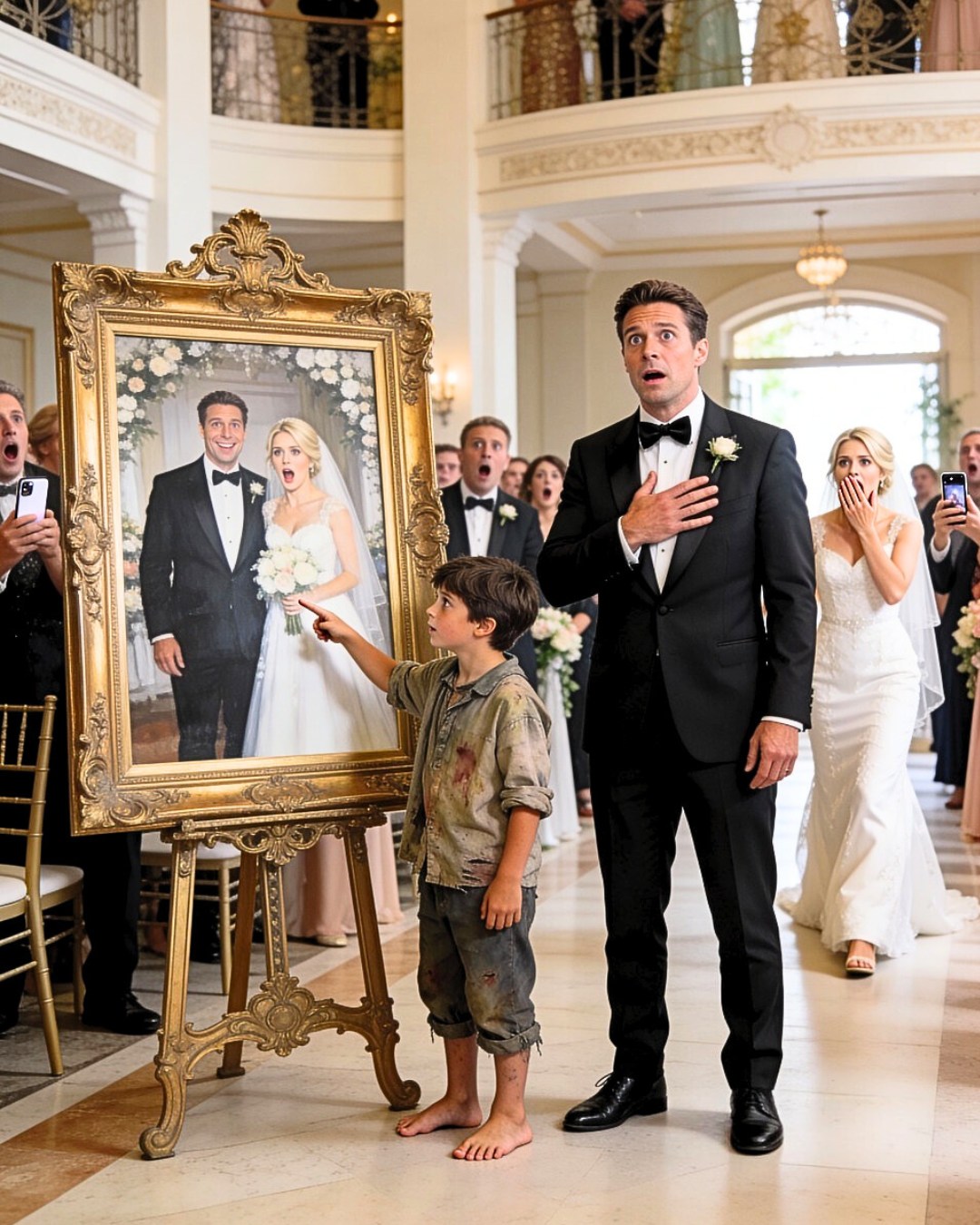
I was leaving my annual charity fundraiser when a barefoot boy pressed his face against a framed wedding photograph and whispered, “That’s my mom.”
The photo stood near the exit on an easel—my wife, Madeleine Cross, glowing in ivory lace beside me in a tailored black tux. We were smiling like nothing had ever touched us. I almost laughed. The idea was ridiculous.
Madeleine came from a spotless family, a carefully edited past she liked to call “uneventful.” We’d been married for five years. By thirty-two, I was a multimillionaire, featured in business magazines, a man whose life ran on control and predictability.
But the boy wasn’t joking.
He pointed at Madeleine’s face, his finger shaking. “She told me to stay quiet,” he whispered, “or you’d hate me.”
Cold spread through my chest. “What’s your name?” I asked gently.
“Noah,” he said. “And she’s been hiding me for ten years.”
Behind him, the valet lights reflected off the glass doors. Guests passed by laughing, oblivious to the earthquake standing in my lobby. Noah’s feet were filthy, his jacket too thin for the cold, and when he looked up at me, my breath caught. His eyes were the same steel-gray as mine.
I crouched. “Where’s your father?”
He shrugged. “Gone. She said he didn’t want me.”
“And your mom… Madeleine… where do you see her?”
“Sometimes,” he said. “She comes to a church kitchen with food. She always looks scared.”
A familiar laugh rang out behind me. I turned and saw Madeleine near the ballroom doors, still radiant, still wearing the sapphire necklace I’d given her. She waved at a donor—then froze when she saw Noah.
The color drained from her face.
She rushed over, gripping my arm. “Julian,” she hissed through a forced smile, “we need to leave. Now.”
I didn’t look away from her. “Do you know this boy?”
“No,” she said too fast. “He’s lying. Please.”
Noah flinched. “Mom,” he whispered.
“Don’t say that,” Madeleine snapped, her voice shaking.
I straightened slowly. “If you lie to me right now,” I said quietly, “we’re finished.”
Her lips parted, panic flickering across her face.
Then Noah spoke again. “She told me my dad’s name,” he said, staring at me. “It’s you.”
For a moment, my mind rejected it. My world was built on proof—contracts, numbers, facts. A child’s words weren’t proof.
But Madeleine’s face was.
She didn’t deny it. She looked like someone caught mid-fall.
“Not here,” she whispered.
“Where then?” I asked. “At home? Or in front of the son you’ve been hiding?”
Noah stiffened like he was bracing for punishment. I saw then he wasn’t here to ruin anything. He was desperate.
“How did you find this place?” I asked him.
“I saw your picture on a poster,” he said. “I thought maybe you’d help.”
Madeleine grabbed my wrist. “Please. Let me explain.”
“Everything?” I asked.
She nodded. “I was scared,” she admitted. “You told me once you couldn’t afford distractions.”

Ten years ago, I’d been building my first company, living on caffeine and ambition. Madeleine had been my girlfriend—bright, chaotic, alive. After a fight, she disappeared for weeks. When she returned, she said she’d fixed a “mistake” and wanted a clean start. I believed her because it was convenient.
Now I stared at a boy who looked too much like me to be coincidence.
“Come with me,” I said to Noah. “We’re not doing this here.”
At home, the silence felt crushing. Madeleine sat rigid on the couch. Noah hovered nearby, watching everything like it might vanish.
“I found out I was pregnant at nineteen,” Madeleine said. “You were broke. Angry. You didn’t want kids. My parents sent me to my aunt in Flagstaff. I had Noah there. They made me promise you’d never know.”
“She visited when she could,” Noah added quietly. “But we moved a lot.”
Madeleine swallowed. “When I married you, my parents threatened to expose everything.”
Noah pulled a crumpled paper from his pocket. “My birth certificate doesn’t list a father,” he said. “But the hospital bracelet says ‘Baby Cross.’”
My last name.
That night, I didn’t sleep. At dawn, I called my attorney—not for revenge, but answers. A paternity test. Immediately.
When the doctor called later that day, I put him on speaker.
“The probability of paternity is 99.99%,” he said.
Madeleine sobbed. Noah just stared at me, frozen.
I knelt in front of him. “I don’t know how to do this perfectly,” I said. “But I’m not leaving.”
“You’re not mad?” he asked.
“I’m mad about the years we lost,” I said honestly. “But not at you.”
I turned to Madeleine. “You lied to me,” I said. “But right now, this is about him. Noah lives here. No secrets. Therapy—for all of us. If you can’t do that, we’re done.”
She nodded, crying.
Over the next week, I focused on one thing—my son’s safety. School. Legal protections. Support. I even called Madeleine’s parents myself.
“You don’t get to threaten my family,” I told them.
Later, Noah watched me from the hallway. “Is it okay now?”
I exhaled. “It’s not perfect,” I said. “But it’s real. And we’ll build something better.”