I didn’t plan to wear short sleeves to the reunion.
That part matters, because people like to assume moments like these are intentional, like I was secretly waiting for someone to notice, for everything to explode dramatically so I could finally be rescued in front of an audience. The truth was far less cinematic and much more stupid: it was July, the house didn’t have good air conditioning, and the dress I grabbed off the chair happened to be the one that didn’t cling to my skin.
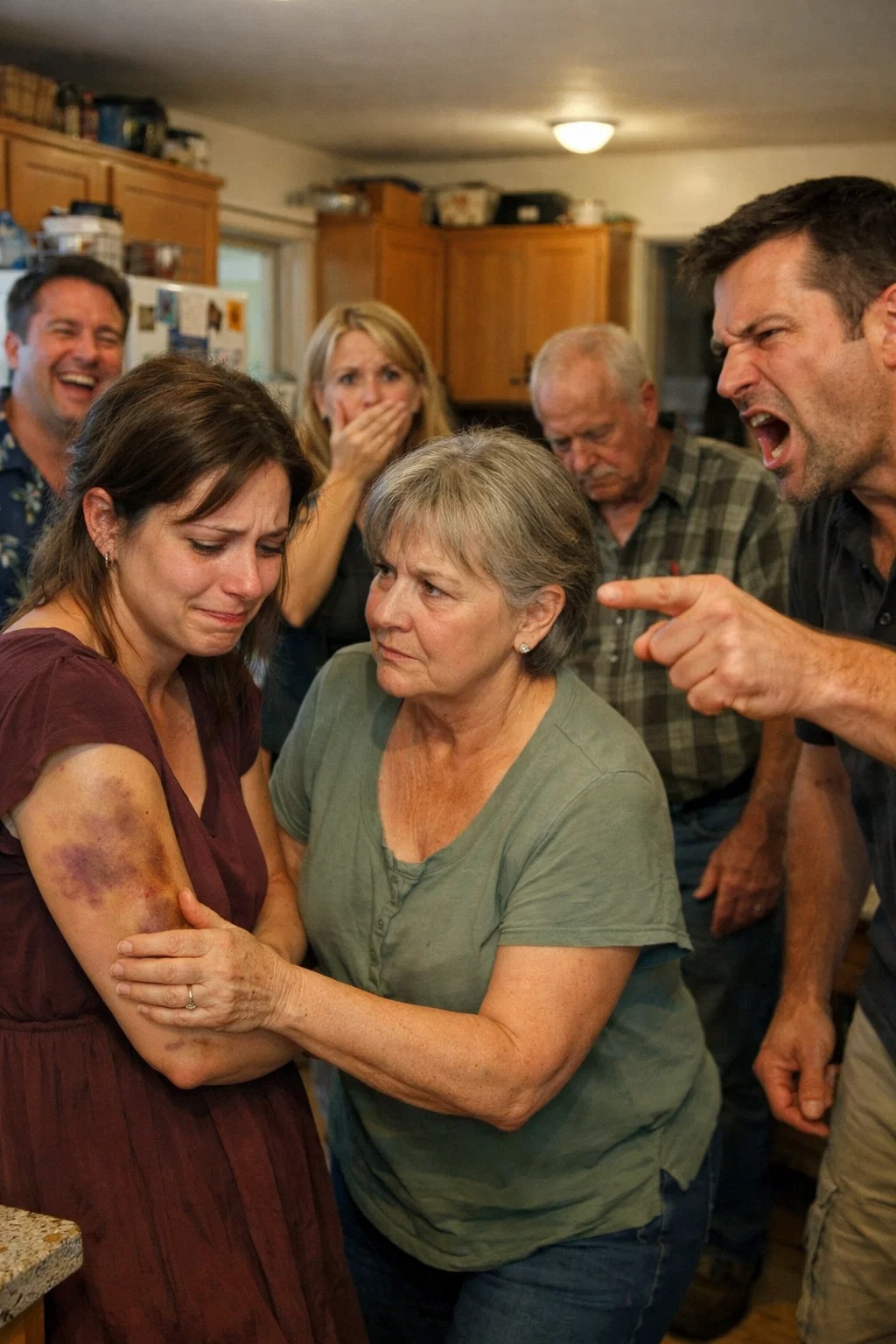
I didn’t realize how visible the marks were until my aunt stopped mid-sentence.
Her name is Ruth. She’s my mother’s older sister, the kind of woman who rarely speaks unless she’s certain her words will land exactly where they need to. She had driven down from Ohio for the weekend, bringing a lemon pie she’d made herself and a quiet presence that always made me feel steadier, even as a child.
She was standing near the kitchen doorway, plate in hand, when her eyes dropped to my arm.
She didn’t gasp. She didn’t make a sound.
She simply asked, “Claire… how did that happen?”
The room didn’t stop immediately. Laughter continued, someone turned up the music, my cousin complained about parking. But I felt the question hit my chest like a hand pressing me backward.
I opened my mouth.
Nothing came out.
Before I could find an excuse, my husband, Marcus, stepped in smoothly, already smiling.
“Oh, that?” he said, chuckling like this was an inside joke everyone should enjoy. “She’s clumsy. Always bumping into things. You should see the coffee table.”
A few people laughed politely.
I forced a smile because that’s what I’d learned to do—translate discomfort into humor before it could turn into curiosity.
Ruth didn’t laugh.
She walked closer, gently set her plate down, and took my arm in her hands with a care that made my throat tighten.
“This isn’t from furniture,” she said quietly. Not accusing. Not angry. Just certain.
Marcus’s smile stiffened.
“You doctors now?” he asked lightly. “It was a joke.”
Ruth looked at him for the first time.
“How long,” she asked me, still holding my arm, “have you been afraid to answer questions like that?”
The room went silent.
It wasn’t dramatic. It wasn’t sudden. It was the kind of silence that spreads slowly, people sensing that something has crossed a line they didn’t know was there.
My heart started pounding so loudly I couldn’t hear myself think.
Marcus scoffed. “This is ridiculous.”
But Ruth didn’t let go of my arm. She didn’t raise her voice.
“Claire,” she said, “you don’t owe anyone comfort right now.”
I felt something crack.
Not shatter. Crack. Like ice under careful pressure.
“I’m fine,” I whispered automatically.
Ruth nodded once. “Okay. Then answer me this instead.”
She turned to Marcus.
“Why does she flinch when you move too fast?”
No one laughed that time.
Marcus straightened. “You’re crossing a line.”
She tilted her head. “So did you.”
My mother had been standing near the window, frozen. My father looked like he wanted the floor to open up and swallow him. Everyone else suddenly found the walls fascinating.
Marcus leaned in close to me, voice low. “We’re leaving.”
Ruth stepped between us.
“No,” she said simply. “You’re not.”
His face darkened. “This is my wife.”
“And she’s my niece,” Ruth replied, calm as still water. “And she’s coming with me.”
The word with hung in the air.
Marcus laughed sharply. “You think you can just take her?”
Ruth finally raised her voice—not loud, but firm.
“I think,” she said, “that if you touch her again tonight, you will explain yourself to people who don’t laugh at excuses.”
I didn’t know until later that she had already texted someone.
Her neighbor, a retired state trooper who lived two houses down from my parents and owed her a favor from years ago.
I only knew that something in Marcus shifted.
Control depends on isolation. On the certainty that no one will interfere.
And suddenly, someone had.
I felt my legs shaking as Ruth turned to me.
“Do you want to go home with him?” she asked gently.
For the first time in years, the question wasn’t loaded.
I swallowed.
“No,” I said.
The word felt unreal. Dangerous. Free.
Marcus stared at me like I’d spoken a foreign language.
“You’re embarrassing yourself,” he snapped.
Ruth placed a hand on my back. “She’s done being quiet.”
The knock on the door came moments later.
It wasn’t loud. It didn’t need to be.
A uniform stood on the porch—not aggressive, not accusatory, just present.
Everything unraveled after that.
Not in shouting or chaos, but in process.
Statements. Separate rooms. Careful questions.
Marcus tried to charm, then blame, then minimize. None of it worked outside the echo chamber he’d built.
I went home with Ruth that night.
At her house, she gave me a sweatshirt, made tea, and sat across from me without pushing.
“You don’t have to explain,” she said. “But if you want to, I’m here.”
I cried until my ribs hurt.
The next weeks were slow and terrifying and steady all at once.
I filed for protection. I packed quietly. I learned how much I’d been covering for someone who never intended to change.
The twist came later.
During the proceedings, records surfaced—complaints from a previous relationship that had never gone anywhere because the woman moved away and didn’t have family nearby.
Patterns don’t stay hidden forever.
Marcus lost more than his marriage.
And me?
I learned how it feels to speak without bracing for impact.
Months later, Ruth visited again.
She handed me a small notebook.
“For your thoughts,” she said. “And for reminders.”
Inside the cover, she’d written one line:
Someone noticed. And that mattered.
On my next birthday, there were no jokes at my expense. No tension disguised as humor. Just cake, soft laughter, and people who looked at me without measuring how much space I was allowed to take.
I wore short sleeves again.
Not because I wanted anyone to see.
But because I no longer needed to hide.