The dog lunged forward the moment the maintenance worker reached for the backpack, and the way he wrapped his thin, shaking body around it made the entire bus terminal freeze, as if someone had pressed pause on the morning.
It was just past dawn, that gray, in-between hour when the city hadn’t fully woken yet but was already exhausted. Diesel engines idled in long lines, coughing white exhaust into the air. Commuters stood in thick coats with paper cups of coffee cooling between their hands, checking watches, scrolling phones, counting minutes. The smell of wet concrete, fuel, and old snow clung to everything.
And in the middle of Bay 7, where buses usually came and went without ceremony, a quiet standoff unfolded.
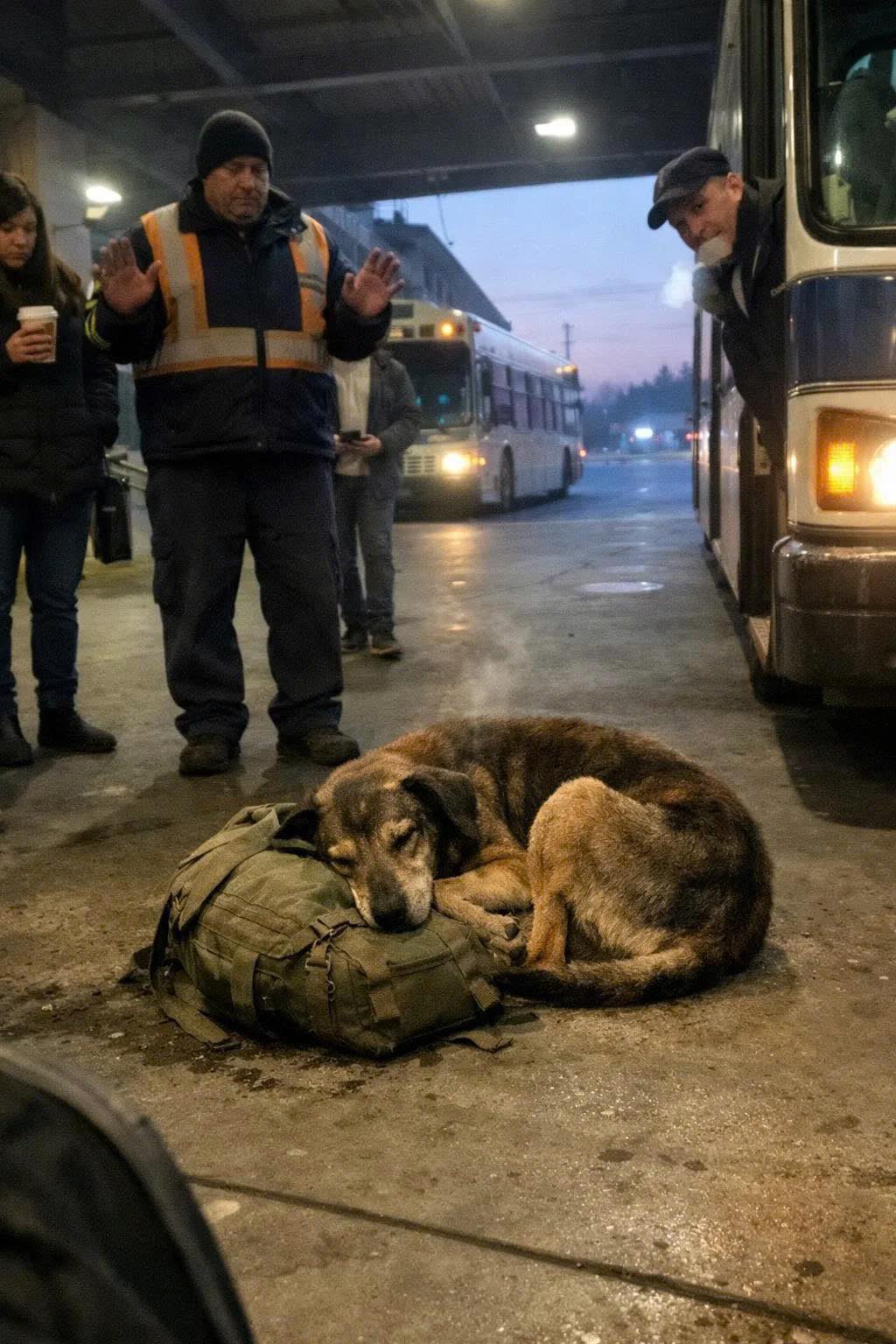
The dog was old. That much was obvious. His coat, once a warm golden brown, had faded to the color of dried wheat left too long in the sun, thin in patches along his spine. His ribs showed faintly when he breathed. One ear drooped lower than the other, scarred near the edge. His paws trembled against the concrete, not only from the cold but from the effort of staying alert after what looked like days without real rest.
Pressed tightly beneath his chest was a battered army backpack—olive drab, heavy canvas, seams fraying, one strap repaired with electrical tape. A name had once been stenciled across the flap, but time and friction had scraped most of it away, leaving only a few ghosted letters. Resting on top of the pack was a faded military cap, its brim bent and soft, the fabric shiny in spots where fingers had worried it over and over again.
The maintenance worker, Rick Donnelly, hadn’t meant any harm. He was in his mid-forties, shoulders hunched from years of manual labor, fluorescent vest zipped halfway. He had been told to clear abandoned items before the morning rush hit full force. He’d nudged trash bags, dragged a broken suitcase aside, and when he saw the backpack blocking part of the walkway, he bent down on instinct.
That’s when the dog moved. Not with noise. Not with teeth.
He simply surged forward, placing his entire body over the bag, spine curved protectively, head low, and let out a sound that made Rick stop cold. It wasn’t a bark or a snarl. It was a deep, trembling rumble, raw and pleading, vibrating through the dog’s chest like it took everything he had left to produce it.
Rick’s hands flew up. He backed away slowly.
“Okay, okay,” he said, voice dropping despite himself. “Easy, buddy. I didn’t mean—”
The dog’s eyes never left him. They weren’t wild. They weren’t angry. They were desperate.
Dark, glossy, rimmed with red from exhaustion, those eyes held one clear message: Do not take this. This is all that remains.
Around them, the terminal grew unnaturally quiet. A man in a suit lowered his phone. A woman tugged her daughter closer by the sleeve. Even the engines seemed to idle softer.
“Why’s he guarding it like that?” someone whispered.
The dog lowered his head and pressed his nose into the rough canvas of the backpack, breathing in deeply, as if scent alone could anchor him to something slipping away. His tail gave a faint twitch, not in greeting, but in reassurance to himself.
He was certain of one thing. He will come back.
An older bus driver, Harold Jensen, stepped closer, thermos tucked under his arm. He squinted at the pack, his brow furrowing.
“I’ve seen that bag before,” he said slowly. “Weeks now.”
Rick turned. “You know whose it is?”
Harold nodded. “Name was Aaron Cole. Veteran. Army. He was trying to get to Ohio. Said his sister lived out there. Always polite. Always apologized for taking up space.” He glanced at the dog. “That mutt showed up with him. Same day.”
A murmur rippled through the crowd. Aaron Cole hadn’t been seen in days.
What people didn’t know yet—but would soon—was that two nights earlier, Aaron had collapsed at a shelter a few blocks away, his lungs already fighting an infection that had been brewing for weeks, his body worn thin by cold, old injuries, and the stubborn refusal to ask for help. He’d been taken to County General, unconscious, the backpack left behind in the confusion. He never woke up.
No next of kin listed. No phone charged enough to unlock. Just a name and a history folded into government files.
And a dog who escaped the shelter that same night and ran until he found the last place his human had been.
The realization spread slowly, painfully, through Bay 7.
The first truth landed heavy.
The second shattered something deeper.
Rick crouched again, slower this time, careful not to startle the dog. He didn’t reach for the bag. Instead, he noticed a piece of folded paper sticking out of one of the side pockets, edges darkened by rain.
“Easy,” he murmured, extending only two fingers. The dog watched, tense but silent.
Rick pulled the paper free and stood, unfolding it with clumsy hands. His voice caught as he read.
“If I don’t make it back, please don’t take this bag away from him. His name is Ranger. He thinks the bag means I’m close. It keeps him calm. Please.”
Rick stopped reading. He didn’t need to finish.
The silence that followed wasn’t awkward anymore. It was reverent.
People looked at the dog differently now. Not as an obstruction. Not as a stray.
As a guardian.
A woman stepped forward, gray hair tucked beneath a wool hat, eyes sharp with recognition. Eleanor Brooks, a retired trauma nurse. She knelt on the cold concrete without hesitation, her knees protesting but ignored.
“He’s waiting,” she said softly. “Waiting is all he knows how to do.”
The dog lifted his head, tail giving one weak thump. Yes. Waiting.
Snow began to fall—thin, wet flakes that clung to fur and melted instantly. Ranger’s breathing grew shallow. His body shook harder. Still, he did not move.
A sanitation worker returned with a heavy wool blanket and draped it gently over the dog. A police officer removed his gloves and offered his bare hands for Ranger to sniff. A teenage girl held a flashlight steady, illuminating the corner so no one would trip near him.
“We can’t leave him out here,” the officer said quietly. “But we can’t take the bag from him either.”
“Then don’t,” Eleanor replied.
They carried both—dog and backpack—into a warm office nearby. White walls. Old coffee. A humming heater.
The backpack was placed in the corner.
Ranger walked to it, circled three times, then collapsed with a sigh that sounded like surrender. For the first time in days, he slept.
Weeks later, Eleanor adopted him. The backpack stayed by his bed.
Every morning, Ranger touched it once with his nose, then went to the window to watch the world continue.
Some loyalty waits.
Some loyalty learns.
And sometimes, love doesn’t end—it just changes shape, and finds a place to rest.